NorrChemica™
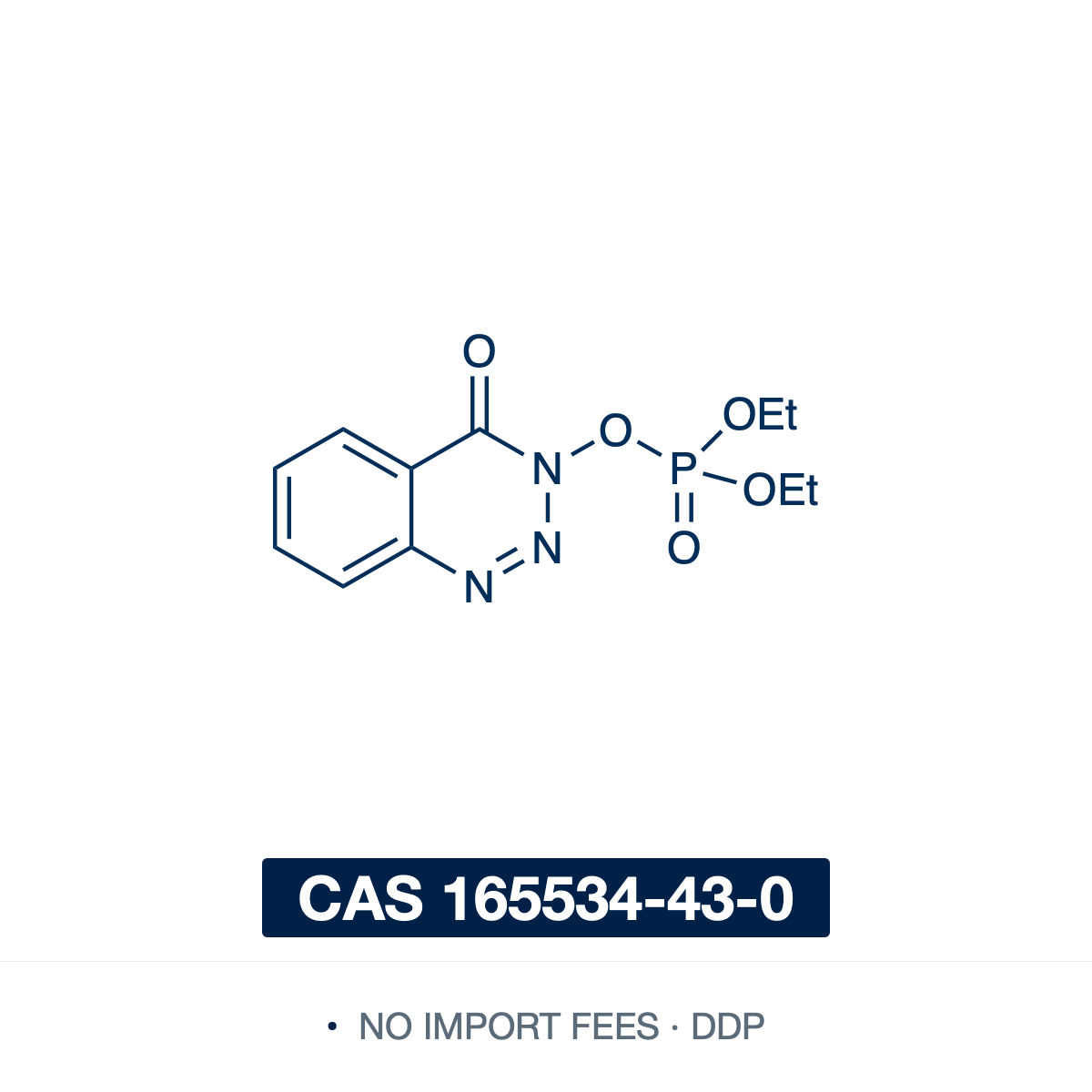
DEPBT
DEPBT | CAS 165534-43-0 | ≥98%
Couldn't load pickup availability
Technical Specifications
| CAS Number | 165534-43-0 |
| EC / EINECS Number | 628-030-5 |
| MDL Number | MFCD01236967 |
| SMILES | CCOP(=O)(OCC)ON1C(=O)C2=CC=CC=C2N=N1 |
| InChI | InChI=1S/C11H14N3O5P/c1-3-17-20(16,18-4-2)19-14-11(15)9-7-5-6-8-10(9)12-13-14/h5-8H,3-4H2,1-2H3 |
| InChIKey | AJDPNPAGZMZOMN-UHFFFAOYSA-N |
| PubChem CID | 4293995 |
| Molecular Formula | C₁₁H₁₄N₃O₅P |
| Molecular Weight | 299.22 g/mol |
| Melting Point | 72–76 °C |
| Solubility | Soluble in DMF, THF, and DCM. Sparingly soluble in water. |
| Purity | ≥98% |
| Physical Form | White to off-white powder |
| HS Code | 2933.99 |
| Shelf Life | Retest period: 36 months from date of manufacture |
| Storage Conditions | Store refrigerated (2–8 °C) in a tightly sealed container, protected from moisture. |
Product Description & Scientific Applications
DEPBT — 3-(diethoxyphosphoryloxy)-1,2,3-benzotriazin-4(3H)-one — is a phosphate-type peptide coupling reagent valued for low-racemisation amide bond formation. On activation it forms a 3-hydroxy-1,2,3-benzotriazin-4(3H)-one-derived active ester in situ, delivering the low-epimerisation behaviour of the benzotriazinone leaving group from a single crystalline reagent. It is particularly suited to couplings where epimerisation at the activated residue is the principal risk. DEPBT is supplied as a white to almost-white crystalline solid, soluble in common peptide-coupling solvents such as THF and DMF.
Common Scientific Applications
- Amide and peptide bond formation: a tertiary amine base generates the carboxylate of the N-protected acid, which attacks the phosphorus centre of DEPBT; the intermediate rearranges to a benzotriazinone-derived active ester, which the amine then aminolyses to give the amide.
- Low-racemisation segment coupling: the benzotriazinone-derived active ester preserves configuration at the activated C-terminal residue, making DEPBT well suited to fragment or segment condensation, where racemisation is otherwise severe.
- Racemisation-prone residues: couples readily epimerised substrates such as arylglycines and phenylglycine derivatives with high retention of configuration.
- Reduced side-chain protection: DEPBT couplings often avoid the need to protect the side-chain hydroxy groups of tyrosine, serine and threonine, or the imidazole of histidine.
- Cyclic peptides and macrolactamisation: mediates head-to-tail cyclisation of linear peptides and the synthesis of cyclic peptides such as cyclopenta- and cycloheptapeptides.
- Solution- and solid-phase synthesis: applied in both solution and solid-phase peptide synthesis, including the assembly of complex, racemisation-sensitive peptides and natural products.
Further Reading
For guidance on selecting between carbodiimides, aminium/uronium salts, phosphonium salts and other reagent classes for amide and peptide bond formation, see NorrChemica's Lab Journal guide: Choosing a Coupling Reagent for Amide and Peptide Bond Formation.
Shipping Destinations
- EU & UK: Priority delivery, 2–5 business days.
- United States (DDP): 3–7 business days, duties and taxes prepaid.
- EFTA Countries (DDP): 3–7 business days, duties and taxes prepaid.
- Worldwide: 7–14 business days, selected locations.
Safety Information
| GHS Pictograms |

|
| Signal Word | Warning |
| Hazard Class | Not regulated for transport |
| Transport Category | Not classified as dangerous goods for transport (ADR/IATA/IMDG) |
| H-Statements | H302 - H312 - H315 - H319 - H332 - H335 |
| P-Statements | P101 - P260 - P280 - P301+P330+P331 - P303+P361+P353 - P304+P340 - P305+P351+P338 - P321 - P332+P313 - P342+P311 - P405 - P501 |
Documentation
| Safety Data Sheet | Download PDF |