NorrChemica™
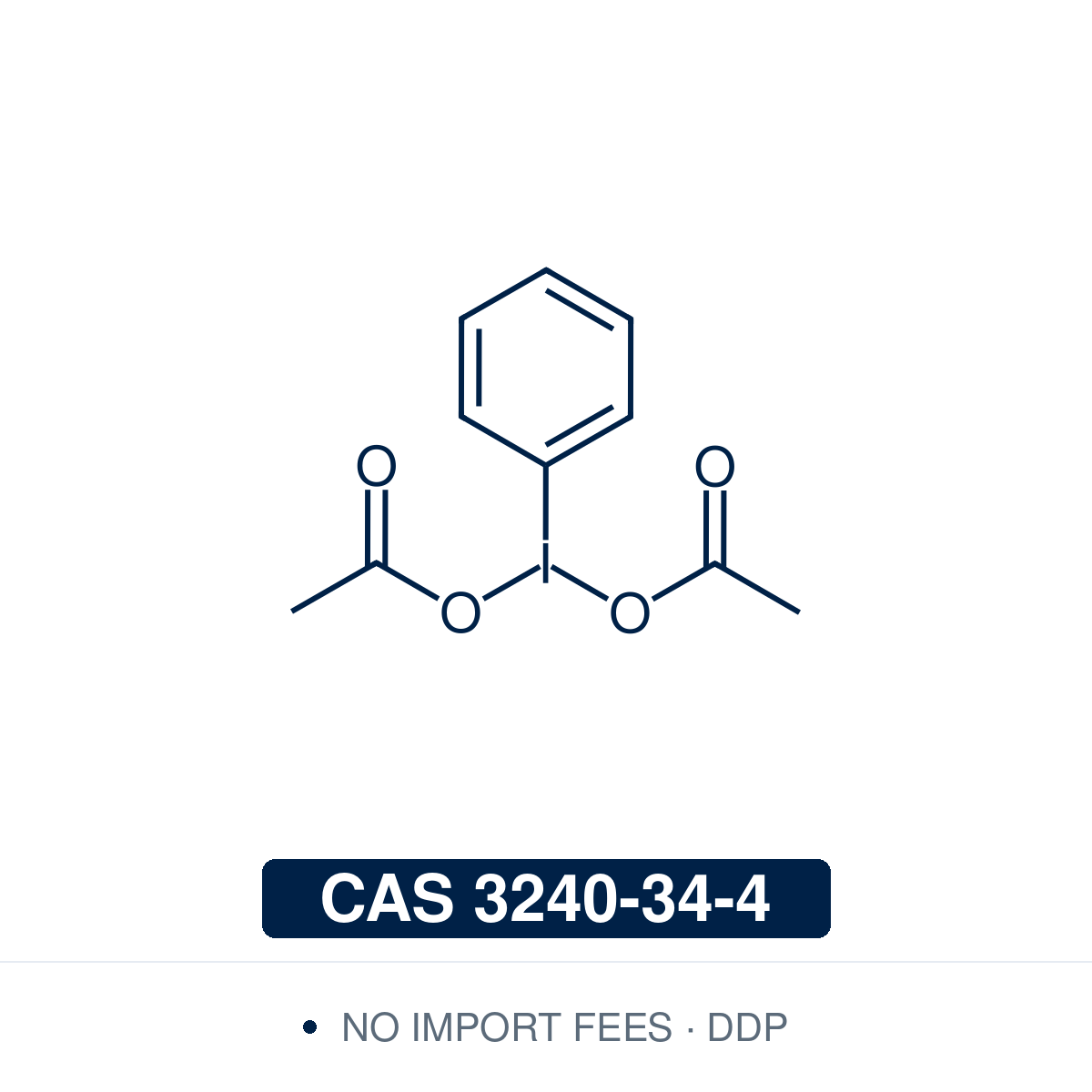
PIDA ((Diacetoxyiodo)benzene)
CAS 3240-34-4
≥97%
PIDA ((Diacetoxyiodo)benzene) | CAS 3240-34-4 | ≥97%
| Pack size | Excl. VAT | Incl. VAT | Add to cart |
|---|---|---|---|
| 1.0 g | €29,30 | ||
| 5.0 g | €39,20 | ||
| 10 g | €49,20 | ||
| 25 g | €69,20 | ||
| 50 g | €98,20 | ||
| 100 g | €149,20 | ||
| 500 g | €249,00 |
Taxes and fees, e.g. VAT, included in the price. Shipping calculated at checkout.Free shipping on EU, UK and EFTA orders above €250, and above €400 to the rest of the world.
Technical Specifications
| CAS Number | 3240-34-4 |
| EC / EINECS Number | 221-808-1 |
| MDL Number | MFCD00008692 |
| RTECS Number | DA3525000 |
| SMILES | CC(=O)OI(C1=CC=CC=C1)OC(=O)C |
| InChI | InChI=1S/C10H11IO4/c1-8(12)14-11(15-9(2)13)10-6-4-3-5-7-10/h3-7H,1-2H3 |
| InChIKey | ZBIKORITPGTTGI-UHFFFAOYSA-N |
| PubChem CID | 76724 |
| Molecular Formula | C₁₀H₁₁IO₄ |
| Molecular Weight | 322.1 g/mol |
| Melting Point | 161-163 °C (lit.) |
| Solubility | Soluble in acetic acid, acetonitrile and dichloromethane. Reacts with water. |
| Log Pow | 2.8 |
| Purity | ≥97% |
| Physical Form | White to light yellow crystal powder |
| HS Code | 2915.39 |
| Shelf Life | Retest period: 36 months from date of manufacture |
| Storage Conditions | Light and moisture sensitive. Store in a dark place, sealed, in a dry place at room temperature. |
Product Description & Scientific Applications
PIDA (iodobenzene diacetate; (diacetoxyiodo)benzene, phenyliodine(III) diacetate, PhI(OAc)2) is a hypervalent iodine(III) oxidant carrying two acetate ligands on a T-shaped iodine centre (C10H11IO4, 322.10 g/mol) — a metal-free alternative to heavy-metal oxidants across oxidation, cyclisation and C–H functionalisation.
It is used stoichiometrically, but the same chemistry can be run organocatalytically in the iodoarene by generating the iodine(III) species in situ from iodobenzene and mCPBA.
Applications and Reactions
- Halocyclisation of olefins: effects haloamidation, haloetherification and halolactonisation of unfunctionalised olefins with regiocontrol.
- Heterocycle synthesis: mediates intramolecular cyclisation of enamides to functionalised oxazoles, and acts as the sole iodine(III) reagent in intermolecular dehydrogenative annulation.
- C–H functionalisation: under gold(III) catalysis it is the acetoxylation reagent for direct C–H acetoxylation of electron-rich arenes, and it enables distal C–H functionalisation of biarylsulfonanilides.
- Oxidative aromatisation: aromatises Hantzsch 1,4-dihydropyridines to the corresponding pyridines.
- Ring contraction: promotes ring contraction of cycloalkenes and cycloalkanones, and with iodine and iron dust activates one-pot oxidative decarboxylation–Friedel–Crafts sequences.
- Terminal oxidant: with iron(III) porphyrins it oxidises bromomethyl groups to carboxylic acids, and it serves as the aryl source in palladium-catalysed ligand-free arylation of heteroaromatics.
- Radical generation: oxidises N-hydroxy compounds to the corresponding aminoxyl (N-oxyl) radicals.
- Alkynol acetoxylation: converts ethynylcarbinols to α,α′-diacetoxy ketones, and mediates metal-free three-component acetoxyaminoalkylation of α-diazo amides.
- Handling: light and moisture sensitive; store sealed in a dark, dry place at room temperature.
Shipping Destinations
- EU & UK: Priority delivery, 3–5 business days.
- United States (DDP): 3–7 business days, duties and taxes prepaid.
- EFTA Countries (DDP): 3–7 business days, duties and taxes prepaid.
- Worldwide: 7–14 business days, selected locations.
Safety Information
| GHS Pictograms |

|
| Signal Word | Warning |
| Hazard Class | Not regulated for transport |
| Transport Category | Not classified as dangerous goods for transport (ADR/IATA/IMDG) |
| H-Statements | H315 - H319 |
| P-Statements | P264 - P280 - P302+P352 - P332+P313 - P337+P313 - P362+P364 |
Documentation
| Safety Data Sheet | Download PDF |