NorrChemica™
DMTMM chloride
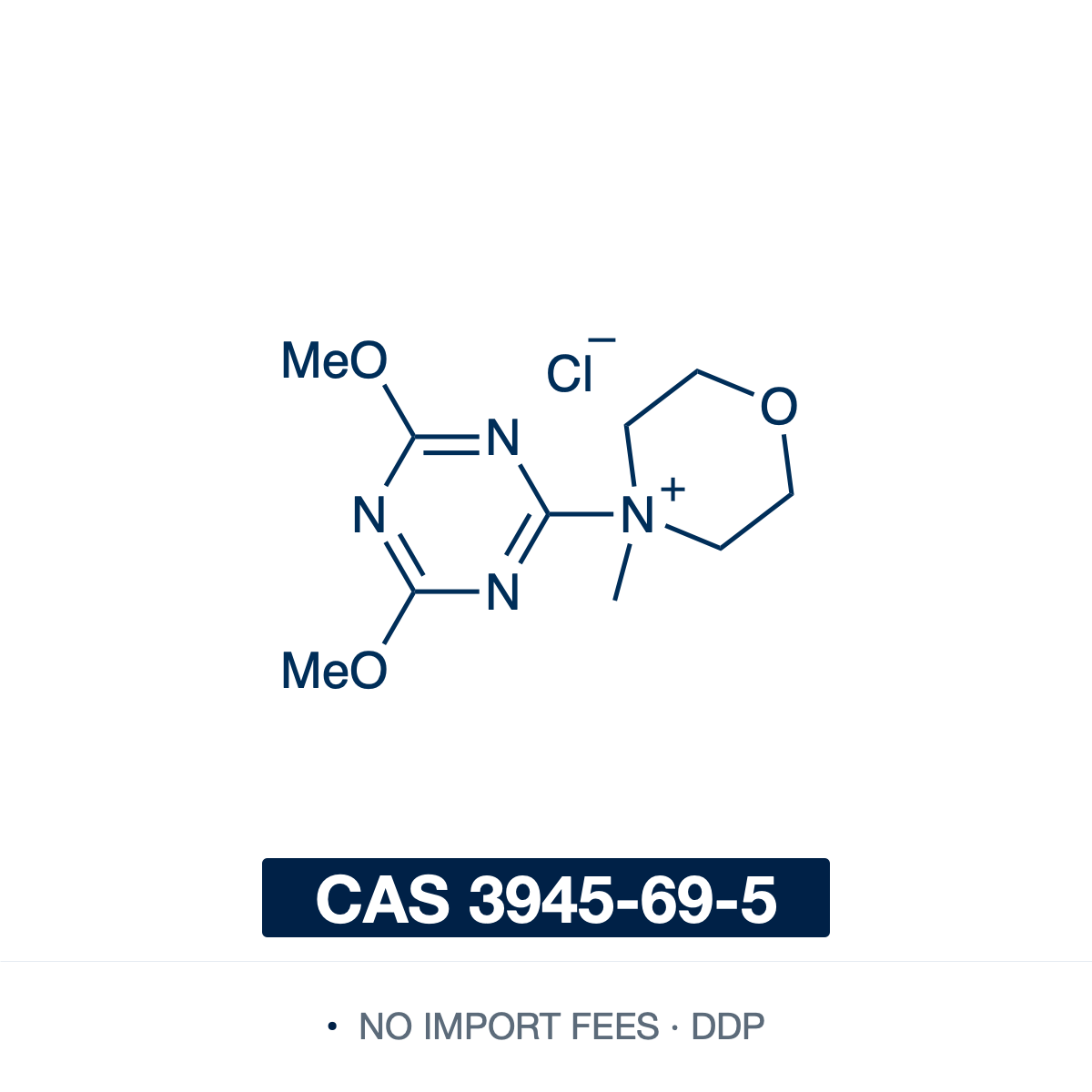
DMTMM chloride | CAS 3945-69-5 | ≥95% (contains 15% H2O)
Couldn't load pickup availability
Technical Specifications
| CAS Number | 3945-69-5 |
| EC / EINECS Number | 447-230-1 |
| MDL Number | MFCD03613550 |
| SMILES | C[N+]1(CCOCC1)C2=NC(=NC(=N2)OC)OC.[Cl-] |
| InChI | InChI=1S/C10H17N4O3.ClH/c1-14(4-6-17-7-5-14)8-11-9(15-2)13-10(12-8)16-3;/h4-7H2,1-3H3;1H/q+1;/p-1 |
| InChIKey | BMTZEAOGFDXDAD-UHFFFAOYSA-M |
| PubChem CID | 2734059 |
| Molecular Formula | C₁₀H₁₇ClN₄O₃ |
| Molecular Weight | 276.72 g/mol |
| Melting Point | 110-114 °C |
| Solubility | Soluble in water, THF and methanol; slightly soluble in DMSO. Insoluble in diethyl ether |
| Purity | ≥95% (contains 15% H₂O) |
| Physical Form | Light-yellow powder |
| HS Code | 2934.99 |
| Shelf Life | Retest period: 36 months from date of manufacture |
| Storage Conditions | Store at −20 °C in a tightly sealed container, protected from moisture. |
Product Description & Scientific Applications
DMTMM (4-(4,6-dimethoxy-1,3,5-triazin-2-yl)-4-methylmorpholinium chloride; DMT-MM; the Kunishima reagent) is a triazine-based condensing agent for amide and ester bond formation, prepared from 2-chloro-4,6-dimethoxy-1,3,5-triazine (CDMT) and N-methylmorpholine (NMM). It is a pre-formed active reagent: a carboxylic acid forms a 2-acyloxy-4,6-dimethoxytriazine active ester, which then acylates an amine or alcohol to give the amide or ester, with water-soluble triazine and morpholinium by-products. Its defining feature is that it operates in protic and aqueous media — water, methanol and other lower alcohols — without solvent drying and without a separate carbodiimide, making it attractive where carbodiimide/NHS preactivation or dry organic solvent conditions are inconvenient. DMTMM chloride is supplied as a crystalline hydrate, soluble in water and lower alcohols; store cold and dry.
Amide and ester formation in protic and aqueous media
- Condenses carboxylic acids with amines to amides and with alcohols to esters, and converts carboxylic acids to Weinreb amides, under mild conditions.
- Reactions proceed in water, methanol and other lower alcohols, and in hydrous organic solvents without drying — the key practical distinction from many peptide-coupling reagents.
- No separate carbodiimide or NHS-type additive is required; the water-soluble triazine and morpholinium by-products are removed by aqueous extraction, washing or dialysis.
Peptide synthesis
- Activates carboxylic acids for solution-phase and solid-phase peptide coupling, including reported use in sterically hindered peptidomimetic synthesis.
- Its water and alcohol compatibility allows peptide and amino-acid couplings to be run in protic media where carbodiimide/NHS chemistry or dry organic conditions are less convenient.
Bioconjugation and biomacromolecule modification
- Activates carboxyl groups on proteins, polysaccharides and synthetic polymers for amide coupling in water, supporting chemical modification and conjugation of biomacromolecules.
- Couples carboxyl-bearing polysaccharides to amine partners, including carrier proteins and microsphere supports for immunoassay and glycoconjugate research.
- It has been used for polymer-analogous conjugation, attaching amine-bearing ligands to carboxylated polymers in water.
Biopolymer and hydrogel functionalisation
- A widely used reagent for amidation of hyaluronan and other carboxylated polysaccharides in water, grafting amines and reactive handles such as norbornene, methacrylate or tyramine onto the backbone; for hyaluronan ligation it has been reported to outperform EDC/NHS at equal feed ratio and to work without the pH-control sequence EDC/NHS requires.
- The modified polymers are crosslinked into hydrogels for tissue-engineering scaffolds, cell-culture matrices and biomaterials research, with DMTMM enabling an organic-solvent-free aqueous route.
- DMTMM is likewise applied to alginate, carboxymethyl cellulose and other carboxylated polysaccharides for amine, hydrazide or crosslinking chemistry in water.
Further Reading
For guidance on selecting between carbodiimides, aminium/uronium salts, phosphonium salts and other reagent classes for amide and peptide bond formation, see NorrChemica's Lab Journal guide: Choosing a Coupling Reagent for Amide and Peptide Bond Formation.
Shipping Destinations
- EU, UK & Switzerland only: Priority delivery, 3–5 business days. UK and Switzerland (DDP): duties and taxes prepaid. Classified as dangerous goods — shipping restrictions apply outside the EU, UK and Switzerland.
Safety Information
| GHS Pictograms |


|
| Signal Word | Danger |
| Hazard Class | UN 3261 — Corrosive solid, acidic, organic, n.o.s. (4-(4,6-dimethoxy-1,3,5-triazin-2-yl)-4-methylmorpholinium chloride) (Class 8, PG II) |
| Transport Category | Class 8, PG II (ADR/IATA/IMDG) |
| H-Statements | H302 - H314 |
| P-Statements | P260 - P264 - P270 - P280 - P301+P312 - P301+P330+P331 - P303+P361+P353 - P304+P340 - P305+P351+P338 - P310 - P330 - P363 - P405 - P501 |
Documentation
| Safety Data Sheet | Download PDF |