Skip to product information
1 of 2

NorrChemica™

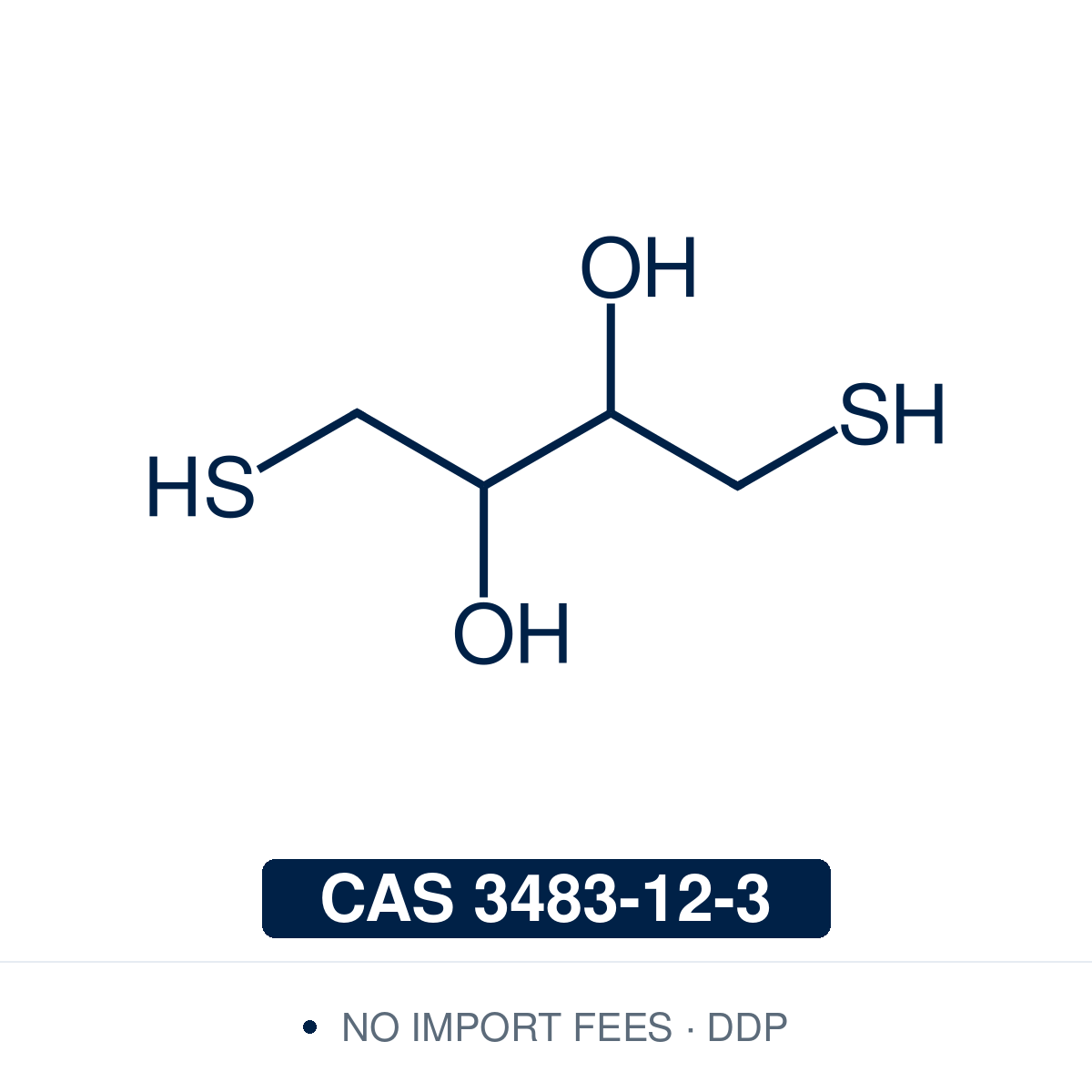
DL-Dithiothreitol (DTT) | CAS 3483-12-3 | ≥95%

DL-Dithiothreitol (DTT) | CAS 3483-12-3 | ≥95%

Regular price €27,20 EUR (incl. VAT)
Regular price Sale price €27,20 EUR
Sale Sold out
Taxes included. Shipping calculated at checkout.
Weight
Quantity

Technical Specifications

CAS Number 3483-12-3
EC / EINECS Number 222-468-7
MDL Number MFCD00004877
RTECS Number EK1610000
SMILES C([C@@H]([C@H](CS)O)O)S
InChI InChI=1S/C4H10O2S2/c5-3(1-7)4(6)2-8/h3-8H,1-2H2/t3-,4-/m0/s1
InChIKey VHJLVAABSRFDPM-IMJSIDKUSA-N
PubChem CID 439196
Molecular Formula C₄H₁₀O₂S₂
Molecular Weight 154.25 g/mol
Melting Point 41–44 °C
Solubility Highly soluble in water (50 mg/mL), ethanol, chloroform, diethyl ether, ethyl acetate
Log Pow 0.07 at pH 5.0 and 25 °C
Purity ≥95%
Physical Form White crystalline powder
HS Code 2930.90
Shelf Life Retest period: 12 months from date of manufacture
Storage Conditions Store refrigerated (2–8 °C) in a tightly sealed container under inert atmosphere, protected from moisture

DTT (DL-dithiothreitol, also known as Cleland’s reagent) is a small-molecule dithiol reducing agent widely used across molecular biology, protein biochemistry, and proteomics. DTT quantitatively reduces disulfide bonds (S–S) to free thiols (–SH) by forming a thermodynamically stable six-membered cyclic disulfide, making it significantly more effective than monothiol reductants such as β-mercaptoethanol. It is a standard component of SDS-PAGE sample buffers, protein purification workflows, restriction enzyme and ligase reaction mixes, and mass spectrometry sample preparation protocols. DTT is also used as a pharmacological tool to induce endoplasmic reticulum stress via disruption of oxidative protein folding. It is soluble in water, ethanol, and most polar organic solvents, and is stable as a solid at room temperature when protected from moisture.​​​​​​​​​​​​​​​​

Product Description & Scientific Applications

Reducing agent for disulfide bonds in proteins — DTT is the standard small-molecule thiol reductant for cleaving disulfide bonds (S–S) in proteins and peptides. At concentrations of 1–10 mM, DTT quantitatively reduces intramolecular and intermolecular disulfide bridges to free thiols (–SH), denaturing protein tertiary structure and dissociating disulfide-linked subunits. This reaction is thermodynamically driven by the formation of a stable six-membered cyclic disulfide (oxidised DTT, trans-4,5-dihydroxy-1,2-dithiane), which makes DTT a more effective reductant than monothiols such as β-mercaptoethanol or glutathione. DTT was introduced by W. W. Cleland in 1964 and is frequently referred to as Cleland’s reagent (Cleland, Biochemistry 1964, 3, 480).

SDS-PAGE and protein electrophoresis — DTT is routinely included in Laemmli sample buffer at 50–100 mM to ensure complete reduction of disulfide bonds prior to denaturing polyacrylamide gel electrophoresis. Under these conditions, proteins migrate strictly according to molecular weight, unaffected by disulfide-mediated aggregation or conformational heterogeneity. DTT has largely replaced β-mercaptoethanol in many electrophoresis protocols due to its lower odour and more complete reduction at equivalent concentrations.

Protection of free thiols and enzyme active sites — DTT is added at 0.5–5 mM to protein purification buffers, enzyme assay mixtures, and cell lysis buffers to maintain cysteine residues in the reduced state and prevent oxidative inactivation of thiol-dependent enzymes. This is critical for cysteine proteases, protein tyrosine phosphatases, and other enzymes whose catalytic activity depends on a free thiol at the active site.

Protein refolding and disulfide shuffling — controlled ratios of reduced DTT and oxidised DTT (DTTox) are used to establish a redox buffer during in vitro protein refolding. By adjusting the DTT/DTTox ratio, researchers can promote the formation of native disulfide bonds while preventing kinetic trapping in non-native disulfide pairings. This approach is widely used in the refolding of recombinant proteins expressed as inclusion bodies in E. coli.

Restriction enzyme and ligase digestion buffers — many commercial restriction enzyme and DNA ligase reaction buffers contain 1–10 mM DTT to maintain enzyme stability and activity during molecular cloning workflows. DTT is a standard component of T4 DNA ligase buffer, T4 polynucleotide kinase buffer, and reverse transcriptase reaction mixes.

Cell biology and intracellular redox studies — DTT is used as a membrane-permeable reducing agent to induce endoplasmic reticulum (ER) stress by disrupting disulfide bond formation in the secretory pathway. At 1–5 mM, DTT triggers the unfolded protein response (UPR), making it a standard pharmacological tool for studying ER stress signalling and protein quality control mechanisms in mammalian cells.

Mass spectrometry sample preparation — in bottom-up proteomics, DTT reduction (typically 10 mM, 56 °C, 30 min) followed by iodoacetamide alkylation is the standard protocol for preparing protein digests prior to LC-MS/MS analysis. Complete disulfide reduction ensures that all cysteine-containing peptides are accessible for tryptic digestion and identified during database searching.

Thiol-reactive chemistry and bioconjugation — DTT is used to selectively reduce disulfide bonds in antibodies and other proteins to generate free thiols for subsequent conjugation with maleimide-functionalised payloads, fluorophores, or PEG chains. This approach is central to the preparation of antibody-drug conjugates and site-specifically labelled proteins for imaging and therapeutic applications.

Shipping Destinations

  • EU & UK: Priority delivery, 2–5 business days.
  • United States (DDP): 3–7 business days, duties and taxes prepaid.
  • EFTA Countries (DDP): 3–7 business days, duties and taxes prepaid.
  • Worldwide: 7–14 business days, selected locations.

The NorrChemica™ Standard

Identity Verified — Batch-verified via analytical QC; documentation available on request.

Direct EU Distribution — Dispatched from Finland for fast delivery to EU-based laboratories.

Professional Logistics — Tracked courier shipping via UPS / Matkahuolto / Posti.

Packaging & Storage

  • Supplied in tightly sealed containers suitable for laboratory handling.
  • Store under recommended conditions as specified on the product label and SDS.
  • Retest period per lot-specific CoA / label under recommended conditions.

Technical Documentation

  • Batch-specific Certificate of Analysis (CoA) included with every order.
  • GHS-compliant Safety Data Sheet (SDS) provided with every shipment.
  • Batch documentation available for institutional procurement.
Payment: Wise (Bank Transfer) or Manual Invoice.
Disclaimer: Research Use Only (RUO) — not for human or veterinary use. Sold strictly for laboratory research and technical applications. By purchasing this item, the buyer confirms professional intent and compliance with applicable regulations.

Safety Information

GHS Pictograms
GHS07 Harmful/Irritant
Signal Word Danger
Hazard Class None — not subject to transport regulations
Transport Category Not classified as dangerous goods for transport (ADR/IATA/IMDG)
H-Statements H302 — Harmful if swallowed
H315 — Causes skin irritation
H319 — Causes serious eye irritation
P-Statements P264 — Wash hands thoroughly after handling
P270 — Do not eat, drink or smoke when using this product
P280 — Wear protective gloves/eye protection
P301+P312 — IF SWALLOWED: Call a POISON CENTER if you feel unwell
P302+P352 — IF ON SKIN: Wash with plenty of water
P305+P351+P338 — IF IN EYES: Rinse cautiously with water for several minutes. Remove contact lenses, if present and easy to do. Continue rinsing
P332+P313 — If skin irritation occurs: Get medical advice
P337+P313 — If eye irritation persists: Get medical advice

NorrChemica™ is a Finnish supplier of niche research reagents — focused on reliable EU distribution, transparent analytical documentation, and specialist technical support.

View full details