NorrChemica™
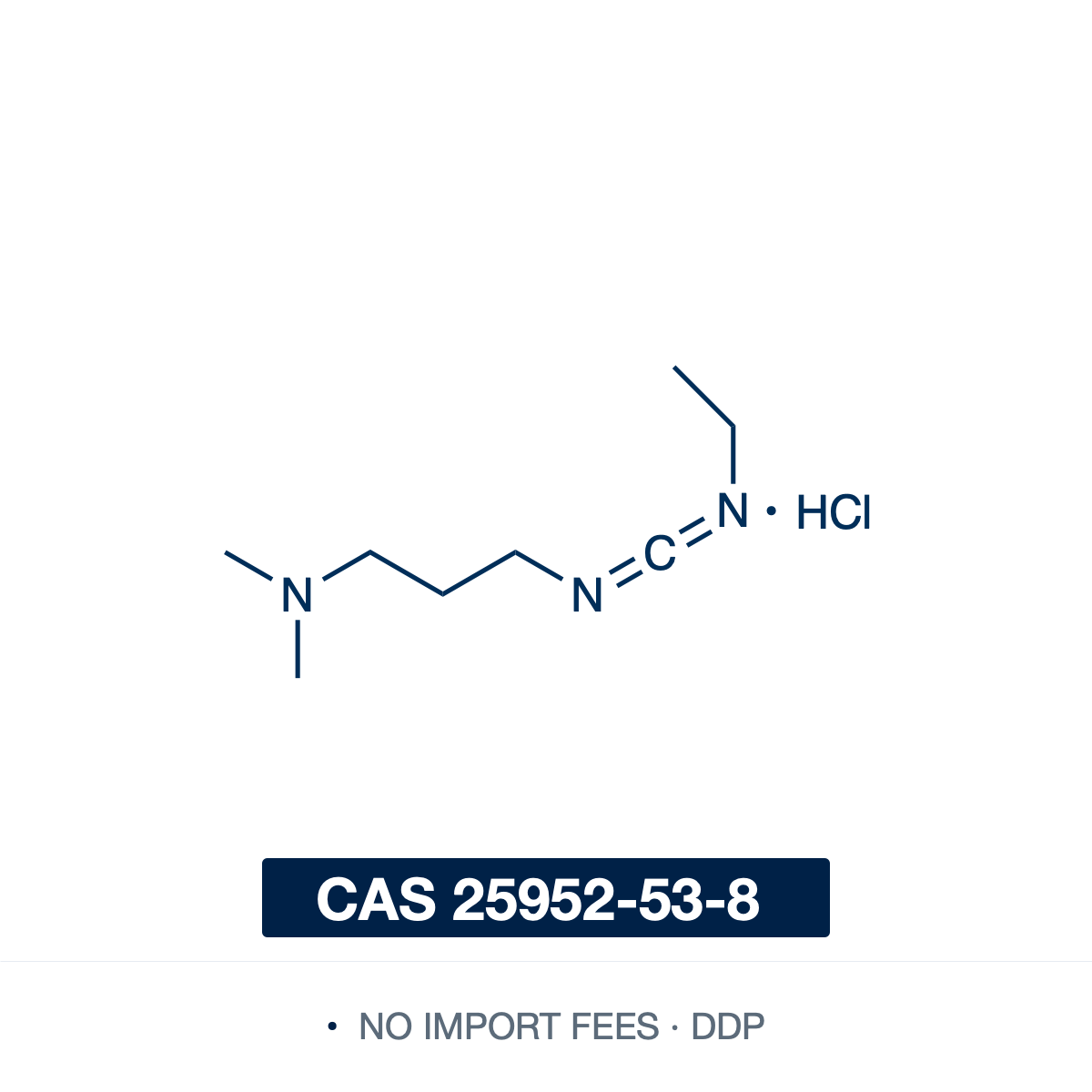
EDC·HCl (EDCI·HCl)
EDC·HCl (EDCI·HCl) | CAS 25952-53-8 | ≥99%
Couldn't load pickup availability
Technical Specifications
| CAS Number | 25952-53-8 |
| EC / EINECS Number | 247-361-2 |
| MDL Number | MFCD00012503 |
| RTECS Number | FF2200000 |
| SMILES | CCN=C=NCCCN(C)C.Cl |
| InChI | InChI=1S/C8H17N3.ClH/c1-4-9-8-10-6-5-7-11(2)3;/h4-7H2,1-3H3;1H |
| InChIKey | FPQQSJJWHUJYPU-UHFFFAOYSA-N |
| PubChem CID | 2723939 |
| Molecular Formula | C₈H₁₈ClN₃ |
| Molecular Weight | 191.7 g/mol |
| Melting Point | 110-115 °C |
| Solubility | Soluble in water, soluble in polar organic solvents |
| Log Pow | -2.98 |
| Purity | ≥99% |
| Physical Form | White solid |
| HS Code | 2925.29 |
| Shelf Life | Retest period: 24 months from date of manufacture |
| Storage Conditions | Store refrigerated (2–8 °C) in a tightly sealed container, protected from moisture |
Product Description & Scientific Applications
EDC·HCl (1-ethyl-3-(3-dimethylaminopropyl)carbodiimide hydrochloride; EDAC; EDCI; WSC) is a standard water-soluble carbodiimide for zero-length crosslinking, amide-bond formation and bioconjugation chemistry. It activates a carboxylic acid to a reactive O-acylisourea, which a primary amine then attacks to form an amide bond, joining the two groups with no added spacer atoms. The O-acylisourea is short-lived in water: it can hydrolyse back to the acid, rearrange to an unreactive N-acylurea, or, in peptide coupling of α-chiral amino-acid derivatives, contribute to oxazolone-mediated racemisation. Adding NHS or sulfo-NHS diverts it to a more persistent amine-reactive ester and improves aqueous carboxyl-to-amine coupling; HOBt or HOAt is used in peptide synthesis to reduce racemisation. EDC's practical advantage over DCC is that its urea by-product is water-soluble and removable by aqueous extraction or washing. Activation is commonly run in MES or another non-amine, non-carboxylate buffer near pH 5–6, then shifted nearer neutral for amine coupling. EDC also activates 5′-phosphate groups. EDC·HCl is supplied as a white crystalline powder, soluble in water; keep cold and dry.
Carbodiimide activation and amide-bond formation
- As a zero-length crosslinker, EDC forms a direct amide bond between a carboxyl and a primary amine, adding no spacer atoms.
- EDC activates the carboxyl to an O-acylisourea, which a primary amine displaces to give the amide; because the intermediate is unstable in water, hydrolysis competes with coupling.
- Adding NHS or sulfo-NHS converts the O-acylisourea to a more persistent amine-reactive ester, limiting hydrolysis and N-acylurea formation and improving productive amide formation.
- The urea by-product is water-soluble and removed by aqueous extraction or washing — the main handling advantage over DCC, whose urea is poorly soluble.
Peptide and solution-phase synthesis
- EDC·HCl is a standard water-compatible carbodiimide for solution-phase amide and peptide coupling, with the soluble urea by-product simplifying work-up.
- Run with HOBt or HOAt, EDC gives peptide couplings with reduced racemisation by converting the O-acylisourea into a less epimerisation-prone active ester.
- With catalytic DMAP, EDC is also used in Steglich-type esterification and acylation.
Bioconjugation and biomolecule modification
- EDC, alone or with NHS or sulfo-NHS, couples carboxyls to primary amines in aqueous workflows, with activation usually run mildly acidic and amine coupling shifted nearer neutral.
- It is a standard reagent for hapten–carrier conjugation, covalently attaching small haptens to carrier proteins such as KLH or BSA to prepare immunogens.
- With imidazole, EDC activates 5′-phosphate groups of DNA and RNA oligonucleotides, enabling oligonucleotide labelling, immobilisation or amine conjugation through phosphoramidate bond formation.
- MES or another non-amine, non-carboxylate buffer near pH 5–6 is preferred for activation; Tris, glycine and carboxylate-containing buffers or additives are avoided during the activation step.
Surface functionalisation, biosensors and biomaterials
- EDC with NHS or sulfo-NHS is the standard amine-coupling chemistry for immobilising ligands on carboxylated biosensor surfaces, including carboxymethyl-dextran SPR chips and 11-mercaptoundecanoic-acid self-assembled monolayers.
- The same activation conjugates biomolecules to carboxylated microspheres, nanoparticles and microarray supports through stable amide bonds.
- In biomaterials, EDC/NHS is widely used for zero-length crosslinking of collagen and gelatin scaffolds, where the amide crosslinks commonly raise collagen denaturation or shrinkage temperature, reduce swelling and increase resistance to enzymatic degradation.
Further Reading
For guidance on selecting between carbodiimides, aminium/uronium salts, phosphonium salts and other reagent classes for amide and peptide bond formation, see NorrChemica's Lab Journal guide: Choosing a Coupling Reagent for Amide and Peptide Bond Formation.
Shipping Destinations
- EU, UK & Switzerland only: 2–7 business days
Safety Information
| GHS Pictograms |


|
| Signal Word | Danger |
| Hazard Class | UN 2811 — Toxic solid, organic, n.o.s. (1-(3-(dimethylamino)propyl)-3-ethyl-carbodiimide hydrochloride) (Class 6.1, PG III) |
| Transport Category | Class 6.1, PG III (ADR/IATA/IMDG) |
| H-Statements | H302 - H311 - H315 - H317 - H319 - H373 - H410 |
| P-Statements | P260 - P264 - P270 - P272 - P273 - P280 - P301+P312 - P302+P352 - P305+P351+P338 - P314 - P333+P313 - P337+P313 - P361+P364 - P391 - P405 - P501 |
Documentation
| Safety Data Sheet | Download PDF |