NorrChemica™
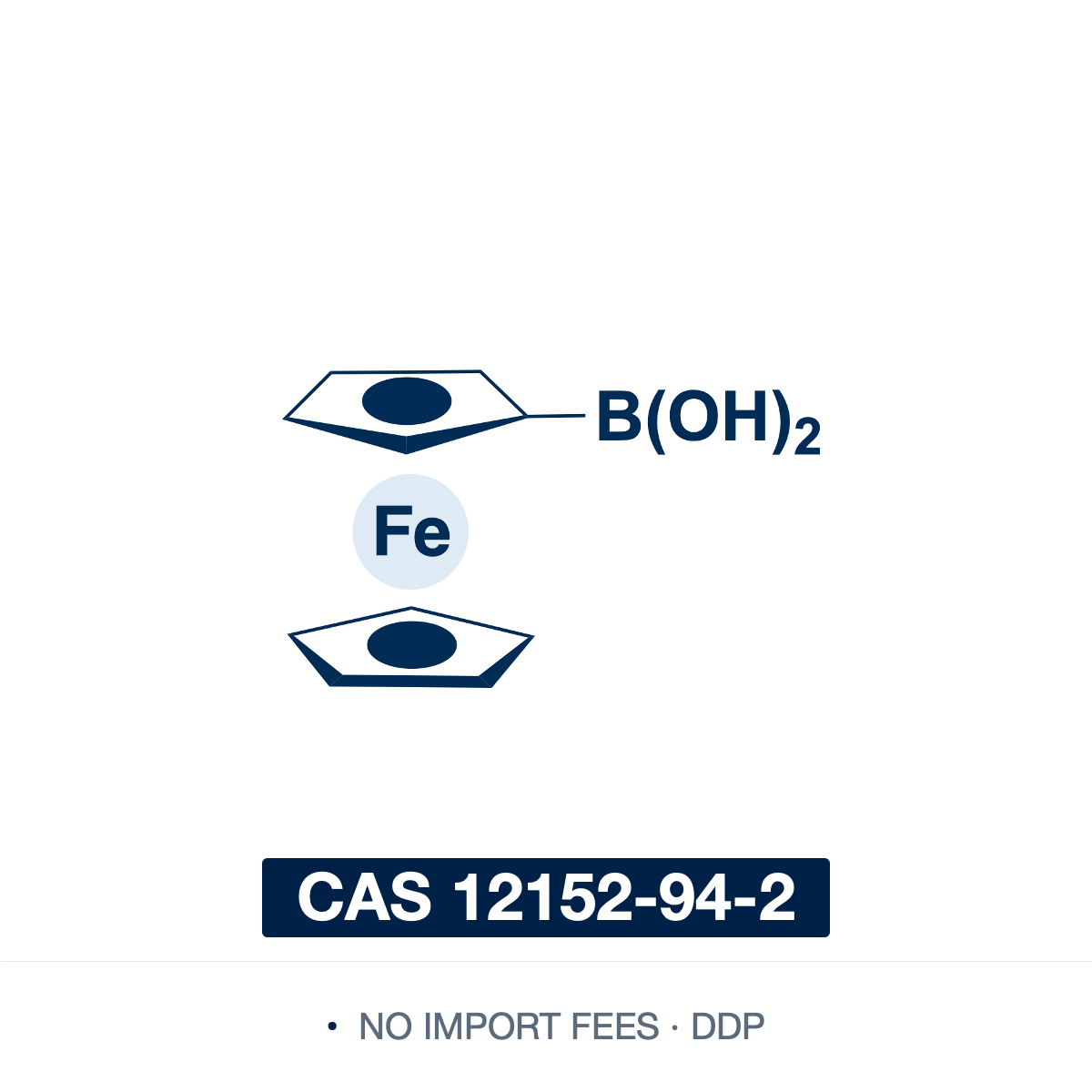
Ferroceneboronic Acid
Ferroceneboronic Acid | CAS 12152-94-2 | ≥95%
Couldn't load pickup availability
Technical Specifications
| CAS Number | 12152-94-2 |
| EC / EINECS Number | 235-272-1 |
| MDL Number | MFCD00059074 |
| SMILES | B(C1=CC=C[CH-]1)(O)O.[CH-]1C=CC=C1.[Fe+2] |
| InChI | InChI=1S/C5H6BO2.C5H5.Fe/c7-6(8)5-3-1-2-4-5;1-2-4-5-3-1;/h1-4,7-8H;1-5H;/q2*-1;+2 |
| InChIKey | XCHXIPVWFCEEMB-UHFFFAOYSA-N |
| PubChem CID | 82949 |
| Molecular Formula | C₁₀H₁₁BFeO₂ |
| Molecular Weight | 229.85 g/mol |
| Melting Point | 145-150 °C (dec.) |
| Solubility | Slightly soluble in ether |
| Purity | ≥95%. May contain small variable amounts of boron anhydrides |
| Physical Form | Yellow to orange crystalline powder |
| HS Code | 2931.90 |
| Shelf Life | Retest period: 36 months under recommended storage conditions |
| Storage Conditions | Store at 2-8 °C. Keep container tightly closed in a dry place. Mildly hygroscopic — protect from moisture |
Product Description & Scientific Applications
Ferroceneboronic Acid ((dihydroxyboryl)ferrocene, ferrocenyl boronic acid, (boronocyclopentadienyl)cyclopentadienyl iron) is a redox-active organometallic boronic acid used in Suzuki cross-coupling, electrochemical saccharide and diol sensing, cyclic-boronate derivatisation, and the synthesis of ferrocene-appended macrocycles. The electron-rich and sterically demanding ferrocenyl group features a reversible Fe(II)/Fe(III) redox couple that remains intact post-coupling, endowing the target molecule with a built-in electrochemical handle rarely found in standard boronic-acid building blocks. The boronic acid forms cyclic esters with 1,2- and 1,3-diols, which is the basis of saccharide-sensing electrochemistry and of cyclic-boronate diol derivatisation in GC/MS and HPLC.
The product may contain small amounts of the cyclic anhydride ferroceneboroxine; under aqueous or basic coupling conditions the two forms re-equilibrate and the impact on yield is minor.
Applications and Reactions
- Suzuki–Miyaura coupling: couples with aryl and heteroaryl halides and triflates to install the ferrocenyl group on organic scaffolds. The reaction tolerates electron-rich, electron-poor, and heteroaryl partners; cyclic voltammetry of the products tracks how each new substituent shifts the ferrocene oxidation potential.
- Electrochemical saccharide and diol sensors: reversible cyclic boronate ester formation with 1,2- and 1,3-diols shifts the ferrocenyl Fe(II)/Fe(III) redox potential. This signal-transduction principle has been used to build amperometric and cyclic-voltammetric sensors for fructose, glucose, and other cis-diol analytes; mono-, bis-, and chiral ferroceneboronic-acid derivatives have been developed on this basis.
- Cyclic boronate derivatisation for GC/MS and HPLC: ferroceneboronic acid reacts with vicinal diols and polyols to form cyclic boronate derivatives. This chemistry has been applied in GC/MS derivatisation and in HPLC with electrochemical detection, where the ferrocenyl unit provides the electroactive label; the determination of brassinosteroids in plant samples is one established example.
- Ferrocene-appended porphyrins and subporphyrins: Suzuki coupling with halogenated porphyrin or subporphyrin precursors gives ferrocenyl macrocycles studied for optical absorption, fluorescence quenching, electronic communication, and reversible ferrocene-centred oxidation.
- Protected and masked boron variants: ferroceneboronic acid has been converted into protected ferrocenylboron derivatives including FcB(dan), FcB(aam), FcBF3K, FcB(MIDA), and triolborate variants, providing better-defined and more easily handled ferrocenylboron reagents for further organometallic synthesis.
Further Reading
For boronic acids, boronic esters, protodeboronation, boroxine content, and Suzuki–Miyaura reagent selection, see NorrChemica's Lab Journal guide: Choosing Your Boron Source for Suzuki–Miyaura Coupling.
Shipping Destinations
- EU & UK: Priority delivery, 2–5 business days.
- United States (DDP): 3–7 business days, duties and taxes prepaid.
- EFTA Countries (DDP): 3–7 business days, duties and taxes prepaid.
- Worldwide: 7–14 business days, selected locations.
Safety Information
| GHS Pictograms |

|
| Signal Word | Warning |
| Hazard Class | None — not subject to transport regulations |
| Transport Category | Not classified as dangerous for transport (ADR/IATA/IMDG) |
| H-Statements | H315 - H319 - H335 |
| P-Statements | P261 - P264 - P271 - P280 - P302+P352 - P304+P340 - P305+P351+P338 - P332+P313 - P337+P313 - P362+P364 - P501 |
Documentation
| Safety Data Sheet | Download PDF |