NorrChemica™
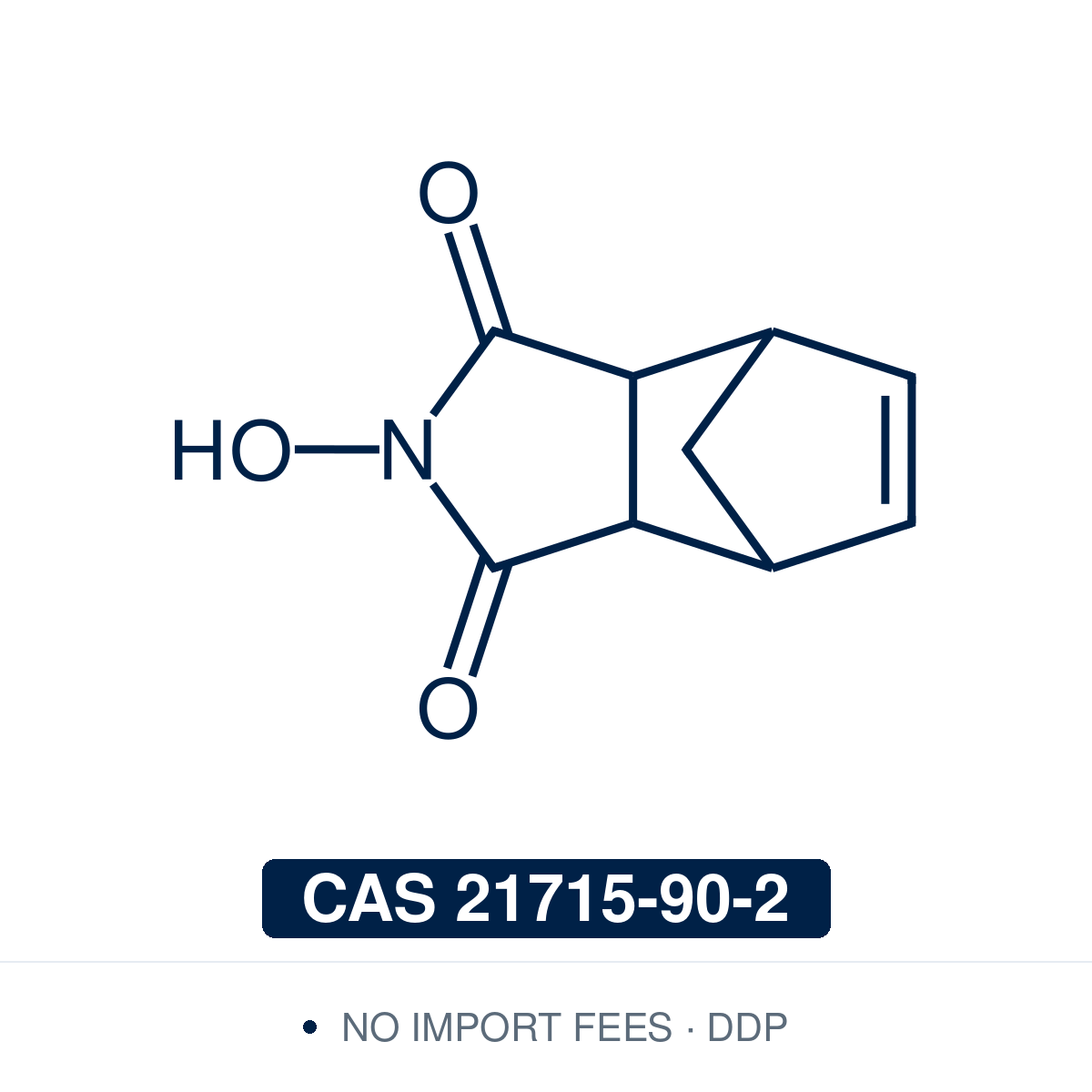
HONB (N-Hydroxynorbornene Dicarboximide)
HONB (N-Hydroxynorbornene Dicarboximide) | CAS 21715-90-2 | ≥98%
Couldn't load pickup availability
Technical Specifications
| CAS Number | 21715-90-2 |
| EC / EINECS Number | 244-538-6 |
| MDL Number | MFCD00065691 |
| SMILES | C1C2C=CC1C3C2C(=O)N(C3=O)O |
| InChI | InChI=1S/C9H9NO3/c11-8-6-4-1-2-5(3-4)7(6)9(12)10(8)13/h1-2,4-7,13H,3H2 |
| InChIKey | ZUSSTQCWRDLYJA-UHFFFAOYSA-N |
| PubChem CID | 89529 |
| Molecular Formula | C₉H₉NO₃ |
| Molecular Weight | 179.17 g/mol |
| Melting Point | 165–170 °C |
| Solubility | Soluble in ethanol, chloroform, ethyl acetate, THF; sparingly soluble in water |
| Purity | ≥98% |
| Physical Form | White to off-white crystalline powder |
| HS Code | 2925.19 |
| Shelf Life | Retest period: 36 months from date of manufacture |
| Storage Conditions | Store at room temperature in a tightly sealed container, protected from moisture |
Product Description & Scientific Applications
HOBN / HONB (N-hydroxy-5-norbornene-2,3-dicarboximide) is a non-benzotriazole N-hydroxyimide coupling additive used with carbodiimide reagents such as DCC, DIC, and EDC for amide and peptide bond formation. The compound is structurally unrelated to HOBt: it contains no benzotriazole ring and is built instead on a rigid bicyclic norbornene-dicarboximide scaffold. In carbodiimide activation, HONB forms N-hydroxy-norbornene-dicarboximide active esters that undergo aminolysis with low racemisation while suppressing N-acylurea formation. Its active esters are unusually resistant to hydrolysis for N-hydroxyimide esters, enabling peptide-forming reactions that can tolerate aqueous media, while liberated HONB is sufficiently soluble in water and common organic solvents to simplify removal during work-up.
Racemisation suppression in carbodiimide couplings
In carbodiimide activation, an N-protected amino acid or peptide first forms an O-acylisourea intermediate, which can undergo side reactions including oxazolone formation and O→N acyl migration. HONB diverts this intermediate into the corresponding N-hydroxy-norbornene-dicarboximide active ester, reducing racemisation during subsequent amine coupling. Racemisation-test studies show that HONB markedly lowers racemisation while delivering peptides in high yield and purity.
Inhibition of N-acylurea formation
A major loss pathway in carbodiimide couplings is irreversible O→N acyl migration of the O-acylisourea to the unreactive N-acylurea, a dead-end by-product that consumes both the activated acid and the carbodiimide. HONB diverts the O-acylisourea into the corresponding active ester before significant O→N acyl migration can occur, increasing the fraction of activated acid that proceeds to productive amide formation. The effect matters most in fragment condensation and longer coupling sequences, where small per-cycle losses compound across many steps.
Non-benzotriazole alternative to HOBt
Benzotriazole additives such as HOBt can carry explosive-classification and transport constraints, particularly for anhydrous or inadequately desensitised material. HONB provides a non-benzotriazole active-ester route for carbodiimide coupling: its norbornene-dicarboximide framework lacks the benzotriazole motif associated with HOBt’s energetic handling profile while retaining the racemisation-control and active-ester benefits expected from auxiliary N-hydroxyimide additives.
Resistance to Lossen rearrangement
N-hydroxysuccinimide-derived activation chemistry can suffer from Lossen-rearrangement side reactions that generate β-alanine-derived by-products. HONB rarely undergoes this side reaction because its rigid bicyclic framework disfavours the geometry required for the rearrangement, reducing a side-reaction pathway associated with HOSu/DCC activation chemistry.
Peptide fragment condensation and stereochemically sensitive coupling
HONB/carbodiimide protocols have been applied to stepwise elongation and fragment condensation of stereochemically sensitive peptide targets, where high coupling efficiency and low racemisation are required. The combination of hydrolysis-resistant active-ester formation, racemisation suppression, N-acylurea control, and non-benzotriazole structure suits HONB to research-scale peptide synthesis, fragment condensation, and larger-scale coupling work where benzotriazole additives are undesirable.
Further Reading
For guidance on selecting between carbodiimides, aminium/uronium salts, phosphonium salts, and other reagent classes for amide and peptide bond formation, see NorrChemica's Lab Journal guide: Choosing a Coupling Reagent for Amide and Peptide Bond Formation.
Shipping Destinations
- EU & UK: Priority delivery, 2–5 business days.
- United States (DDP): 3–7 business days, duties and taxes prepaid.
- EFTA Countries (DDP): 3–7 business days, duties and taxes prepaid.
- Worldwide: 7–14 business days, selected locations.
Safety Information
| GHS Pictograms |

|
| Signal Word | Warning |
| Hazard Class | None — not subject to transport regulations |
| Transport Category | Not classified as dangerous goods for transport (ADR/IATA/IMDG) |
| H-Statements | H315 - H319 - H335 |
| P-Statements | P261 - P264 - P271 - P280 - P302+P352 - P305+P351+P338 - P332+P313 - P337+P313 - P362+P364 - P501 |
Documentation
| Safety Data Sheet | Download PDF |