NorrChemica™
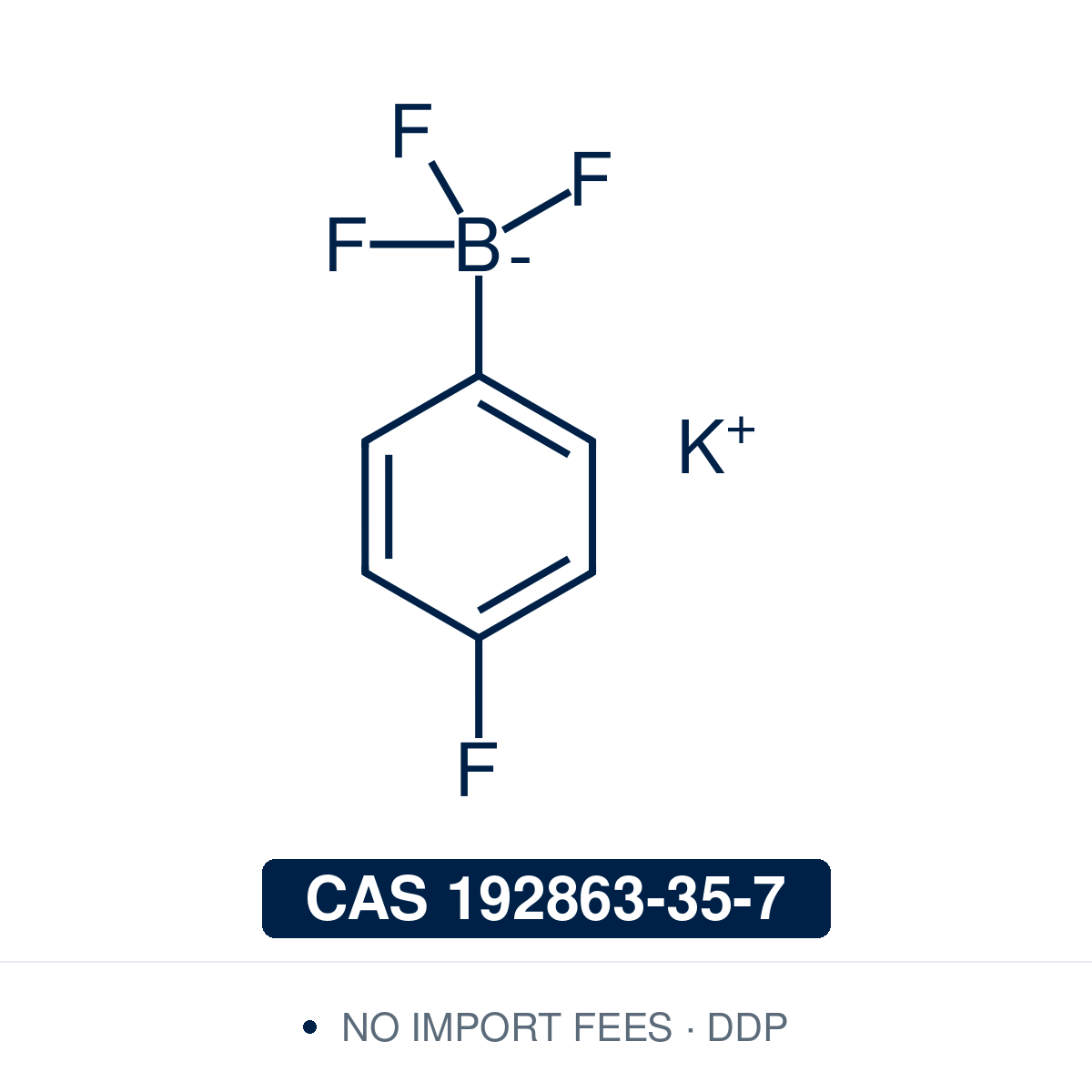
Potassium (4-Fluorophenyl)trifluoroborate
Potassium (4-Fluorophenyl)trifluoroborate | CAS 192863-35-7 | ≥97%
Couldn't load pickup availability
Technical Specifications
| CAS Number | 192863-35-7 |
| EC / EINECS Number | 681-607-3 |
| MDL Number | MFCD01318170 |
| SMILES | [B-](C1=CC=C(C=C1)F)(F)(F)F.[K+] |
| InChI | InChI=1S/C6H4BF4.K/c8-6-3-1-5(2-4-6)7(9,10)11;/h1-4H;/q-1;+1 |
| InChIKey | PXKNUQDMYBUYSZ-UHFFFAOYSA-N |
| PubChem CID | 23677644 |
| Molecular Formula | C₆H₄BF₄K |
| Molecular Weight | 202.0 g/mol |
| Melting Point | 290–292 °C |
| Solubility | Soluble in water, methanol, DMF, DMSO |
| Purity | ≥97% |
| Physical Form | White to off-white crystalline powder |
| HS Code | 2931.90 |
| Shelf Life | Retest period: 36 months from date of manufacture |
| Storage Conditions | Store at room temperature in a tightly sealed container under inert atmosphere |
Product Description & Scientific Applications
Potassium (4-fluorophenyl)trifluoroborate is an aryltrifluoroborate salt. It is a bench-stable surrogate for 4-fluorophenylboronic acid. The boron is four-coordinate, anionic and not Lewis acidic. The reagent is an air- and moisture-stable, ionic crystalline solid.
Suzuki–Miyaura coupling. The reagent is a 4-fluorophenyl donor for Suzuki–Miyaura cross-coupling. Under aqueous or protic conditions it hydrolyses to the boronic acid. That boronic acid then transmetalates to the metal. It couples with aryl and heteroaryl bromides and chlorides to give 4-fluorobiaryls.
Slow release. The 4-fluorophenyl salt needs acid catalysis for efficient hydrolysis. Under basic coupling conditions it therefore hydrolyses slowly. Gearing this slow release to catalytic turnover keeps the free boronic acid low. The low concentration suppresses oxidative homocoupling and protodeboronation.
Further applications
- Nickel-catalysed coupling. Aryltrifluoroborates couple with phenol-derived electrophiles under earth-abundant nickel catalysis. Aryl mesylates and carbonates serve as partners. The metal activates the carbon–oxygen bond by oxidative addition.
- C–H arylation. Aryltrifluoroborates arylate arene C–H bonds without a prehalogenated partner. Indoles couple at C2 to give 2-arylindoles. A copper oxidant turns over the catalyst.
- Oxidative Heck. The salt arylates alkenes to give arylated alkenes. Acrylates give cinnamates. p-Benzoquinone reoxidises the catalyst.
- Rhodium conjugate addition. Potassium organotrifluoroborates add 1,4 to enones under rhodium catalysis. Asymmetric variants proceed at room temperature.
- Ketone synthesis. They couple with aromatic aldehydes to give ketones. The reaction uses acetone as a hydride acceptor.
- Carbonyl arylation. Aryltrifluoroborates add to aldehydes by 1,2-addition. The reaction gives secondary benzylic alcohols.
- Imine arylation. Potassium organotrifluoroborates add to N-sulfonyl ketimines. Asymmetric variants give chiral amines.
- Petasis amine synthesis. Trifluoroacetic acid promotes addition to imines and enamines. The reaction gives amines with no metal catalyst.
- Chan–Lam coupling. Copper(II) acetate couples aryltrifluoroborates with amines and anilines to give arylamines. It also couples them with alcohols and phenols to give aryl ethers. Oxygen is the oxidant.
Further Reading
For boronic acids, boronic esters, protodeboronation, boroxine content, and Suzuki–Miyaura reagent selection, see NorrChemica's Lab Journal guide: Choosing Your Boron Source for Suzuki–Miyaura Coupling
Shipping Destinations
- EU & UK: Priority delivery, 2–5 business days.
- United States (DDP): 3–7 business days, duties and taxes prepaid.
- EFTA Countries (DDP): 3–7 business days, duties and taxes prepaid.
- Worldwide: 7–14 business days, selected locations.
Safety Information
| GHS Pictograms |

|
| Signal Word | Warning |
| Hazard Class | None — not subject to transport regulations |
| Transport Category | Not classified as dangerous goods for transport (ADR/IATA/IMDG) |
| H-Statements | H315 - H319 - H335 |
| P-Statements | P261 - P264 - P271 - P280 - P302+P352 - P304+P340 - P305+P351+P338 - P332+P313 - P337+P313 - P362+P364 - P501 |
Documentation
| Safety Data Sheet | Download PDF |