NorrChemica™
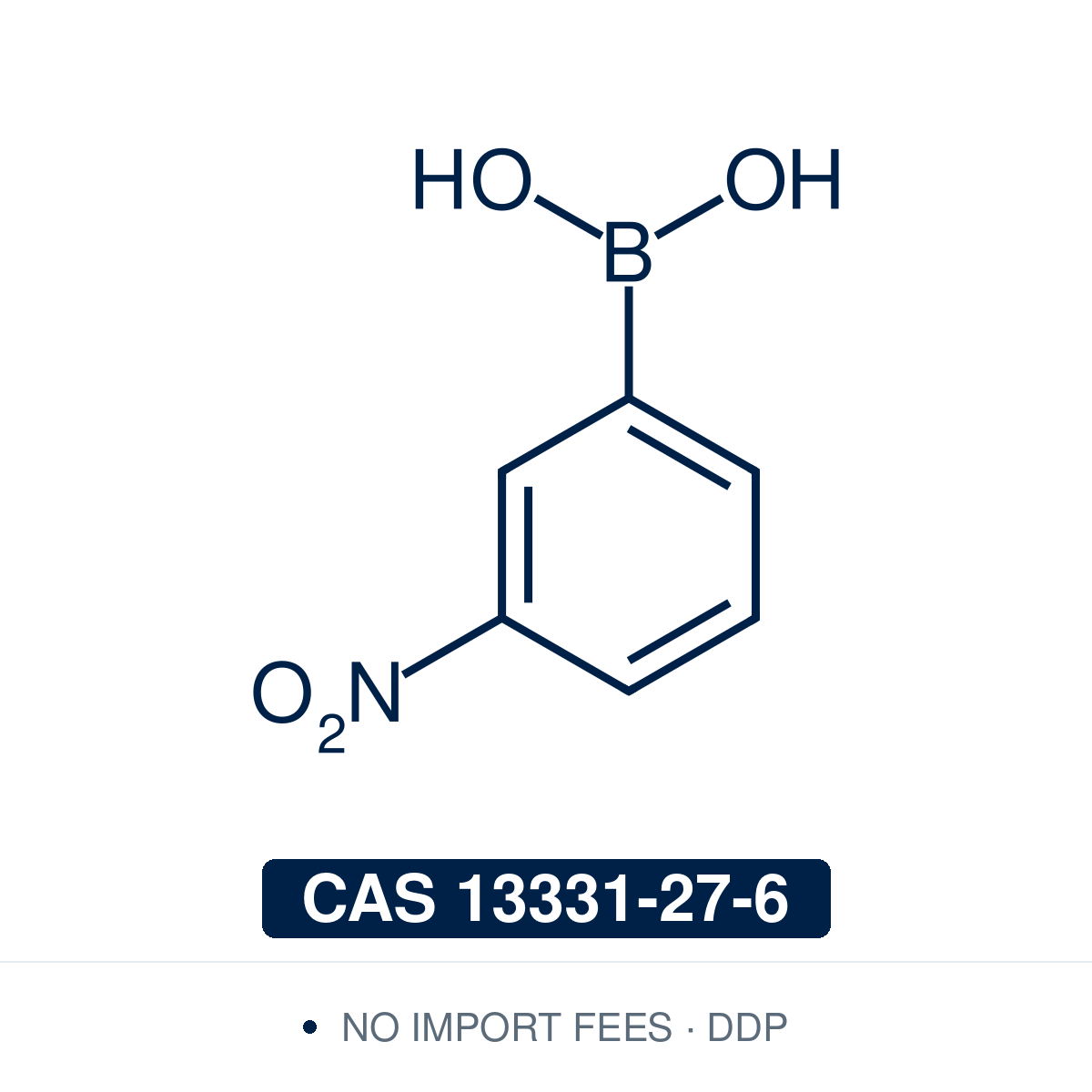
3-Nitrophenylboronic Acid
3-Nitrophenylboronic Acid | CAS 13331-27-6 | ≥98%
Couldn't load pickup availability
Technical Specifications
| CAS Number | 13331-27-6 |
| EC / EINECS Number | 603-734-5 |
| MDL Number | MFCD00007193 |
| RTECS Number | CY8980000 |
| SMILES | B(C1=CC(=CC=C1)[N+](=O)[O-])(O)O |
| InChI | InChI=1S/C6H6BNO4/c9-7(10)5-2-1-3-6(4-5)8(11)12/h1-4,9-10H |
| InChIKey | ZNRGSYUVFVNSAW-UHFFFAOYSA-N |
| PubChem CID | 1677 |
| Molecular Formula | C₆H₆BNO₄ |
| Molecular Weight | 166.93 g/mol |
| Melting Point | 284-285 °C (dec.) |
| Solubility | Slightly soluble in water; soluble in alcoholic solvents, acetonitrile, DMF, DMSO |
| Purity | ≥98%. May contain small variable amounts of boron anhydrides |
| Physical Form | Off-White pale to yellow crystalline powder |
| HS Code | 2931.90 |
| Shelf Life | Retest period: 36 months from date of manufacture |
| Storage Conditions | Store at room temperature. Keep container tightly closed in a dry place. Mildly hygroscopic — protect from moisture |
Product Description & Scientific Applications
3-Nitrophenylboronic Acid (3-nitrobenzeneboronic acid, m-nitrophenylboronic acid, m-nitrobenzeneboronic acid) is a strongly electron-poor arylboronic acid generally used as a building block in medicinal chemistry, agrochemical development, and the synthesis of electron-poor π-conjugated materials. The meta-nitro group is strongly electron-withdrawing (σm = +0.71) and lowers the boronic-acid pKa to an estimated 7.1–7.3 in water.
This compound may contain small amounts of the cyclic anhydride 3-nitrophenylboroxine. Under aqueous or basic coupling conditions the two forms re-equilibrate and the impact on yield is minor.
Applications and Reactions
- Suzuki–Miyaura coupling: couples with aryl, heteroaryl, and alkenyl electrophiles to give 3-nitrobiaryls and related products. Ligand-free Pd-catalysed Suzuki–Miyaura protocols are reported.
- Nitro group transformations: the meta-nitro group remains an orthogonal handle after coupling. Catalytic hydrogenation or chemical reduction (Sn/HCl, Fe/HCl, Zn, SnCl2) gives the 3-aminobiaryl; controlled partial reduction gives nitroso, hydroxylamine, or azo intermediates. The aniline can then be further used in Sandmeyer-type reactions to give halides, phenols, cyanides, fluorides (Balz–Schiemann), azides, and arylated products.
- Diol and polyol recognition: 3-nitrophenylboronic acid is a well-studied model substrate for arylboronic-acid–diol complexation. Ishihara and co-workers measured the reactions of both the trigonal acid and tetrahedral boronate forms with ethylene and propylene glycols, showing that the trigonal acid reacts at least 103 times faster than the boronate. Later work used the same compound with alizarin red S to build a general mechanism for boronic acid–diol condensation.
- Lewis-acid catalysis: Dixon and co-workers introduced 3-nitrophenylboronic acid as the Lewis-acid catalyst for ene carbocyclisation of acetylenic 1,3-dicarbonyl compounds, giving five- and six-membered carbocycles from ketoester substrates.
- Capillary electrophoresis probe for sugar alcohols: Britz-McKibbin and co-workers used 3-nitrophenylboronic acid as an electrokinetic probe in capillary electrophoresis. Dynamic complexation with neutral polyols forms anionic boronate ester complexes during electromigration, allowing simultaneous separation and UV detection of sugar alcohol stereoisomers in phosphate buffer.
- Nanoparticle-enhanced alizarin carbohydrate assay: 3-nitrophenylboronic acid forms reporter complexes with alizarin dyes for saccharide sensing. Crosslinked polymer nanoparticles enhance fluorescence from the 3-nitrophenylboronic acid–alizarin system and improve sensitivity and dynamic range in separation-free assays for glucose and fructose.
- Chemoselective H2O2 probe chemistry: nitrophenylboronic-acid isomers, including the 3-nitro compound, react with hydrogen peroxide under alkaline conditions to give yellow nitrophenolates. This reaction supports colorimetric peroxide detection in food and agricultural samples.
- Copper-catalysed arylation of indolin-2,3-diones: Cu(OTf)2/1,10-phenanthroline catalyses arylation of indolin-2,3-diones (isatin derivatives) with 3-nitrophenylboronic acid, giving 3-(3-nitroaryl)-3-hydroxy-2-oxindoles under air.
- Petasis borono-Mannich: arylboronic acids undergo metal-free three-component coupling with amines and carbonyl partners to give α-aryl amines, α-amino acids, or β-amino alcohols. The 3-nitrophenyl group can be used where the selected Petasis conditions tolerate electron-poor arylboronic acids.
- Other palladium-catalysed couplings: 3-nitrophenylboronic acid is reported in Pd-catalysed decarboxylative coupling and in oxidative arylation/carbocyclisation chemistry. In the oxidative carbocyclisation case, the 3-nitroaryl group is introduced during ring formation.
- Rhodium-catalysed addition to arylpropargyl alcohols: a Rh/BINAP system catalyses regio- and stereoselective addition of arylboronic acids to arylpropargyl alcohols, transferring the 3-nitrophenyl group across the alkyne to give trisubstituted allylic alcohols.
- Protected boronate esters: precursor to Bpin, neopentyl glycol, MIDA, and Bdan esters for iterative cross-coupling and easier chromatography.
- Non-classical arylation: arylboronic acids can couple with arenediazonium tetrafluoroborates as alternative aryl electrophiles; reaction conditions determine suitability for the 3-nitrophenyl variant.
- Ipso-halodeboronation: arylboronic-acid halodeboronation methods can replace B(OH)2 with Br, Cl, or I, giving access to 3-halonitrobenzene motifs depending on the halogen source and conditions.
- Oxidative ipso-hydroxylation: peroxide or perborate converts arylboronic acids to phenols and can give 3-nitrophenol from the 3-nitro substrate; Cu/aerobic and Fe-mediated variants offer alternative oxidants
Further Reading
For boronic acids, boronic esters, protodeboronation, boroxine content, and Suzuki–Miyaura reagent selection, see NorrChemica's Lab Journal guide: Choosing Your Boron Source for Suzuki–Miyaura Coupling.
Shipping Destinations
- EU & UK: Priority delivery, 2–5 business days.
- United States (DDP): 3–7 business days, duties and taxes prepaid.
- EFTA Countries (DDP): 3–7 business days, duties and taxes prepaid.
- Worldwide: 7–14 business days, selected locations.
Safety Information
| GHS Pictograms |

|
| Signal Word | Warning |
| Hazard Class | None — not subject to transport regulations |
| Transport Category | Not classified as dangerous goods for transport (ADR/IATA/IMDG) |
| H-Statements | H315 - H319 - H335 |
| P-Statements | P261 - P264 - P271 - P280 - P302+P352 - P304+P340 - P305+P351+P338 - P332+P313 - P337+P313 - P362+P364 - P501 |
Documentation
| Safety Data Sheet | Download PDF |