NorrChemica™
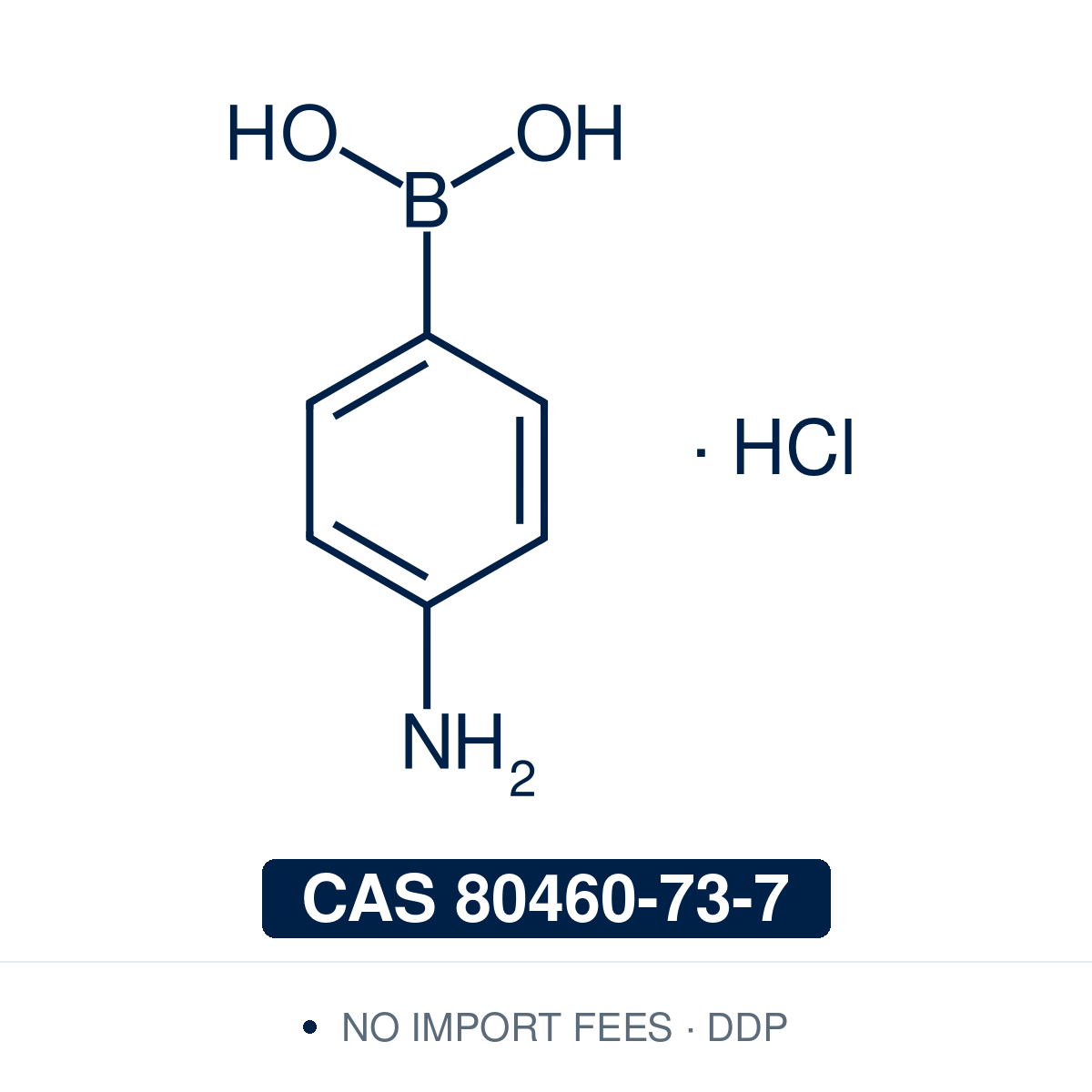
(4-Aminophenyl)boronic Acid HCl
(4-Aminophenyl)boronic Acid HCl | CAS 80460-73-7 | ≥95%
Couldn't load pickup availability
Technical Specifications
| CAS Number | 80460-73-7 |
| EC / EINECS Number | 623-030-1 |
| MDL Number | MFCD03001333 |
| SMILES | B(C1=CC=C(C=C1)N)(O)O.Cl |
| InChI | InChI=1S/C6H8BNO2.ClH/c8-6-3-1-5(2-4-6)7(9)10;/h1-4,9-10H,8H2;1H |
| InChIKey | QBYGJJSFMOVYOA-UHFFFAOYSA-N |
| PubChem CID | 2734614 |
| Molecular Formula | C₆H₉BClNO₂ |
| Molecular Weight | 173.41 g/mol |
| Melting Point | 195-200 °C |
| Solubility | Soluble in water, methanol, ethanol |
| Log Pow | 1.035 |
| Purity | ≥95%. May contain small variable amounts of boron anhydrides |
| Physical Form | White to off-white crystalline powder |
| HS Code | 2931.90 |
| Shelf Life | Retest period: 36 months under recommended storage conditions |
| Storage Conditions | Store under inert atmosphere at room temperature in a tightly sealed container, in a dark place. Mildly hygroscopic - Protect from moisture and light |
Product Description & Scientific Applications
(4-Aminophenyl)boronic acid hydrochloride (4-aminophenylboronic acid HCl, 4-boronoaniline hydrochloride, 4-aminobenzeneboronic acid hydrochloride) is a bifunctional arylboronic acid carrying a para-amino group, supplied as the hydrochloride salt.
May contain small amounts of the corresponding cyclic anhydride (boroxine) form. Under aqueous or basic coupling conditions the two forms re-equilibrate and the impact on yield is minor.
Form and handling: The free 4-aminophenylboronic acid is air- and moisture-sensitive, so the compound is supplied as the bench-stable hydrochloride. Protonation holds the aniline as the anilinium ion during storage and coupling; the free aniline is liberated on basic workup.
Applications and Reactions
Suzuki–Miyaura cross-coupling: Installs the 4-aminophenyl group onto aryl, heteroaryl, and vinyl halides to give 4-amino-substituted biaryls and heterobiaryls. The hydrochloride is the convenient coupling form, with the free aniline recovered after basic workup.
Chan–Lam C–N and C–O coupling: As an arylboronic acid it undergoes copper-mediated aerobic coupling with N–H and O–H partners to form arylamines, arylamides, and diaryl ethers; the aniline provides a second site for downstream derivatisation.
Bifunctional building block: The orthogonal boronic acid and aniline handles support sequential cross-coupling followed by amide formation, reductive amination, diazotisation, or heterocycle construction on one scaffold. The aniline is also the anchor for immobilisation — by amide coupling to polymers and supports or by diazonium grafting onto carbon surfaces — which underpins the affinity and sensor materials below.
Medicinal-chemistry building block: Used in the preparation of chromen-4-ones investigated as DNA-dependent protein kinase (DNA-PK) inhibitors, where Suzuki coupling installs the aminophenyl unit onto the chromone scaffold.
Boronate-affinity capture of cis-diol compounds: Anchored to monoliths, magnetic particles, and molecularly imprinted polymers through the aniline, the boronic acid binds cis-diols reversibly — covalent ester formation under basic conditions, release under acid — for enrichment and separation of glycoproteins, nucleosides, catechols, and saccharides in proteomics and sample preparation.
Glucose-responsive materials and insulin-release systems: Aminophenylboronic-acid derivatives incorporated into polymers, microgels, and nanoparticles bind saccharide cis-diols reversibly; the resulting charge and swelling changes drive the glucose-responsive behaviour exploited in saccharide sensing and self-regulated insulin-release materials.
Enzyme-free electrochemical sugar sensors: Used to build 4-aminophenylboronic-acid–modified reduced graphene oxide (rGO/APBA) electrodes, where boronate binding of sugar cis-diols enables non-enzymatic voltammetric detection of fructose, mannose, and glucose, including in fruit-juice samples.
Dual NADH and hydrogen-peroxide sensing: H₂O₂-triggered conversion of the aminophenylboronic acid generates adsorbed aminophenol on pre-anodised screen-printed carbon electrodes, giving a non-enzymatic amperometric platform for NADH and H₂O₂ detection.
Fluorescent carbon dots: Serves as a boron- and nitrogen-containing precursor for fluorescent carbon dots, applied to the sequential detection of ferric ions and ascorbic acid.
Further Reading
For boronic acids, boronic esters, protodeboronation, boroxine content, and Suzuki–Miyaura reagent selection, see NorrChemica's Lab Journal guide: Choosing Your Boron Source for Suzuki–Miyaura Coupling.
Shipping Destinations
- EU & UK: Priority delivery, 2–5 business days.
- United States (DDP): 3–7 business days, duties and taxes prepaid.
- EFTA Countries (DDP): 3–7 business days, duties and taxes prepaid.
- Worldwide: 7–14 business days, selected locations.
Safety Information
| GHS Pictograms |

|
| Signal Word | Warning |
| Hazard Class | None — not subject to transport regulations |
| Transport Category | Not classified as dangerous goods for transport (ADR/IATA/IMDG) |
| H-Statements | H315 - H319 - H335 |
| P-Statements | P261 - P264 - P271 - P280 - P302+P352 - P304+P340 - P305+P351+P338 - P332+P313 - P337+P313 - P362+P364 - P501 |
Documentation
| Safety Data Sheet | Download PDF |