NorrChemica™
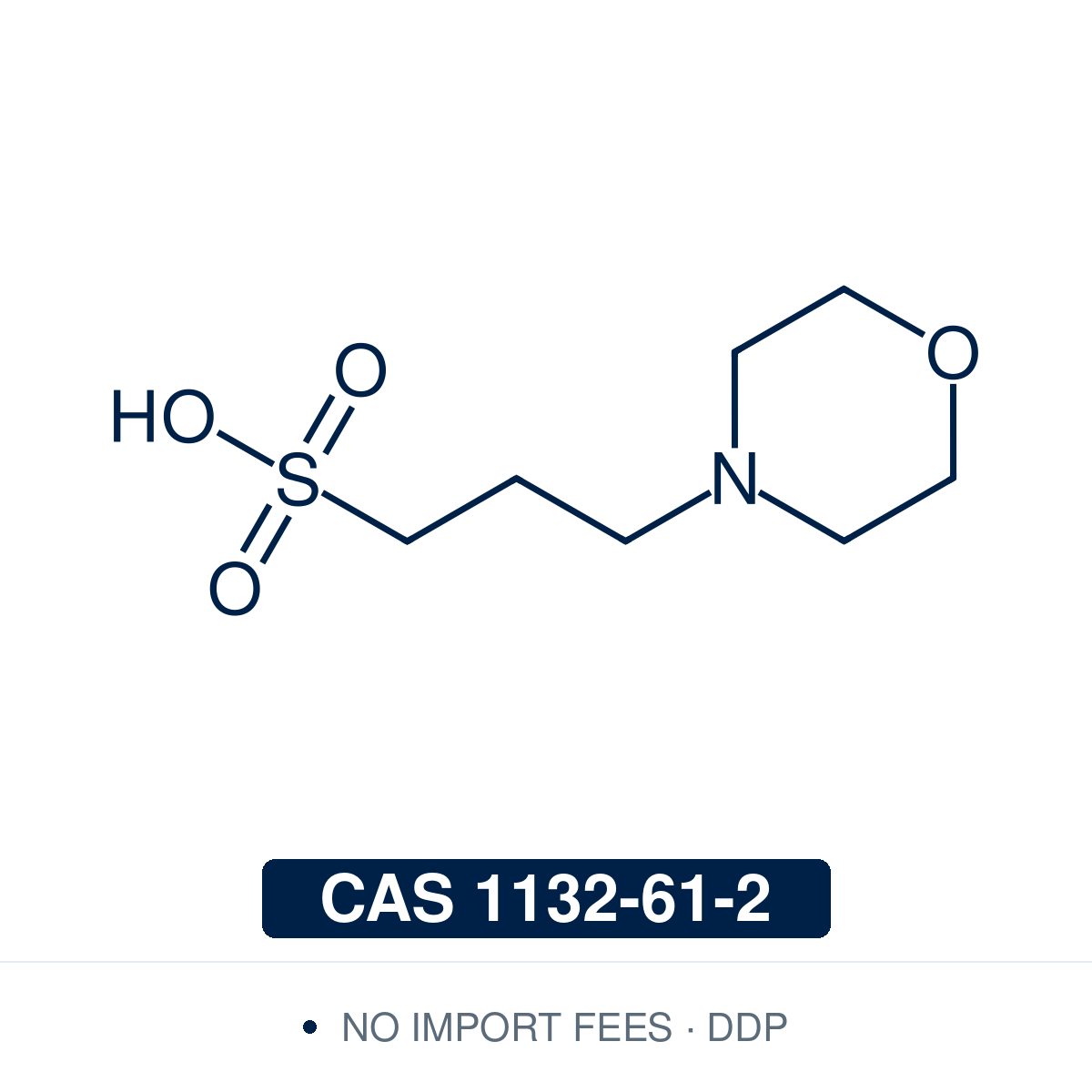
MOPS
MOPS | CAS 1132-61-2 | ≥99.0%
Couldn't load pickup availability
Technical Specifications
| CAS Number | 1132-61-2 |
| EC / EINECS Number | 214-478-5 |
| MDL Number | MFCD00006183 |
| RTECS Number | QE9104530 |
| SMILES | C1COCCN1CCCS(=O)(=O)O |
| InChI | InChI=1S/C7H15NO4S/c9-13(10,11)7-1-2-8-3-5-12-6-4-8/h1-7H2,(H,9,10,11) |
| InChIKey | DVLFYONBTKHTER-UHFFFAOYSA-N |
| PubChem CID | 70807 |
| Molecular Formula | C₇H₁₅NO₄S |
| Molecular Weight | 209.26 g/mol |
| Melting Point | 277–281 °C (decomposition) |
| Solubility | 1000 g/L in water at 20 °C |
| Purity | ≥99.0% |
| Physical Form | White crystalline powder |
| HS Code | 2934.99 |
| Country of Origin | Finland |
| Shelf Life | Retest period: 36 months from date of manufacture |
| Storage Conditions | Store in a cool, dry place in a tightly sealed container |
Product Description & Scientific Applications
MOPS (3-(N-morpholino)propanesulfonic acid) is a zwitterionic Good's buffer for near-neutral pH control in biochemistry, molecular biology, microbiology, and analytical work. Its morpholine-sulfonate scaffold gives a pKa of approximately 7.2 at 25 °C and an effective buffering range of about pH 6.5–7.9, matched to physiological and enzyme-compatible conditions, with a temperature coefficient of approximately −0.012 pH unit per °C. The scaffold also confers high water solubility, low UV absorbance above 240 nm, and limited metal-ion complexation relative to phosphate, citrate, and Tris, though Cu²⁺ and Zn²⁺ controls remain advisable in quantitative metal-binding work. It is best known as the buffer of denaturing-RNA agarose electrophoresis, of Bis-Tris SDS-PAGE for medium-sized to larger proteins, and of Neidhardt-style defined minimal media for E. coli and related enterobacteria.
Near-neutral biological buffering. MOPS provides stable buffering across the physiological pH window in enzyme assays, protein-purification chromatography buffers, immunoassay diluents, and reconstitution media for nucleotides, cofactors, and reactive small molecules. Its zwitterionic Good's-buffer design buffers near neutrality without primary-amine functionality, and NaOH- or KOH-titrated formulations let ionic strength be set independently with added salts. It is preferable when phosphate precipitation of divalent metals, buffer–metal complexation, or primary-amine reactivity from Tris (with aldehydes, NHS-active esters, or reducing sugars) would compromise a metalloenzyme assay, protein-labelling reaction, or cofactor-dependent measurement — for example in Mg²⁺-dependent enzyme assays, metal-sensitive cofactor measurements, and spectrophotometric protein or nucleic-acid quantification, where its background absorbance is also low. MOPS interferes with the Folin–Lowry protein assay, so Bradford or BCA quantification is preferred. In handling, it is sterile-filtered rather than autoclaved — especially in glucose-containing formulations, where it can partially degrade and yellow — and kept below approximately 20 mM in mammalian cell-culture formulations unless the system has been validated.
RNA electrophoresis and Northern blotting. MOPS-based buffer systems are the standard for denaturing agarose gel electrophoresis of RNA — total-RNA quality assessment, transcript sizing, and Northern-blot preparation. The classical 1× MOPS / sodium acetate / EDTA running buffer at pH 7.0 holds near-neutral pH while formaldehyde in the gel and sample buffer reduces RNA secondary structure during separation. Samples are denatured in formamide-containing loading buffer with bromophenol blue and xylene cyanol tracking dyes; migration then supports size-dependent separation, the recognisable 28S/18S rRNA integrity readout for mammalian total RNA, and well-resolved transcript bands for Northern analysis. It also underpins capillary or vacuum transfer to nylon or nitrocellulose membranes for hybridisation-based detection of specific transcripts.
Bis-Tris/MOPS SDS-PAGE. In Bis-Tris SDS-PAGE, chloride is the leading ion and MOPS or MES the trailing ion, with Bis-Tris as the common counter-cation at a near-neutral running pH (approximately 7.0–7.7). MOPS and MES differ in mobility, shifting the moving boundary and the apparent unstacking range, so MOPS resolves medium-sized to larger proteins while MES suits smaller polypeptides on the same gel chemistry. Running near neutrality, rather than in the alkaline Tris-glycine of the classical Laemmli system, improves gel and protein stability, extends cast-gel shelf-life, and reduces pH-driven artefacts during electrophoresis. MOPS-buffered Bis-Tris gels are therefore standard for routine protein analysis, Western-blot transfer preparation, and band excision for mass-spectrometric identification, where mid- to higher-MW resolution and protein stability matter more than low-MW compression.
Defined microbial media. MOPS is the buffering component of Neidhardt-style defined minimal media for Escherichia coli, Salmonella, and related enterobacteria. It replaces the high phosphate of traditional formulations with MOPS-based pH control, letting phosphate, sulfate, nitrogen, carbon source, and trace metals be varied independently. This makes MOPS minimal medium valuable for isotopic labelling and reproducible growth phenotyping in microbial physiology and systems-level studies, including rich-defined supplemented variants now used as standard formats.
Further applications. MOPS also serves as a low-absorbance buffer in spectroscopic assays and in electrochemical pH and metal-speciation studies.
Shipping Destinations
- EU & UK: Priority delivery, 2–5 business days.
- United States (DDP): 3–7 business days, duties and taxes prepaid.
- EFTA Countries (DDP): 3–7 business days, duties and taxes prepaid.
- Worldwide: 7–14 business days, selected locations.
Safety Information
| Hazard Class | None — not subject to transport regulations |
| Transport Category | Not classified as dangerous goods for transport (ADR/IATA/IMDG) |
Documentation
| Safety Data Sheet | Download PDF |
Share