NorrChemica™
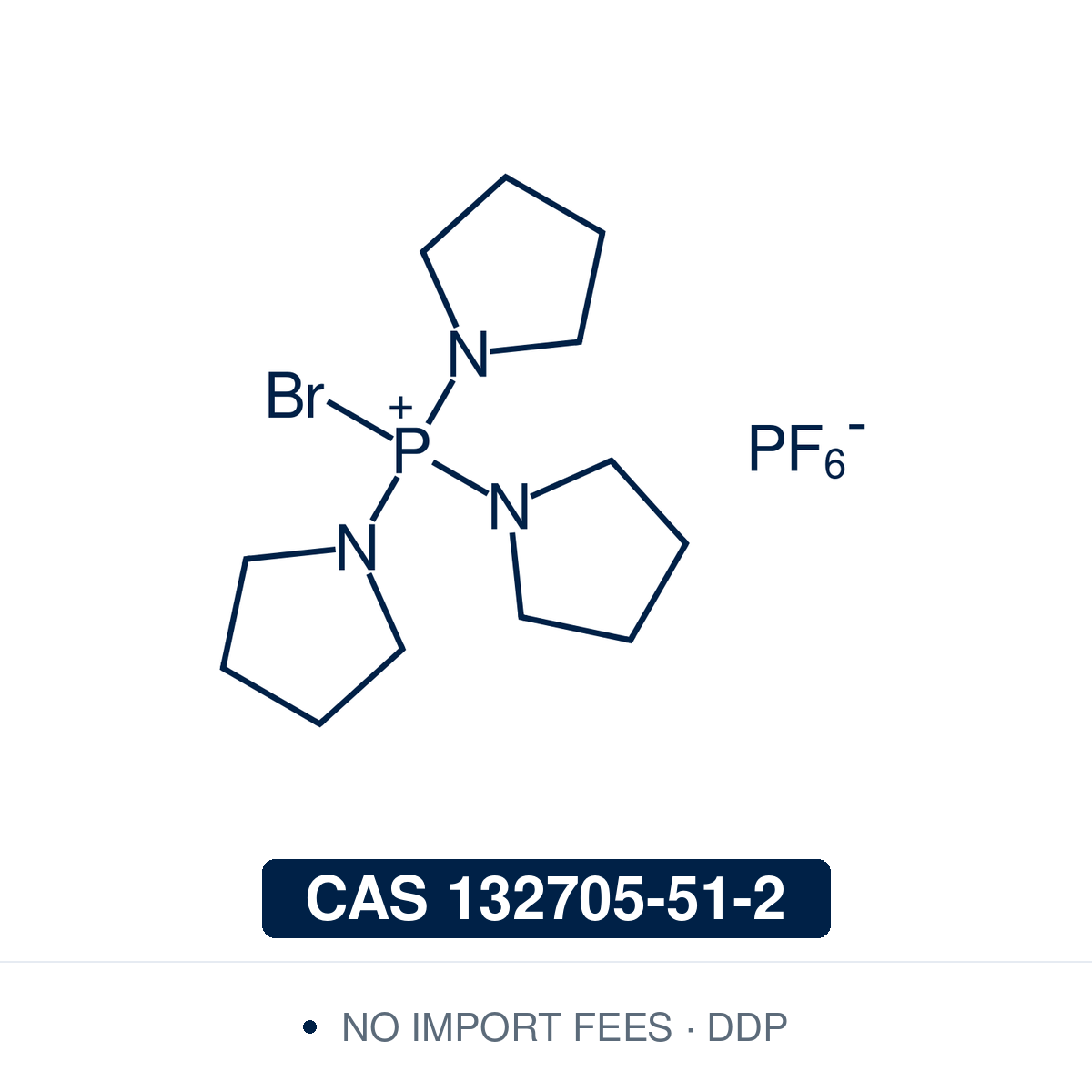
PyBroP
PyBroP | CAS 132705-51-2 | ≥98%
Couldn't load pickup availability
Technical Specifications
| CAS Number | 132705-51-2 |
| EC / EINECS Number | 620-834-4 |
| MDL Number | MFCD00077412 |
| SMILES | C1CCN(C1)[P+](N2CCCC2)(N3CCCC3)Br.F[P-](F)(F)(F)(F)F |
| InChI | InChI=1S/C12H24BrN3P.F6P/c13-17(14-7-1-2-8-14,15-9-3-4-10-15)16-11-5-6-12-16;1-7(2,3,4,5)6/h1-12H2;/q+1;-1 |
| InChIKey | CYKRMWNZYOIJCH-UHFFFAOYSA-N |
| PubChem CID | 2733179 |
| Molecular Formula | C₁₂H₂₄BrF₆N₃P₂ |
| Molecular Weight | 466.18 g/mol |
| Melting Point | 152–156 °C |
| Solubility | Soluble in DMF; expected to be soluble in NMP, acetonitrile, dichloromethane and THF. Moderately soluble in water. |
| Purity | ≥98% |
| Physical Form | White crystalline powder |
| HS Code | 2933.99 |
| Shelf Life | Retest period: 36 months from date of manufacture |
| Storage Conditions | Store frozen (-20 °C) in a tightly sealed container, protected from moisture. |
Product Description & Scientific Applications
PyBrOP — bromotripyrrolidinophosphonium hexafluorophosphate — is a halogenophosphonium peptide-coupling reagent of the BOP/PyBOP family, carrying bromide in place of the benzotriazol-1-yloxy group of PyBOP. In the presence of a tertiary amine base, it activates carboxylic acids through an acyloxyphosphonium intermediate to highly reactive acylating species, including oxazolone and/or symmetrical-anhydride intermediates, which are rapidly aminolysed. Unlike the benzotriazolyl active ester formed by PyBOP — poorly reactive toward N-methyl amino esters — these intermediates readily acylate hindered, slow-reacting amines, which makes PyBrOP a powerful reagent for the difficult coupling of N-methyl and α,α-dialkyl amino acids. As a phosphonium salt, PyBrOP avoids the N-terminal guanidinylation/end-capping side reaction associated with uronium/aminium reagents such as HBTU and HATU, so excess reagent can be used without blocking the free amine terminus. PyBrOP is supplied as a white to off-white crystalline powder, soluble in common peptide-coupling solvents such as DMF and NMP; store cold and dry.
Common Scientific Applications
- Carboxyl activation: with a tertiary amine base such as DIPEA, PyBrOP activates carboxylic acids to highly reactive acylating species for amide bond formation.
- N-methyl amino-acid coupling: often gives better results than phosphonium/HOBt reagents for the difficult coupling of N-methyl amino acids, where BOP and HOBt-based reagents are inefficient. Little epimerisation is reported for this coupling, although racemisation is not fully suppressed in principle, since the reagent carries no auxiliary nucleophile; a weaker base such as collidine is used for racemisation-sensitive or prolonged couplings.
- α,α-Dialkyl and hindered residues: effective for sterically demanding couplings, including α,α-disubstituted amino acids such as Aib; the most hindered cases are run with added DMAP.
- Advantage over uronium and BOP reagents: unlike HBTU and other uronium/aminium salts it forms no guanidinylated end-capping by-product at the amine, and unlike BOP it generates no HMPA by-product.
- Activation of phenols and hydroxy-heterocycles: beyond peptide coupling, PyBrOP is used in phosphonium-coupling chemistry to activate phenols, enols and tautomerisable hydroxy-heterocycles as O-phosphonium electrophiles for nucleophilic substitution or transition-metal cross-coupling.
- Azine N-oxide activation: PyBrOP activates pyridine and related azine N-oxides for regioselective nucleophilic 2-substitution under mild conditions, providing an N-oxide activation route to substituted azines.
Further Reading
For guidance on selecting between carbodiimides, aminium/uronium salts, phosphonium salts and other reagent classes for amide and peptide bond formation, see NorrChemica's Lab Journal guide: Choosing a Coupling Reagent for Amide and Peptide Bond Formation.
Shipping Destinations
- EU, UK & Switzerland only: Priority delivery, 3–5 business days. UK and Switzerland (DDP): duties and taxes prepaid. Classified as dangerous goods — shipping restrictions apply outside the EU, UK and Switzerland.
Safety Information
| GHS Pictograms |


|
| Signal Word | Danger |
| Hazard Class | UN 3261 — Corrosive solid, acidic, organic, n.o.s. (bromotris(pyrrolidino)phosphonium hexafluorophosphate) (Class 8, PG II) |
| Transport Category | Class 8, PG II (ADR/IATA/IMDG) |
| H-Statements | H302 - H314 - H318 |
| P-Statements | P260 - P264 - P270 - P280 - P301+P312 - P301+P330+P331 - P303+P361+P353 - P304+P340 - P305+P351+P338 - P310 - P330 - P363 - P405 - P501 |
Documentation
| Safety Data Sheet | Download PDF |