NorrChemica™
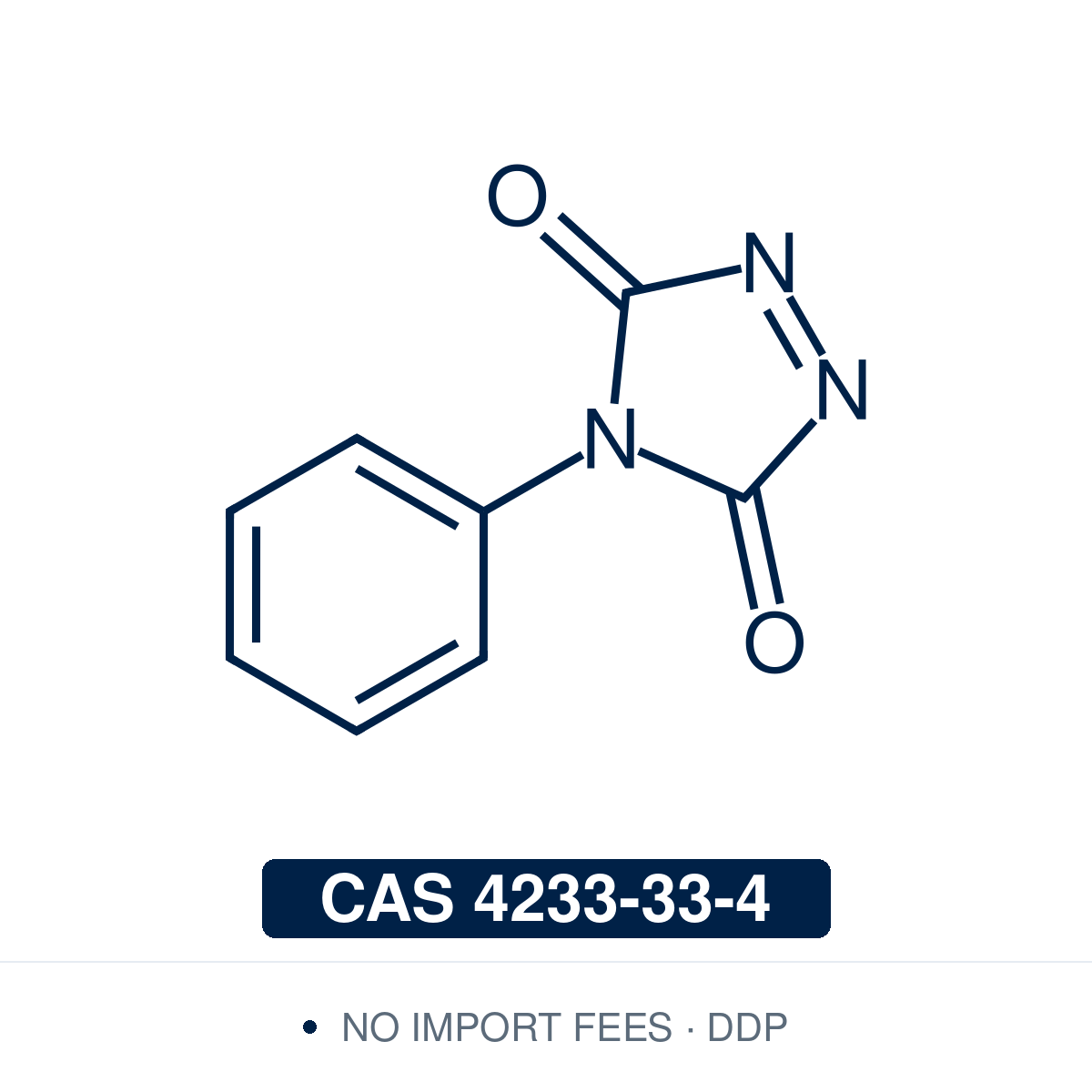
4-Phenyl-1,2,4-triazoline-3,5-dione (PTAD)
4-Phenyl-1,2,4-triazoline-3,5-dione (PTAD) | CAS 4233-33-4 | ≥95%
Couldn't load pickup availability
Technical Specifications
| CAS Number | 4233-33-4 |
| EC / EINECS Number | 224-191-7 |
| MDL Number | MFCD00003148 |
| SMILES | C1=CC=C(C=C1)N2C(=O)N=NC2=O |
| InChI | InChI=1S/C8H5N3O2/c12-7-9-10-8(13)11(7)6-4-2-1-3-5-6/h1-5H |
| InChIKey | ISULLEUFOQSBGY-UHFFFAOYSA-N |
| PubChem CID | 77913 |
| Molecular Formula | C₈H₅N₃O₂ |
| Molecular Weight | 175.14 g/mol |
| Melting Point | 168–175 °C |
| Solubility | Sparingly soluble in chloroform; slightly soluble in ethyl acetate and methanol; workable in THF under synthetic conditions; very slightly soluble in water. |
| Purity | ≥95% |
| Physical Form | Red to dark red crystalline powder |
| HS Code | 2933.99 |
| Shelf Life | Retest period: 36 months from date of manufacture |
| Storage Conditions | Store refrigerated (2–8 °C) in a tightly sealed container under inert atmosphere, protected from moisture and light |
Product Description & Scientific Applications
4-Phenyl-1,2,4-triazoline-3,5-dione (PTAD; Cookson's reagent) is a triazolinedione (TAD), supplied as a carmine-red crystalline solid that decomposes (165–175 °C) before melting. Its reactivity resides in the strongly electrophilic azo (N=N) bond of the triazolinedione ring, which makes it generally regarded as the most reactive bench-stable dienophile and enophile reported; its electrophilicity increases further as the 4-aryl group is made more electron-poor.
Diels–Alder cycloaddition and diene protection. It adds to conjugated dienes in a fast [4+2] cycloaddition across the azo bond, masking the diene as a bicyclic adduct. Because the cycloaddition is reversible, it serves to protect or scavenge diene systems, including steroidal dienes, with the diene regenerated on retro-cycloaddition.
Ene reaction with alkenes. As an enophile it undergoes Alder-ene reactions with alkenes bearing an allylic C–H, forming a C–N bond with allylic transposition of the double bond. With chiral allylic alcohols it gives 3-amino-alkenol products in 78–89% yield, favouring the threo diastereomer (68–90% de).
Amine synthesis. The allylic urazole adducts from the ene reaction act as imine surrogates: base-promoted cleavage of their N–N bond with Grignard reagents converts terminal alkenes into α-branched allylic amines.
Tyrosine bioconjugation (tyrosine-click). It reacts selectively with the phenol side chain of tyrosine through an ene-type reaction, the basis of the tyrosine-click ligation. The reaction proceeds in aqueous buffer across pH 2–10, completes in under five minutes, labels native enzymes and antibodies, and provides a route to bispecific antibodies.
Selectivity and conjugate stability. Against a panel of reactive side chains it modifies tyrosine in preference to cysteine, lysine, serine, histidine, tryptophan and arginine, and the resulting linkage withstands strong acid, strong base and heating.
Click and dynamic-covalent polymer chemistry. As a TAD it enables ultrafast, catalyst-free click reactions for macromolecular functionalisation, polymer–polymer coupling and crosslinking under ambient conditions. Adducts with indoles undergo a thermally reversible transclick, giving polymer networks that can be healed, reshaped and recycled.
Shipping Destinations
- EU & UK: Priority delivery, 2–5 business days.
- United States (DDP): 3–7 business days, duties and taxes prepaid.
- EFTA Countries (DDP): 3–7 business days, duties and taxes prepaid.
- Worldwide: 7–14 business days, selected locations.
Safety Information
| GHS Pictograms |

|
| Signal Word | Warning |
| Hazard Class | None — not subject to transport regulations |
| Transport Category | Not classified as dangerous goods for transport (ADR/IATA/IMDG) |
| H-Statements | H302 |
| P-Statements | P264 - P270 - P301+P312 - P330 - P501 |
Documentation
| Safety Data Sheet | Download PDF |