NorrChemica™
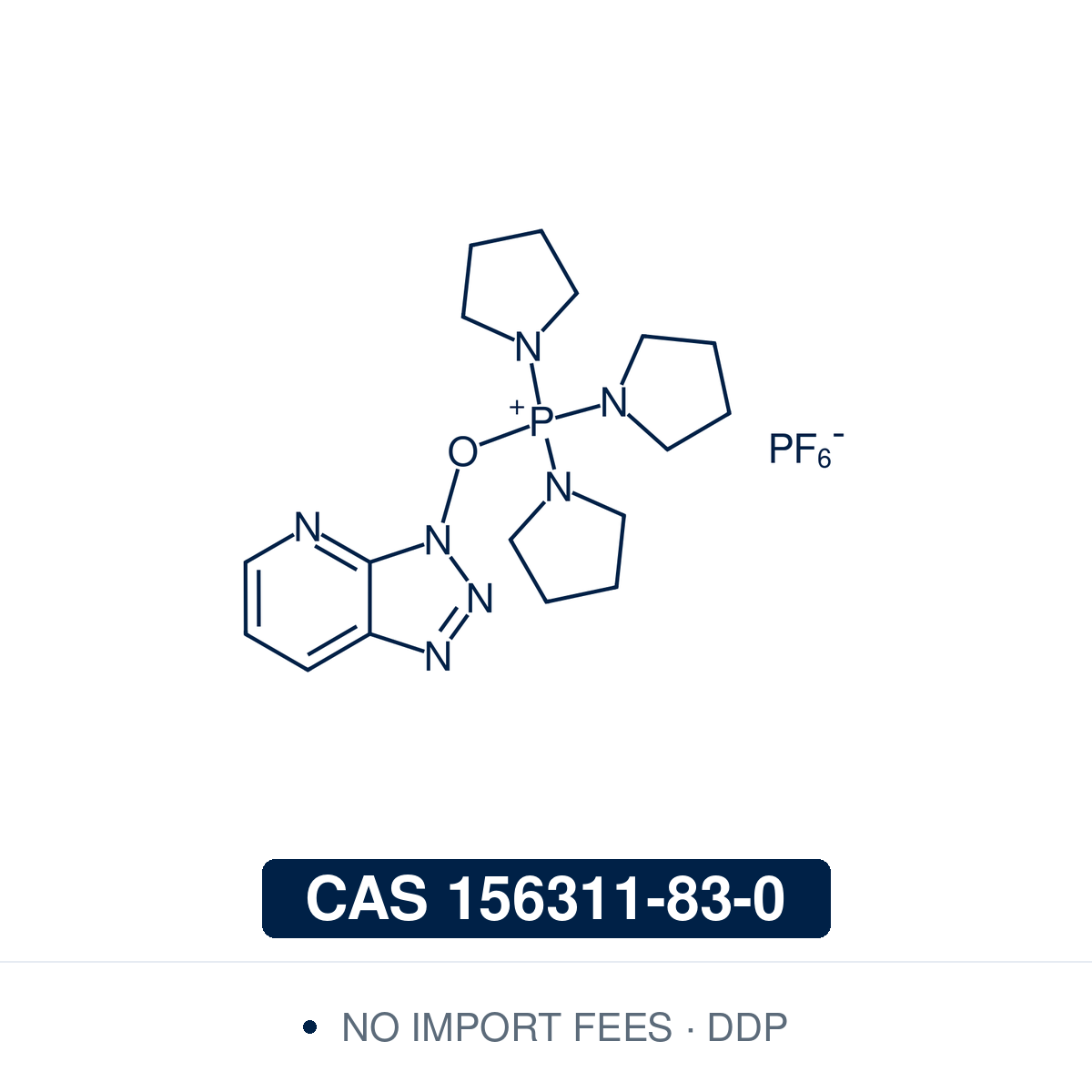
PyAOP
PyAOP | CAS 156311-83-0 | ≥98%
Couldn't load pickup availability
Technical Specifications
| CAS Number | 156311-83-0 |
| EC / EINECS Number | 627-192-4 |
| MDL Number | MFCD03703417 |
| RTECS Number | TH3890000 |
| SMILES | C1CCN(C1)[P+](N2CCCC2)(N3CCCC3)ON4C5=C(C=CC=N5)N=N4.F[P-](F)(F)(F)(F)F |
| InChI | InChI=1S/C17H27N7OP.F6P/c1-2-11-21(10-1)26(22-12-3-4-13-22,23-14-5-6-15-23)25-24-17-16(19-20-24)8-7-9-18-17;1-7(2,3,4,5)6/h7-9H,1-6,10-15H2;/q+1;-1 |
| InChIKey | CBZAHNDHLWAZQC-UHFFFAOYSA-N |
| PubChem CID | 11038641 |
| Molecular Formula | C₁₇H₂₇F₆N₇OP₂ |
| Molecular Weight | 521.39 g/mol |
| Melting Point | 163-168 °C |
| Solubility | Soluble in common polar organic solvents including DMF, DMSO, NMP, THF, acetonitrile and acetone |
| Purity | ≥98% |
| Physical Form | White to off-white crystalline powder |
| HS Code | 2933.99 |
| Shelf Life | Retest period: 36 months from date of manufacture |
| Storage Conditions | Store frozen (-10 to -25 °C) in a tightly sealed container, protected from moisture. |
Product Description & Scientific Applications
PyAOP — (7-azabenzotriazol-1-yloxy)tripyrrolidinophosphonium hexafluorophosphate — is a phosphonium peptide-coupling reagent and the HOAt-derived analogue of PyBOP. In the presence of a tertiary amine base, it converts carboxylic acids to OAt active esters, which then acylate amines to form amide bonds. The HOAt-derived leaving group gives more reactive OAt esters than the OBt esters formed by PyBOP, because HOAt has a lower pKa and its pyridine nitrogen provides neighbouring-group assistance; PyAOP is therefore used for fast, low-racemisation couplings. As a phosphonium salt, it avoids the N-terminal guanidinylation side reaction associated with uronium/aminium reagents such as HATU, so excess PyAOP can be used in slow cyclisation and fragment couplings without blocking the free amine terminus. PyAOP is supplied as a white to colourless crystalline solid, soluble in DMF, dichloromethane, acetonitrile, NMP, THF and related organic solvents; solutions should be prepared fresh for best performance.
Common Scientific Applications
- Carboxyl activation: with a tertiary amine base such as DIPEA, NMM or 2,4,6-collidine, PyAOP converts carboxylic acids to reactive OAt esters for amide bond formation.
- Solid-phase and solution-phase peptide synthesis: a high-efficiency activator for Fmoc- and Boc-strategy SPPS and solution-phase peptide coupling.
- Difficult sequences and hindered residues: effective for hindered couplings, including secondary and α,α-disubstituted amino acids, N-methyl residues and difficult short sequences.
- Cyclisation and fragment coupling: used for head-to-tail peptide cyclisation and fragment coupling, where tolerance of excess reagent is useful for slow conversions.
- Low racemisation: the HOAt-derived active ester reduces epimerisation during activation; the weaker base collidine is used for racemisation-prone residues.
- Advantage over uronium and BOP reagents: unlike HATU and related uronium/aminium salts it forms no guanidinylated by-product at the amine, and unlike BOP it generates no HMPA by-product.
- Broader carboxyl and phosphate activation: beyond peptide-chain assembly, PyAOP is a general activator of carboxylic acids and has been reported as an activator of intact trimetaphosphate in triphosphorylation chemistry.
Further Reading
For guidance on selecting between carbodiimides, aminium/uronium salts, phosphonium salts and other reagent classes for amide and peptide bond formation, see NorrChemica's Lab Journal guide: Choosing a Coupling Reagent for Amide and Peptide Bond Formation.
Shipping Destinations
- EU & UK: Priority delivery, 1–2 business days.
-
- EFTA Countries (DDP): 1–2 business days, duties and taxes prepaid.
Safety Information
| GHS Pictograms |

|
| Signal Word | Warning |
| Hazard Class | Not regulated for transport |
| Transport Category | Not classified as dangerous goods for transport (ADR/IATA/IMDG) |
| H-Statements | H315 - H319 - H335 |
| P-Statements | P261 - P264 - P271 - P280 - P302+P352 - P305+P351+P338 - P332+P313 - P337+P313 - P362+P364 - P501 |
Documentation
| Safety Data Sheet | Download PDF |