NorrChemica™
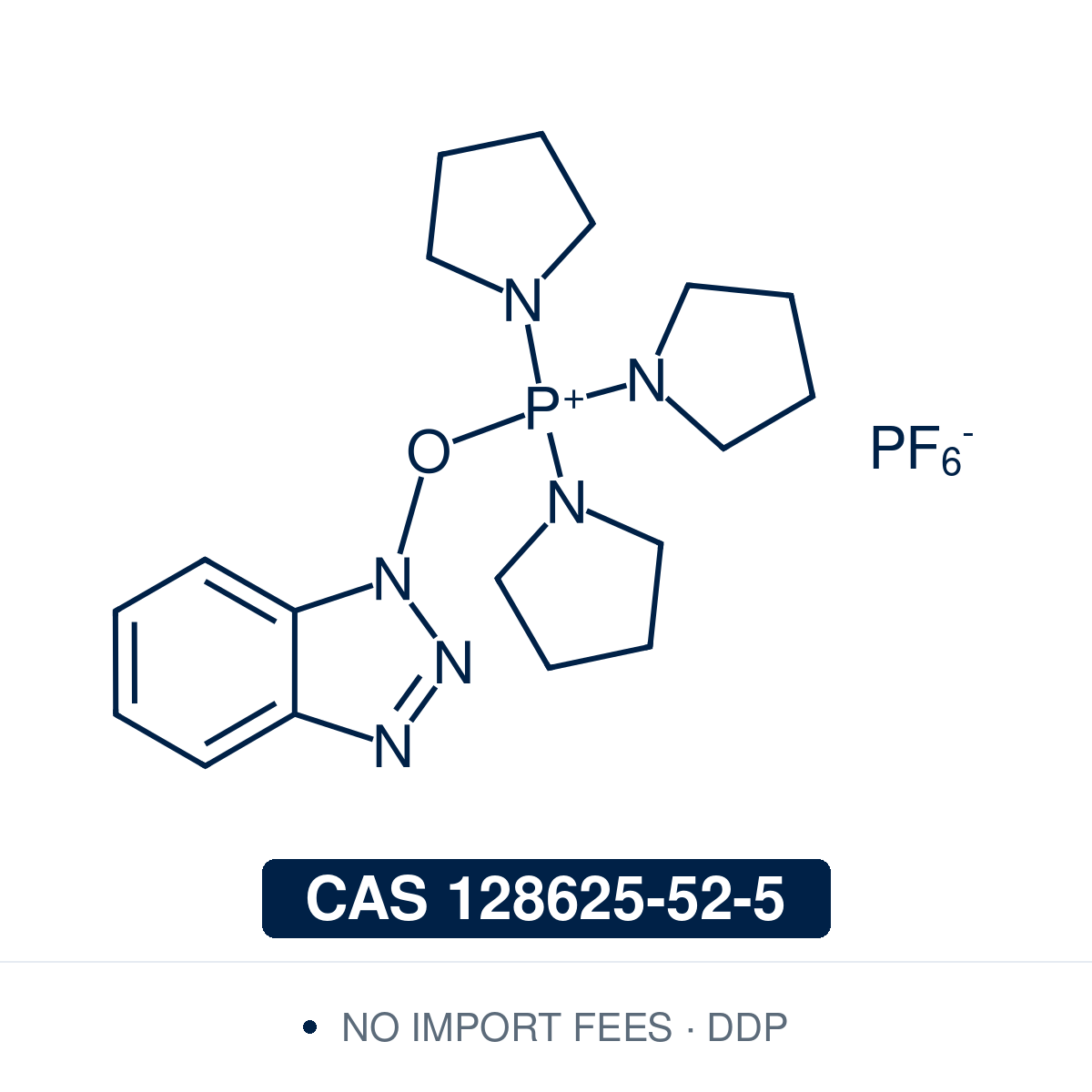
PyBOP
PyBOP | CAS 128625-52-5 | ≥98%
Couldn't load pickup availability
Technical Specifications
| CAS Number | 128625-52-5 |
| EC / EINECS Number | 603-290-2 |
| MDL Number | MFCD00077411 |
| SMILES | C1CCN(C1)[P+](N2CCCC2)(N3CCCC3)ON4C5=CC=CC=C5N=N4.F[P-](F)(F)(F)(F)F |
| InChI | InChI=1S/C18H28N6OP.F6P/c1-2-10-18-17(9-1)19-20-24(18)25-26(21-11-3-4-12-21,22-13-5-6-14-22)23-15-7-8-16-23;1-7(2,3,4,5)6/h1-2,9-10H,3-8,11-16H2;/q+1;-1 |
| InChIKey | VIAFLMPQBHAMLI-UHFFFAOYSA-N |
| PubChem CID | 2724699 |
| Molecular Formula | C₁₈H₂₈F₆N₆OP₂ |
| Molecular Weight | 520.39 g/mol |
| Melting Point | 140–155 °C |
| Solubility | Soluble in acetonitrile, DMF, DCM, THF, and N-methylpyrrolidone |
| Purity | ≥98% |
| Physical Form | White to beige powder |
| HS Code | 2933.99 |
| Shelf Life | Retest period: 36 months from date of manufacture |
| Storage Conditions | Store refrigerated (2–8 °C) in a tightly sealed container, protected from moisture |
Product Description & Scientific Applications
PyBOP ((benzotriazol-1-yloxy)tripyrrolidinophosphonium hexafluorophosphate) is a phosphonium-type peptide coupling reagent, the pyrrolidino analogue of BOP. In the presence of a tertiary-amine base such as DIPEA or N-methylmorpholine it activates a carboxylic acid as the corresponding benzotriazol-1-yl (OBt) active ester, which then acylates the amine to form the amide bond, releasing tripyrrolidinophosphine oxide as the by-product. It matches BOP's coupling efficiency with low racemisation — in the original report it racemised less than BOP. Because it carries a phosphonium rather than a guanidinium centre, PyBOP cannot guanidinylate the free amine of the growing chain — a capping side reaction that can terminate elongation when uronium/aminium reagents such as HBTU or HATU are used in excess. It is soluble in DMF and dichloromethane and is compatible with both Fmoc and Boc strategies.
Common Scientific Applications
Solid-phase and solution-phase peptide synthesis: PyBOP is a standard phosphonium coupling reagent for Fmoc- and Boc-based SPPS and for solution-phase peptide-bond formation. It activates protected amino acids rapidly, including hindered residues, with low racemisation.
Safe replacement for BOP — no carcinogenic HMPA: The original phosphonium reagent BOP generates one equivalent of carcinogenic hexamethylphosphoramide (HMPA) per coupling. PyBOP replaces BOP's three dimethylamino groups with three pyrrolidine rings, so the by-product is tripyrrolidinophosphine oxide rather than the carcinogenic HMPA, while coupling efficiency and stereochemical control are preserved. This makes PyBOP the reagent of choice where BOP-level performance is wanted without generating HMPA.
Fragment condensation and head-to-tail macrolactamisation: Because it forms no guanidinated by-products, PyBOP is well suited to convergent fragment condensation and to head-to-tail macrolactamisation of linear peptide precursors, where the reagent is often used in excess to drive ring closure and the free N-terminus must be preserved. It is a standard reagent for head-to-tail cyclic-peptide synthesis, and in some difficult cyclisations has given cyclised product where uronium reagents such as HATU and HBTU did not.
Esterification and macrolactonisation: Beyond amide bonds, PyBOP activates carboxylic acids for ester bond formation, including macrolactonisation — the lactone counterpart of its macrolactamisation — for the closure of ester macrocycles.
Amide-to-nitrile dehydration: PyBOP also serves as a dehydrating activator that converts primary carboxamides directly into the corresponding nitriles in high yield under mild conditions, tolerating acid- and base-labile functionality.
Further Reading
For guidance on selecting between carbodiimides, aminium/uronium salts, phosphonium salts, and other reagent classes for amide and peptide bond formation, see NorrChemica's Lab Journal guide: Choosing a Coupling Reagent for Amide and Peptide Bond Formation.
Shipping Destinations
- EU & UK : 2–7 business days
Safety Information
| GHS Pictograms |


|
| Signal Word | Danger |
| Hazard Class | UN 3077 — Environmentally hazardous substance, solid, n.o.s. (Class 9, PG III) |
| Transport Category | Dangerous Goods — Class 9, PG III (ADR/IATA/IMDG) |
| H-Statements | H302 - H317 - H340 |
| P-Statements | P201 - P202 - P261 - P272 - P280 - P301+P312 - P302+P352 - P308+P313 - P333+P313 - P330 - P362+P364 - P405 - P501 |
Documentation
| Safety Data Sheet | Download PDF |