NorrChemica™
Thymidine
Thymidine | CAS 50-89-5 | ≥99%
Couldn't load pickup availability
Technical Specifications
| CAS Number | 50-89-5 |
| EC / EINECS Number | 200-070-4 |
| MDL Number | MFCD00006537 |
| RTECS Number | XP2071000 |
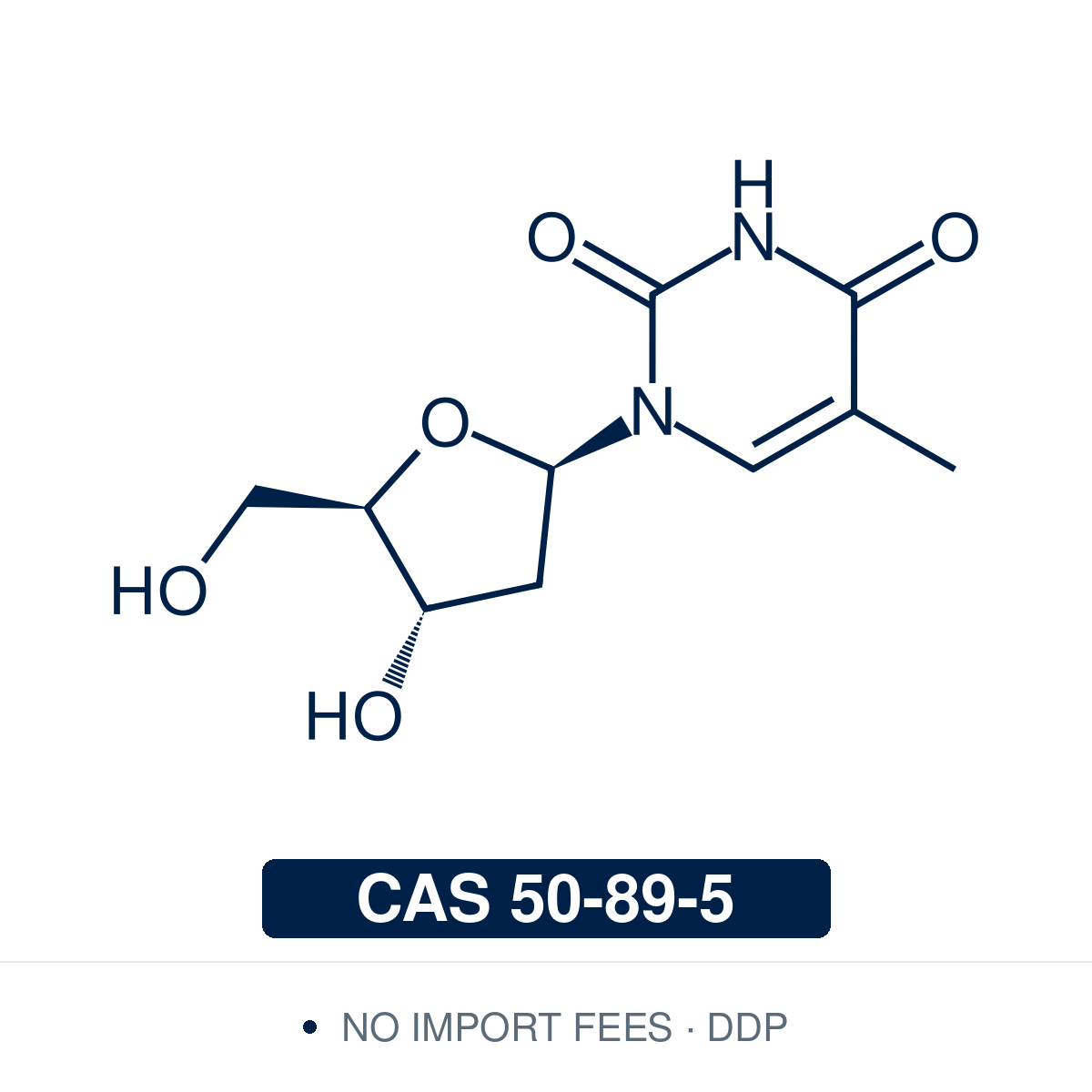
| SMILES | CC1=CN(C(=O)NC1=O)[C@H]2C[C@@H]([C@H](O2)CO)O |
| InChI | InChI=1S/C10H14N2O5/c1-5-3-12(10(16)11-9(5)15)8-2-6(14)7(4-13)17-8/h3,6-8,13-14H,2,4H2,1H3,(H,11,15,16)/t6-,7+,8+/m0/s1 |
| InChIKey | IQFYYKKMVGJFEH-XLPZGREQSA-N |
| PubChem CID | 5789 |
| Molecular Formula | C₁₀H₁₄N₂O₅ |
| Molecular Weight | 242.23 g/mol |
| Melting Point | 186–188 °C |
| Solubility | Freely soluble in water (~50 mg/mL); soluble in ethanol, methanol, DMSO |
| Purity | ≥99.0% |
| Physical Form | White crystalline powder |
| HS Code | 2934.99 |
| Country of Origin | Finland |
| Shelf Life | Retest period: 36 months from date of manufacture |
| Storage Conditions | Store at room temperature in a tightly sealed container |
Product Description & Scientific Applications
Thymidine (2′-deoxythymidine; dT) is a naturally occurring pyrimidine 2′-deoxyribonucleoside — thymine joined to 2-deoxy-D-ribofuranose through a β-N1-glycosidic bond. One of the four canonical DNA deoxyribonucleosides, it pairs with deoxyadenosine in the double helix and enters the thymidine salvage pathway: cytosolic thymidine kinase 1 (TK1) and mitochondrial thymidine kinase 2 (TK2) phosphorylate it to thymidine 5′-monophosphate (dTMP), thymidylate kinase to dTDP, and nucleoside diphosphate kinase to thymidine 5′-triphosphate (dTTP) for nuclear and mitochondrial DNA synthesis. Cellular uptake proceeds through the equilibrative nucleoside transporters hENT1 and hENT2 (SLC29A1/A2) and the concentrative transporters hCNT1 (pyrimidine-preferring) and hCNT3 (broad-selectivity).
Cell cycle synchronisation and dNTP pool manipulation. Thymidine synchronises mammalian cell populations at the G1/S boundary and early S phase. Excess intracellular thymidine is phosphorylated to dTTP, which binds the specificity site (s-site) of ribonucleotide reductase (RNR) and allosterically shifts the α2β2 holoenzyme toward GDP reduction at the expense of CDP and UDP reduction. Suppressed de novo dCDP/dCTP synthesis collapses the dCTP pool; dTTP and other dNTP pools become imbalanced, stalling DNA replication. The double-thymidine block exploits this reversible arrest — typically 16–18 h in 2 mM thymidine, 8–9 h release, then a second 16–18 h block — to release a synchronised S-phase population for studies of replication timing, origin firing, mitotic entry, checkpoint activation, and dNTP-pool homeostasis. Release is achieved by removing thymidine or adding exogenous deoxycytidine, which replenishes cytidine deoxynucleotide pools through the deoxycytidine-kinase (dCK) salvage route, bypassing the inhibited RNR pathway.
DNA synthesis and cell proliferation assays. Tritiated thymidine ([³H]-thymidine) incorporation is the classical method for measuring DNA synthesis and cell proliferation in cultured cells, primary explants, and tissue specimens. After uptake and thymidine kinase-catalysed phosphorylation to [³H]-dTMP, [³H]-dTTP is incorporated into newly synthesised chromosomal DNA, and acid-precipitable radioactivity is quantified by liquid scintillation counting. The same incorporation principle underlies the non-radioactive analogues 5-bromo-2′-deoxyuridine (BrdU) and 5-ethynyl-2′-deoxyuridine (EdU), detected respectively by antibody-based immunofluorescence/immunohistochemistry and by copper-catalysed azide–alkyne (CuAAC) click chemistry. These assays support proliferation profiling in cultured cells, lymphocyte-activation experiments in immunology, cell-cycle phase-distribution studies by flow cytometry, and quantitative DNA-replication timing.
Thymidine kinase substrate and pyrimidine salvage studies. Thymidine is the physiological substrate of thymidine kinase, the rate-limiting first step of the salvage pathway, and serves as a probe substrate in TK kinetic and selectivity assays. Mammalian cells express two isoforms with distinct compartmentalisation and regulation. Cytosolic TK1 is S-phase-regulated, its natural-substrate specificity restricted to thymidine and deoxyuridine; its catalytic efficiency rises roughly 200-fold during S phase through an ATP- and enzyme-concentration-dependent transition from a low-activity dimer to a high-activity tetramer, and is feedback-inhibited by the end-product dTTP. Mitochondrial TK2 is a constitutively expressed homodimer that phosphorylates thymidine, deoxycytidine, and deoxyuridine, supplying the dNTPs for mtDNA replication and maintenance in post-mitotic tissues. Thymidine is therefore a standard reagent for biochemical characterisation of TK1 and TK2 kinetics, isoform-discriminating substrate analogues, deoxyribonucleotidase substrate-cycling studies between TK1/dNT-1 and TK2/dNT-2, nuclear/mitochondrial dNTP-pool partitioning by [³H]-thymidine flux, nucleoside-transporter assays, and quantitative-PCR-based mtDNA copy-number readouts.
Starting material for modified deoxynucleoside and oligonucleotide chemistry. Thymidine is a chiral starting material and reference 2′-deoxyribonucleoside in synthetic nucleoside chemistry. Its defined β-N1-glycosidic stereochemistry, free 3′- and 5′-hydroxyls, and chemically tractable thymine base provide handles for selective 5′-O protection, 3′-O activation, and base functionalisation. These support the preparation of 5′-O-DMTr-thymidine 3′-O-(N,N-diisopropyl)-β-cyanoethyl phosphoramidite — the standard dT monomer of solid-phase oligonucleotide synthesis — and of modified thymidine analogues: 5-substituted, sugar-modified, alkyne-, azide-, and thiol-functionalised variants for click-chemistry conjugation, fluorescent base analogues, phosphorothioate/phosphoramidate backbone research, and structural probes for X-ray crystallography and NMR.
Further applications.
- Reference compound for HPLC, UHPLC, and LC-MS analysis of deoxyribonucleosides in nucleic-acid-hydrolysate profiling and nucleoside-pool measurement.
- Substrate in thymidine phosphorylase kinetic assays and equilibrium studies of phosphorolysis to thymine + 2-deoxyribose-1-phosphate.
- Reference standard in NMR and X-ray structural studies of pyrimidine 2′-deoxyribosides — hydrogen-bonding, glycosyl torsion (anti/syn), and sugar-pucker (north/south).
- Metabolic precursor in DNA-replication and DNA-repair studies, including base-excision repair, mismatch repair, and replication-fork dynamics under nucleotide-pool perturbation.
Shipping Destinations
- EU & UK: Priority delivery, 2–5 business days.
- United States (DDP): 3–7 business days, duties and taxes prepaid.
- EFTA Countries (DDP): 3–7 business days, duties and taxes prepaid.
- Worldwide: 7–14 business days, selected locations.
Safety Information
| Hazard Class | None — not subject to transport regulations |
| Transport Category | Not classified as dangerous goods for transport (ADR/IATA/IMDG) |
Documentation
| Safety Data Sheet | Download PDF |
Share