Skip to product information
1 of 2

NorrChemica™

Trypan Blue (Direct Blue 14) | CAS 72-57-1 | Dye Content ≥70%

Trypan Blue (Direct Blue 14) | CAS 72-57-1 | Dye Content ≥70%

Regular price €24,90 EUR (incl. VAT)
Regular price Sale price €24,90 EUR
Sale Sold out
Taxes included. Shipping calculated at checkout.
Weight
Quantity

Technical Specifications

CAS Number 72-57-1
EC / EINECS Number 200-786-7
MDL Number MFCD00003969
RTECS Number QJ6475000
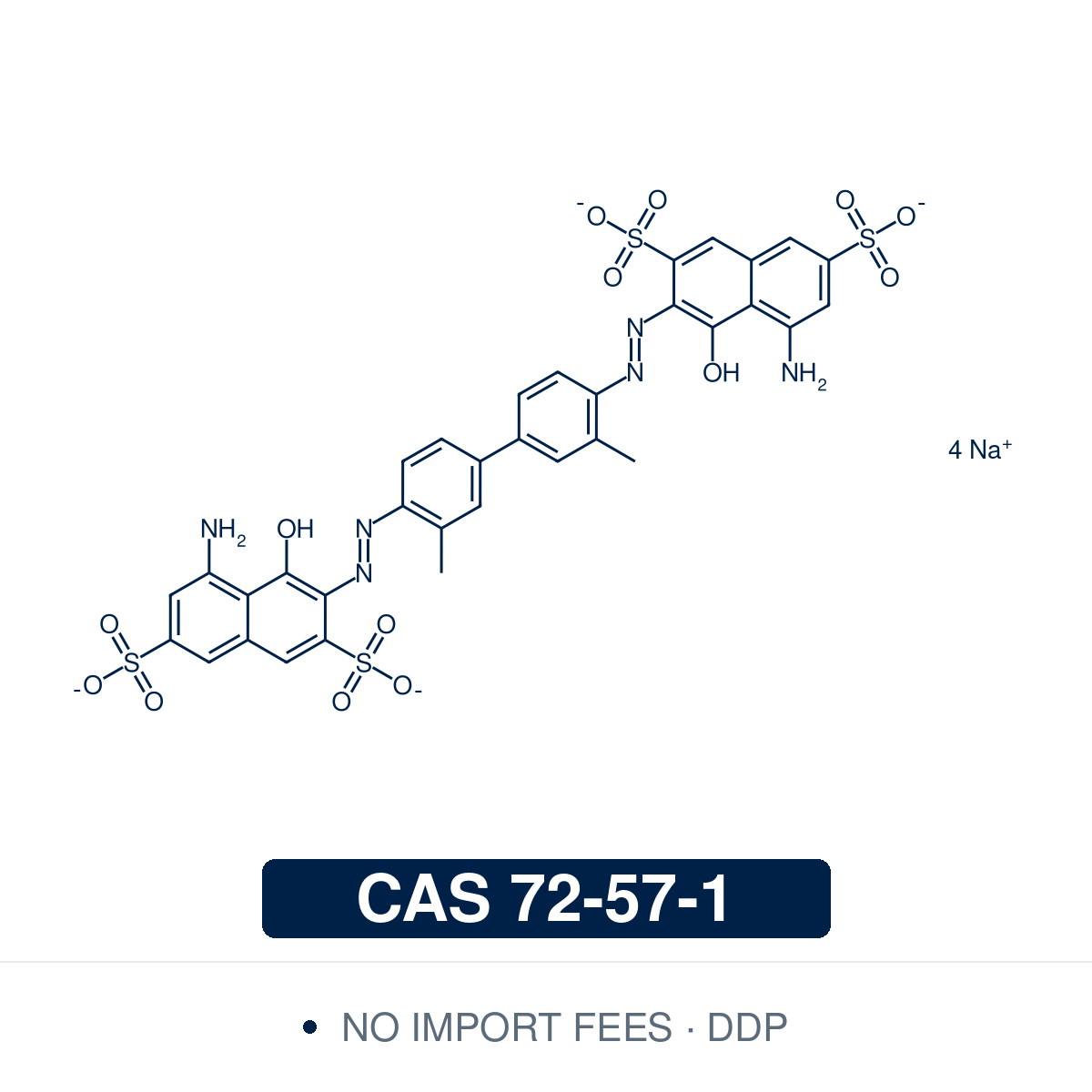
SMILES CC1=C(C=CC(=C1)C2=CC(=C(C=C2)N=NC3=C(C4=C(C=C(C=C4C=C3S(=O)(=O)[O-])S(=O)(=O)[O-])N)O)C)N=NC5=C(C6=C(C=C(C=C6C=C5S(=O)(=O)[O-])S(=O)(=O)[O-])N)O.[Na+].[Na+].[Na+].[Na+]
InChI InChI: InChI=1S/C34H28N6O14S4.4Na/c1-15-7-17(3-5-25(15)37-39-31-27(57(49,50)51)11-19-9-21(55(43,44)45)13-23(35)29(19)33(31)41)18-4-6-26(16(2)8-18)38-40-32-28(58(52,53)54)12-20-10-22(56(46,47)48)14-24(36)30(20)34(32)42;;;;/h3-14,41-42H,35-36H2,1-2H3,(H,43,44,45)(H,46,47,48)(H,49,50,51)(H,52,53,54);;;;/q;4*+1/p-4
InChIKey GLNADSQYFUSGOU-UHFFFAOYSA-J
PubChem CID 6296
Molecular Formula C₃₄H₂₄N₆Na₄O₁₄S₄
Molecular Weight 960.81 g/mol
Melting Point 300 °C (dec.)
Solubility 10 g/L in water (25 °C); slightly soluble in ethanol
Purity Dye content ≥70%
Physical Form Dark blue to black powder
HS Code 3204.14
Shelf Life Retest period: 24 months from date of manufacture
Storage Conditions Store at room temperature in a tightly sealed container under inert atmosphere, protected from light

Trypan Blue (Direct Blue 14, C.I. 23850) is a tetrasulfonated bisazo dye composed of two azo-linked aminonaphthol sulfonic acid units bridged through a 3,3′-dimethylbiphenyl core, supplied as the tetrasodium salt. It appears as a dark blue to black powder and produces deep blue aqueous solutions with an absorption maximum near 607 nm. Trypan Blue is the standard reagent for the dye exclusion viability assay, where it selectively penetrates cells with compromised membrane integrity, staining non-viable cells blue while being excluded by intact living cells. It is also used as a vital stain for mycorrhizal root colonisation studies and as an ophthalmic stain for anterior capsule visualisation during cataract surgery.

Working Solution Preparation — A Little Goes a Long Way

The standard cell viability assay uses Trypan Blue at 0.4% w/v, meaning just 0.4 g of dye powder produces 100 mL of working stain solution. Even the smallest pack size (5 g) is sufficient for over 1.2 litres of 0.4% stain — enough for thousands of viability counts.

Trypan Blue 0.4% Staining Solution: Dissolve 0.4 g Trypan Blue in 100 mL of 1× phosphate-buffered saline (PBS). Filter through a 0.22 µm membrane filter to remove any particulate matter. Store at room temperature. Stable for several months. To use, mix equal volumes of 0.4% Trypan Blue and cell suspension (1:1 ratio), incubate 1–2 minutes at RT, and count immediately on a haemocytometer or automated cell counter. Do not exceed 5 minutes incubation as viable cells will begin to take up the dye. (Per Strober, Curr. Protoc. Immunol. 2001, Appendix 3B; Thermo Fisher Gibco Cell Culture Basics protocol.)

Product Description & Scientific Applications

Trypan Blue Exclusion Cell Viability Assay

  • Trypan Blue is the standard reagent for the dye exclusion assay, the most widely used method for determining cell viability in culture. The assay exploits the principle that viable cells with intact plasma membranes exclude the negatively charged dye, while cells with compromised membranes allow entry and become stained blue. In the standard protocol, a 0.4% Trypan Blue solution is mixed 1:1 with the cell suspension and loaded onto a haemocytometer or automated cell counter within 1–5 minutes. Unstained (viable) and blue-stained (non-viable) cells are counted to calculate the percentage viability. This method is applied routinely in cell culture subpassaging, cytotoxicity screening, post-thaw viability assessment, and quality control of primary cell isolations.
  • Strober (Curr. Protoc. Immunol. 2001, Appendix 3B) established the trypan blue exclusion test as the standard reference protocol for assessing cell viability, defining the methodology adopted universally in cell biology laboratories.

Automated Cell Counting and High-Throughput Viability Assessment

  • Trypan Blue is the preferred dye for automated cell counters, which use brightfield image analysis to distinguish blue-stained non-viable cells from unstained viable cells. Instruments such as the Countess, TC20, and Vi-CELL systems are calibrated specifically for Trypan Blue contrast, enabling rapid and reproducible viability measurements across large sample numbers. The compatibility of Trypan Blue with automated counting platforms makes it essential for standardised cell counting in Good Manufacturing Practice (GMP) environments, bioprocess monitoring, and high-throughput drug screening workflows where consistent and operator-independent viability data are required.

Mycorrhizal Root Colonisation Staining

  • Trypan Blue is used as a non-toxic alternative to chlorazol black E and acid fuchsin for staining arbuscular mycorrhizal (AM) fungal structures within plant roots. In the standard protocol, roots are cleared with potassium hydroxide, acidified with hydrochloric acid, and then stained with 0.05% Trypan Blue in lactoglycerol. The dye selectively stains fungal hyphae, vesicles, and arbuscules within root cortical cells, enabling quantification of mycorrhizal colonisation rates by the gridline intersect or magnified intersection methods. This staining approach is widely adopted in soil ecology and plant biology for studying symbiotic interactions between AM fungi and host plant root systems.
  • Phillips and Hayman (Trans. Br. Mycol. Soc. 1970, 55, 158) developed the lactophenol trypan blue staining method for mycorrhizal root colonisation, which was subsequently adapted to the less toxic lactoglycerol-based protocol now in standard use.

Ophthalmic Surgical Stain for Capsular and Membrane Visualisation

  • Trypan Blue is approved as an ophthalmic vital dye for staining the anterior lens capsule during cataract surgery, particularly in cases of mature or hypermature cataracts where capsular visualisation is poor. A 0.06% Trypan Blue solution is injected under an air bubble into the anterior chamber, where it selectively stains the anterior capsule blue, enabling the surgeon to perform a controlled continuous curvilinear capsulorhexis. Trypan Blue is also used to stain epiretinal membranes and internal limiting membranes during vitreoretinal surgery, facilitating membrane peeling and improving surgical outcomes in macular hole and epiretinal membrane repair procedures.

Cell Membrane Permeability and Cytotoxicity Studies

  • Trypan Blue uptake serves as a quantitative endpoint in cytotoxicity assays measuring the membrane-damaging effects of chemical, physical, and biological agents on cultured cells. The rate and extent of dye uptake correlate with the degree of membrane disruption, enabling dose-response characterisation of cytotoxic compounds, pore-forming toxins, and physical treatments such as electroporation or freeze-thaw cycling. Trypan Blue-based cytotoxicity measurements complement metabolic activity assays such as MTT and resazurin reduction by providing a direct readout of membrane integrity rather than metabolic function, which is particularly important for distinguishing between cytostatic and cytolytic mechanisms of cell death.
  • Chan et al. (PLoS One 2020, 15, e0227950) characterised the morphological effects of trypan blue on dead and dying cells, establishing quantitative criteria for distinguishing membrane rupture from early-stage permeabilisation in dye exclusion assays.

Shipping Destinations

  • EU & UK: Priority delivery, 2–5 business days.
  • Norway (DDP): 3–7 business days, duties and taxes prepaid.
  • Switzerland (DDP): 3–7 business days, duties and taxes prepaid.

The NorrChemica™ Standard

Identity Verified — Batch-verified via analytical QC; documentation available on request.

Direct EU Distribution — Dispatched from Finland for fast delivery to EU-based laboratories.

Professional Logistics — Tracked courier shipping via UPS / Matkahuolto / Posti.

Packaging & Storage

  • Supplied in tightly sealed containers suitable for laboratory handling.
  • Store under recommended conditions as specified on the product label and SDS.
  • Retest period per lot-specific CoA / label under recommended conditions.

Technical Documentation

  • Batch-specific Certificate of Analysis (CoA) included with every order.
  • GHS-compliant Safety Data Sheet (SDS) provided with every shipment.
  • Batch documentation available for institutional procurement.
Payment: Wise (Bank Transfer) or Manual Invoice.
Disclaimer: Research Use Only (RUO) — not for human or veterinary use. Sold strictly for laboratory research and technical applications. By purchasing this item, the buyer confirms professional intent and compliance with applicable regulations.

Safety Information

GHS Pictograms
GHS08 Health Hazard
Signal Word Danger
Hazard Class None — not subject to transport regulations
Transport Category Not classified as dangerous goods for transport (ADR/IATA/IMDG)
H-Statements H350
P-Statements P201 - P202 - P280 - P308+P313 - P405 - P501

NorrChemica™ is a Finnish supplier of niche research reagents — focused on reliable EU distribution, transparent analytical documentation, and specialist technical support.

View full details