NorrChemica™
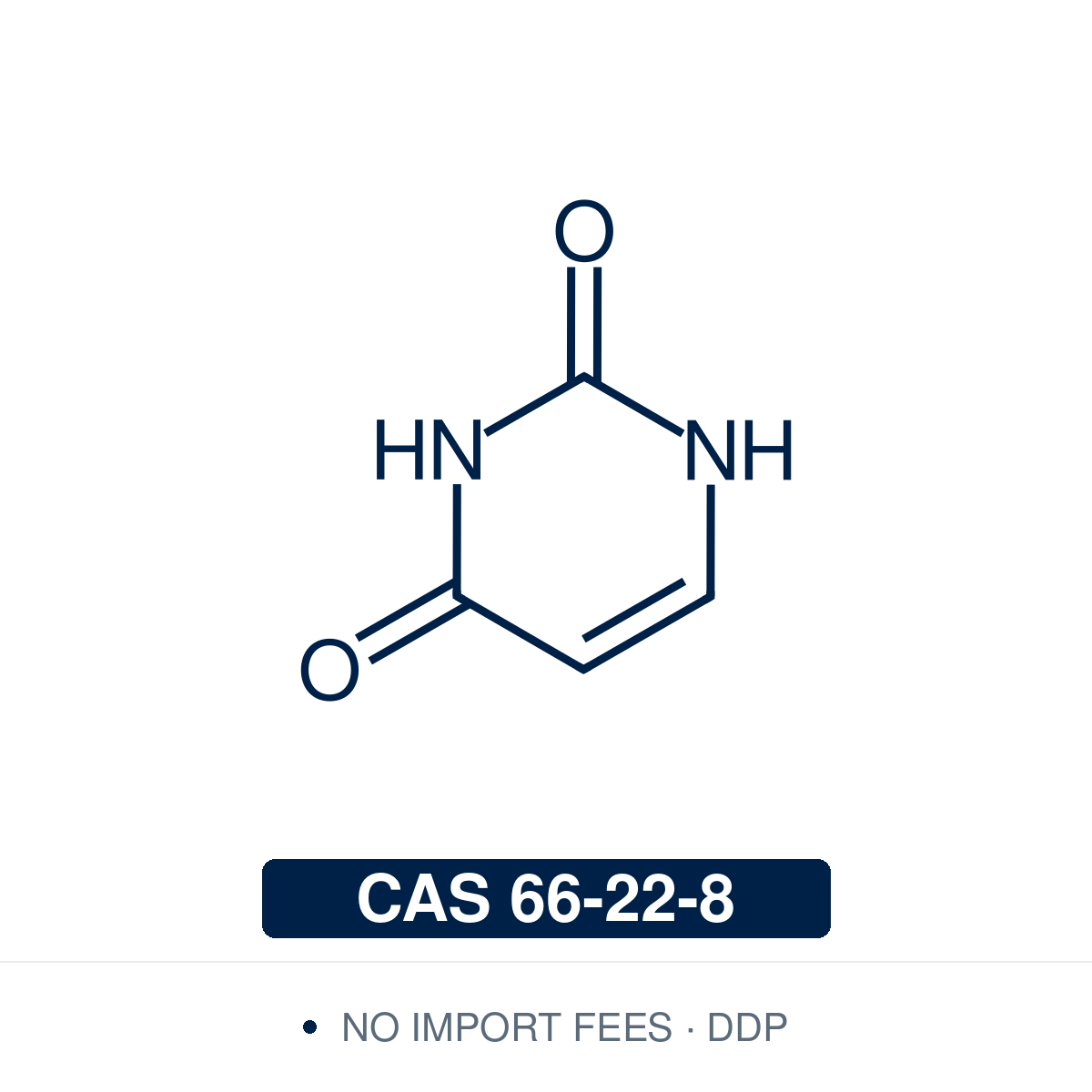
Uracil | CAS 66-22-8 | ≥99%
Couldn't load pickup availability
Technical Specifications
| CAS Number | 66-22-8 |
| EC / EINECS Number | 200-621-9 |
| MDL Number | MFCD00006016 |
| RTECS Number | YQ8650000 |
| SMILES | C1=CNC(=O)NC1=O |
| InChI | InChI=1S/C4H4N2O2/c7-3-1-2-5-4(8)6-3/h1-2H,(H2,5,6,7,8) |
| InChIKey | ISAKRJDGNUQOIC-UHFFFAOYSA-N |
| PubChem CID | 1174 |
| Molecular Formula | C₄H₄N₂O₂ |
| Molecular Weight | 112.09 g/mol |
| Melting Point | >300 °C (dec.) |
| Solubility | Sparingly soluble in water at RT; soluble in dilute alkali, dilute acid, and ammonia; practically insoluble in ethanol and diethyl ether |
| Purity | ≥99% |
| Physical Form | White crystalline powder |
| HS Code | 2933.59 |
| Shelf Life | Retest period: 36 months from date of manufacture |
| Storage Conditions | Store at room temperature in a tightly sealed container under inert atmosphere |
Product Description & Scientific Applications
Uracil (pyrimidine-2,4(1H,3H)-dione) is one of the four canonical nucleobases of RNA, where it pairs with adenine through two complementary hydrogen bonds (N3-H···N1 and C4=O···H-N6) to stabilise base-paired RNA duplex and stem-loop structures. UV absorption at neutral pH peaks at λmax = 258.3 nm with ε ≈ 8,200 M−1cm−1; fluorescence quantum yield is very low, consistent with the ultrafast non-radiative excited-state deactivation that characterises the pyrimidine nucleobases. Uracil differs from thymine by the absence of the C5-methyl group, and the two bases consequently share most N-glycosylation, alkylation, and hydrogen-bonding chemistry, while the C5-H position gives uracil an additional handle for C5 halogenation and electrophilic derivatisation. Uracil is widely used as a starting nucleobase for chemical glycosylation toward uridine, 2′-deoxyuridine, and modified uridine analogues, as a supplement in uracil-auxotrophic yeast strain selection, as a model nucleobase for studying Watson–Crick hydrogen bonding and supramolecular adenine recognition, as a reference analyte for plasma uracil and dihydrouracil quantification in pyrimidine-catabolism research, and as the standard void-volume / dead-time marker for reversed-phase HPLC method development.
Nucleoside Synthesis and Glycosylation Chemistry
Uracil is the parent nucleobase for chemical synthesis of uridine, 2′-deoxyuridine, and modified uridine analogues by Vorbrüggen / silyl-Hilbert-Johnson glycosylation. In a typical sequence, uracil is silylated with HMDS, BSA, or TMSCl/HMDS to generate a reactive silylated uracil nucleophile, which is then coupled with a peracylated sugar donor — commonly protected ribofuranose, 2′-deoxyribofuranose, arabinofuranose, or fluoro-sugar donors — under Lewis-acid promotion with TMSOTf or SnCl4 in acetonitrile or 1,2-dichloroethane. Direct glycosylation of unprotected uracil can produce N3-glycoside side products as well as the desired N1 nucleoside, so when tighter regiocontrol is required the N3 nitrogen is masked beforehand as N3-benzoyluracil or a related N3-acyl derivative. The same chemistry supports access to uridine, 2′-deoxyuridine, ara-uridine, 2′-fluoro-2′-deoxyuridine, 5-substituted uridine analogues, L-uridine, and conformationally restricted ribose analogues, which are then converted into uridine 5′-mono-, di-, and triphosphates and into modified oligoribonucleotide phosphoramidite building blocks. Uracil is also used as the nucleobase precursor in uracil-PNA monomer preparation, where N1-alkylation with ethyl chloroacetate or bromoacetate followed by hydrolysis and AEG-backbone amide coupling delivers the U-PNA monomer; uracil, like thymine, has no exocyclic amine and therefore does not require nucleobase amine protection during oligomerisation.
Yeast Auxotrophy and URA3-Based Selection
Uracil is a standard supplement for synthetic defined media used to culture Saccharomyces cerevisiae strains carrying ura3 auxotrophic markers and related pyrimidine-biosynthesis defects. The URA3 gene encodes orotidine-5′-phosphate decarboxylase (ODCase, EC 4.1.1.23), the final enzyme in pyrimidine de novo biosynthesis, and one of the most catalytically proficient enzymes known to nature: ODCase accelerates the spontaneous decarboxylation of orotidine-5′-monophosphate to UMP by approximately 1017, reducing an uncatalysed half-time of ~78 million years in solution to ~18 ms at the active site (Radzicka & Wolfenden 1995), and achieves this rate enhancement without metal ions, organic cofactors, or covalent catalysis — relying on a TIM-barrel active site with conserved Lys/Asp residues that position OMP and stabilise charge development during decarboxylation. ura3 strains cannot generate UMP from orotidine-5′-monophosphate and therefore depend on exogenous uracil or uridine for growth. URA3 is consequently one of the most widely used selectable markers in yeast molecular biology: ura3 host strains such as BY4741, BY4742, W303-1A, and CEN.PK derivatives are transformed with plasmid- or genomic-cassette-borne URA3, and transformants are selected on synthetic complete dropout media lacking uracil (SC−Ura) prepared from yeast nitrogen base, ammonium sulfate, and the appropriate amino-acid dropout supplement. The same system enables 5-fluoroorotic acid (5-FOA) counter-selection: 5-FOA is processed through the pyrimidine salvage pathway by orotate phosphoribosyltransferase (URA5/URA10) to 5-fluoro-OMP, which ODCase decarboxylates to 5-fluoro-UMP; downstream metabolism gives toxic fluoropyrimidine species that kill ODCase-expressing cells, while ura3 cells lacking ODCase activity survive on 5-FOA — providing the counter-selectable phenotype that underpins marker recycling and plasmid-shuffle workflows. Uracil supplementation of SC, dropout, rich, and YES media supports growth of uracil-auxotrophic strains in gene-deletion library screens, two-hybrid screens, plasmid-shuffle experiments, and metabolic-engineering platforms.
Watson–Crick Base Pairing and Supramolecular Chemistry
Uracil is a standard model nucleobase for studying the hydrogen-bonding interactions that underpin Watson–Crick base pairing in RNA. The uracil·adenine pair, with one N3-H···N1 hydrogen bond and one C4=O···H-N6 hydrogen bond, is the canonical two-bond pyrimidine·purine pair in RNA duplexes, A-RNA helices, and folded RNA structural motifs, and serves as a benchmark for investigating RNA duplex thermodynamics, base-pair kinetics, mismatch discrimination, and tautomer-driven base-pairing alternatives. Beyond duplex chemistry, uracil is incorporated into synthetic receptors, macrocycles, foldamers, and nucleobase-functionalised polymers designed to recognise adenine, adenosine, AMP, and ATP through complementary hydrogen bonding, and it is used as a hydrogen-bonding handle in template-directed synthesis, supramolecular self-assembly, sensor development, and biomimetic catalysis platforms.
Plasma Uracil/Dihydrouracil Quantification and Pyrimidine Catabolism Research
Uracil and its reduced metabolite dihydrouracil are the canonical analyte pair in HPLC and LC-MS/MS methodology for pyrimidine-catabolism research. Quantitative determination of plasma and urine uracil and dihydrouracil is used to characterise dihydropyrimidine dehydrogenase (DPD; EC 1.3.1.2) activity, the rate-limiting first step of endogenous pyrimidine catabolism. DPD catalyses NADPH-dependent reduction of the 5,6-vinylic bond of uracil (and thymine) to the corresponding 5,6-dihydropyrimidine; in bovine liver DPD, steady-state kinetic analysis gives reported KM values around 0.8 µM for uracil and 0.12 µM for NADPH. The mammalian enzyme is a homodimer (2 × 111 kDa) with an unusual cofactor architecture: each subunit carries an FAD site that handles NADPH and an FMN site that handles the pyrimidine substrate ~60 Å away, with four [4Fe-4S] clusters spanning the distance as an electron-transfer wire; the active state is the reductively activated FAD•4(Fe4S4)•FMNH2 cofactor set. Plasma uracil concentration and the uracil:dihydrouracil ratio are therefore widely used surrogate readouts of DPD activity and pyrimidine-catabolism status, provided pre-analytical handling is controlled. Established methodology uses C18 reversed-phase, porous graphitic carbon, or HILIC separation coupled to UV detection at 260 nm or to triple-quadrupole MS/MS, with isotopically labelled uracil-d3 or 13C/15N-uracil and dihydrouracil-d4 as internal standards. The same analytical workflow extends to the downstream dihydropyrimidinase / β-ureidopropionase steps that hydrolyse dihydropyrimidines to β-amino acids (β-alanine from uracil, β-aminoisobutyrate from thymine). Pre-analytical handling matters: validated workflows specify temperature-controlled plasma collection, rapid centrifugation, and frozen storage to limit ex-vivo conversion of uracil to dihydrouracil by residual blood-cell DPD activity. Uracil and dihydrouracil reference standards underpin assay calibration, quality-control samples, and method validation in this analytical workflow.
Analytical Reference Standard and HPLC Void-Volume Marker
Uracil is the standard void-volume / dead-time marker for reversed-phase HPLC method development on C18 stationary phases, and is included in the NIST Standard Reference Material 870 column-performance test mixture. Its weak retention and strong UV chromophore at 260 nm make it convenient for measuring column hold-up time and dead volume, calculating retention factors (k), and comparing column-to-column reproducibility, although recent column-chemistry studies note that uracil can show measurable retention on some modern phases and that cross-checks with thiourea or acetone may be appropriate for true hold-up determination. In metabolomics and nucleobase-analysis workflows, uracil is also used as a primary reference standard for quantification of free pyrimidine bases in plasma, urine, and cell extracts, and as a calibration and identification standard in studies measuring genomic-uracil incorporation arising from cytosine deamination and dUTP misincorporation, where accurate uracil quantification anchors lesion-frequency and DNA-integrity research.
Other Applications
- Reference compound and starting material for in-house synthesis of uridine, 2′-deoxyuridine, modified uridine analogues, and uracil-PNA monomers
- Substrate for N1-selective alkylation, C5 halogenation, and Vorbrüggen / silyl-Hilbert-Johnson glycosylation toward functionalised uracil and uridine derivatives
- Standard supplement in synthetic defined yeast media (SC, SC dropout, YNB-based) for growth of uracil-auxotrophic strains in molecular-biology and metabolic-engineering research
- Reference void-volume / dead-time marker for reversed-phase HPLC method development on C18 stationary phases
- Calibration and identification standard for HPLC, LC-MS, and LC-MS/MS analysis of pyrimidine bases, nucleosides, and DNA-damage products in research samples
Shipping Destinations
- EU & UK: Priority delivery, 2–5 business days.
- United States (DDP): 3–7 business days, duties and taxes prepaid.
- EFTA Countries (DDP): 3–7 business days, duties and taxes prepaid.
- Worldwide: 7–14 business days, selected locations.
The NorrChemica™ Standard
Identity Verified — Batch-verified via analytical QC; documentation available on request.
Direct EU Distribution — Dispatched from Finland for fast delivery to EU-based laboratories.
Professional Logistics — Tracked courier shipping via UPS / Matkahuolto / Posti.
Packaging & Storage
- Supplied in tightly sealed containers suitable for laboratory handling.
- Store under recommended conditions as specified on the product label and SDS.
- Retest period per lot-specific CoA / label under recommended conditions.
Technical Documentation
- Batch-specific Certificate of Analysis (CoA) included with every order.
- GHS-compliant Safety Data Sheet (SDS) provided with every shipment.
- Batch documentation available for institutional procurement.
| Payment: Wise (Bank Transfer) or Manual Invoice. |
| Disclaimer: Research Use Only (RUO) — not for human or veterinary use. Sold strictly for laboratory research and technical applications. By purchasing this item, the buyer confirms professional intent and compliance with applicable regulations. |
Safety Information
| Hazard Class | None — not subject to transport regulations |
| Transport Category | Not classified as dangerous goods for transport (ADR/IATA/IMDG) |
NorrChemica™ is a Finnish supplier of niche research reagents — focused on reliable EU distribution, transparent analytical documentation, and specialist technical support.
Share