NorrChemica™
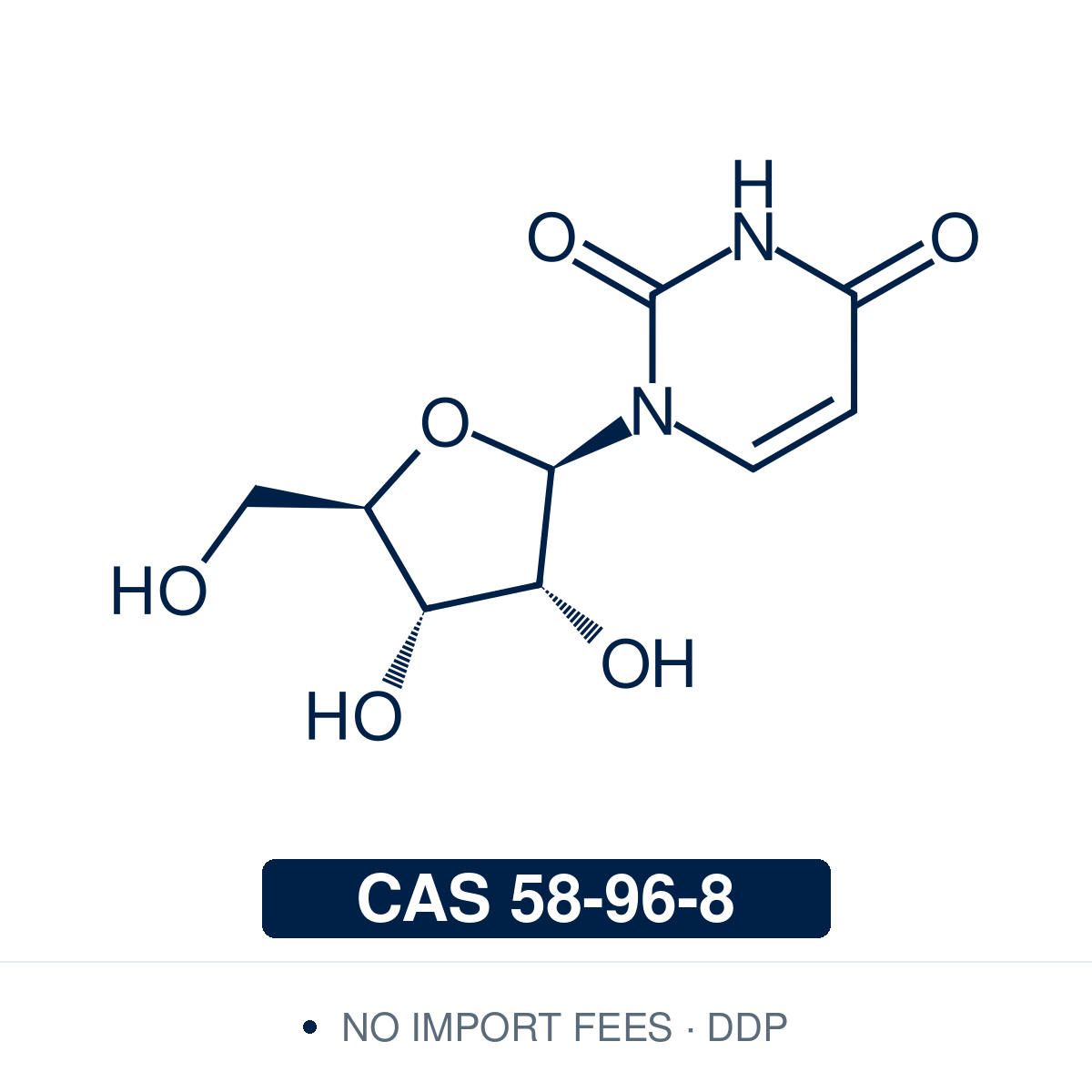
Uridine
Uridine | CAS 58-96-8 | ≥98.0%
Couldn't load pickup availability
Technical Specifications
| CAS Number | 58-96-8 |
| EC / EINECS Number | 200-407-5 |
| MDL Number | MFCD00006526 |
| RTECS Number | YR1450000 |
| SMILES | C1=CN(C(=O)NC1=O)[C@H]2[C@@H]([C@@H]([C@H](O2)CO)O)O |
| InChI | InChI=1S/C9H12N2O6/c12-3-4-6(14)7(15)8(17-4)11-2-1-5(13)10-9(11)16/h1-2,4,6-8,12,14-15H,3H2,(H,10,13,16)/t4-,6-,7-,8-/m1/s1 |
| InChIKey | DRTQHJPVMGBUCF-XVFCMESISA-N |
| PubChem CID | 6029 |
| Molecular Formula | C₉H₁₂N₂O₆ |
| Molecular Weight | 244.2 g/mol |
| Melting Point | 165–167 °C |
| Solubility | Freely soluble in water; soluble in DMSO; slightly soluble in ethanol |
| Purity | ≥98.0% |
| Physical Form | White crystalline powder |
| HS Code | 2934.99 |
| Country of Origin | Finland |
| Shelf Life | Retest period: 36 months from date of manufacture |
| Storage Conditions | Store at room temperature in a tightly sealed container |
Product Description & Scientific Applications
Uridine is a naturally occurring pyrimidine ribonucleoside, uracil linked to D-ribofuranose through a β-N1-glycosidic bond. This pyrimidine linkage is markedly more acid-hydrolysis-resistant than the purine N9-glycosidic bonds of adenosine and guanosine, making uridine compatible with the mildly acidic mobile phases of reversed-phase HPLC and LC-MS; an absorbance maximum near 262 nm and a molar extinction coefficient near 10,100 M⁻¹ cm⁻¹ in neutral aqueous solution underpin its spectrophotometric and chromatographic quantification. One of the four canonical RNA nucleosides, it is a fundamental RNA building block and a central entry into pyrimidine nucleotide metabolism: phosphorylation by uridine-cytidine kinase (UCK1/UCK2; EC 2.7.1.48) gives UMP, which nucleoside-monophosphate and nucleoside-diphosphate kinases raise to UDP and UTP. UTP and CTP supply RNA-polymerase substrates, regulate pyrimidine-pool feedback, and feed UDP-sugar formation for glycoconjugate biosynthesis. Cellular uptake is mediated by the SLC28 concentrative, Na⁺-dependent CNT and SLC29 equilibrative ENT transporter families, while uridine phosphorylase (UPP1/UPP2; EC 2.4.2.3) catalyses the reversible phosphorolysis of uridine to uracil and ribose-1-phosphate. It is supplied as a white to off-white crystalline powder, soluble in water.
Cell-culture supplementation and pyrimidine salvage in mitochondrial biology. Uridine is the standard supplement for mammalian cells with impaired de novo pyrimidine biosynthesis. The de novo pathway is split between cytosol and mitochondrion: the trifunctional cytosolic CAD complex (carbamoyl phosphate synthetase II, aspartate transcarbamoylase, dihydroorotase) makes dihydroorotate from glutamine, ATP, bicarbonate, and aspartate; the mitochondrial inner-membrane dihydroorotate dehydrogenase (DHODH; EC 1.3.5.2) oxidises dihydroorotate to orotate, passing electrons to ubiquinone; and cytosolic UMP synthase (UMPS) couples orotate to PRPP and decarboxylates it to UMP. Because DHODH's ubiquinol must be reoxidised by Complex III, de novo synthesis is hard-wired to a functional electron-transport chain: disrupting mitochondrial respiration — mtDNA depletion in ρ⁰ cells, Complex III inhibition by antimycin A or myxothiazol, OXPHOS dysfunction, or loss of cytochrome bc₁ assembly — collapses pyrimidine output even with CAD and UMPS intact. Exogenous uridine bypasses this bottleneck, entering through SLC28/SLC29 and feeding the UCK1/UCK2 salvage step to UMP independently of respiration. In the canonical ρ⁰ framework it is co-supplemented with pyruvate, which regenerates cytosolic NAD⁺ via lactate dehydrogenase to restore the electron-acceptor availability needed for aspartate biosynthesis. The combination is foundational in mitochondrial biology, OXPHOS research, electron-transport-chain mutant analysis, mtDNA-depleted cell-line maintenance, and metabolic-flux studies of respiration-deficient systems.
Nascent-RNA click-chemistry labelling with 5-ethynyluridine. 5-Ethynyluridine (EU), the C5-alkynyl analogue, is the most widely used non-radioactive metabolic label for nascent RNA. It enters through the same SLC28/SLC29 transporters, is phosphorylated by UCK1/UCK2 and onward kinases to EUTP, and is incorporated by RNA polymerases I, II, and III into newly transcribed RNA at an average of one EU per 35 uridine positions in total RNA. The terminal alkyne is then ligated to fluorescent or biotinylated azides by the copper-catalysed azide–alkyne cycloaddition (CuAAC), the canonical click reaction — a non-denaturing, fluorophore-flexible alternative to ³H-uridine autoradiography and BrU/anti-BrU immunolabelling for transcription-rate measurement, RNA-turnover kinetics, single-cell transcription imaging, and whole-mount visualisation of newly synthesised RNA in tissues and embryos.
4-Thiouridine photocrosslinking and metabolic sequencing. 4-Thiouridine (s⁴U), the C4-thiocarbonyl analogue, anchors a chemistry portfolio on the nucleophilicity and photoreactivity of the thiocarbonyl. UV-365 nm irradiation forms a covalent zero-distance crosslink between s⁴U-labelled RNA and contacting RNA-binding proteins, underpinning PAR-CLIP-class transcriptome-wide RBP target mapping. The same thiocarbonyl supports orthogonal recoding chemistries that read s⁴U incorporation as a sequencing-detectable T-to-C substitution, distinguishing nascent from steady-state transcripts at single-nucleotide resolution: iodoacetamide alkylation (SLAM-seq), osmium-tetroxide-mediated thiouridine-to-cytidine conversion (TUC-seq), and oxidative trifluoroethylamine-mediated recoding (TimeLapse-seq). With EU, s⁴U has redefined transcriptomic measurement of RNA synthesis, processing, and decay. Uridine itself remains the standard substrate and reference compound for uridine kinase activity, uridine phosphorylase kinetics, and SLC28/SLC29-mediated transport, and the entry-point reference for metabolic-labelling studies of pyrimidine-pool regulation, nucleotide turnover, and pathway flux.
Modified-nucleoside synthesis and RNA chemistry. Uridine is a key starting material and reference nucleoside for modified uridine derivatives. Selective protection and functionalisation of the ribose 2′-, 3′-, and 5′-hydroxyls and of the C5 and C4 positions of uracil gives scaffolds including 2′-O-methyluridine, 2′-fluoro-2′-deoxyuridine, 5-bromouridine, 5-iodouridine, 5-aminoallyluridine, 5-ethynyluridine, and 4-thiouridine. Pseudouridine and N1-methylpseudouridine — the C-5 glycoside isomer of uridine and its N1-methyl derivative — are best treated as a separate class, prepared by dedicated chemical or biocatalytic routes rather than direct functionalisation; N1-methylpseudouridine substitution alters RNA hydrogen-bonding, decoding, and innate RNA-sensing relative to unmodified uridine, a distinct benchmark modification in synthetic mRNA research. These materials support synthetic RNA chemistry, antisense-oligonucleotide and siRNA development, modified-mRNA studies, RNA structure analysis, RNA–protein interaction work, and analytical comparison of natural and modified pyrimidine ribosides by HPLC, LC-MS, and NMR.
UDP-sugar biosynthesis and glycoconjugate research. Uridine nucleotides drive glycosylation through conversion into UDP-activated sugar donors. UDP-glucose, UDP-galactose, UDP-glucuronic acid, UDP-N-acetylglucosamine (UDP-GlcNAc), UDP-N-acetylgalactosamine (UDP-GalNAc), UDP-xylose, and UDP-rhamnose serve the glycosyltransferases that build N- and O-linked glycoproteins, glycolipids, proteoglycans, glycosaminoglycans, plant cell-wall polysaccharides, and bacterial capsular polysaccharides. Uridine availability therefore bears on glycoengineering, carbohydrate metabolism, and cellular biosynthesis wherever UDP-sugar pool size, glycosyltransferase activity, hexosamine-pathway flux to UDP-GlcNAc, and glycan composition matter. The same chemistry underpins chemoenzymatic UDP-sugar synthesis, in which uridine or UMP is converted through pyrophosphorylase or kinase cascades to isotopically labelled or non-natural UDP-sugars for in vitro glycosylation.
Further applications.
- Reference compound in HPLC, LC-MS, and capillary electrophoresis of nucleosides and metabolites.
- Standard pyrimidine ribonucleoside in NMR, X-ray, and computational structural studies of nucleic-acid–protein and nucleic-acid–small-molecule interactions.
- Reference standard for quantitative analysis of pyrimidine pools in metabolomics and isotope-tracing workflows.
Shipping Destinations
- EU & UK: Priority delivery, 2–5 business days.
- United States (DDP): 3–7 business days, duties and taxes prepaid.
- EFTA Countries (DDP): 3–7 business days, duties and taxes prepaid.
- Worldwide: 7–14 business days, selected locations.
Safety Information
| Hazard Class | None — not subject to transport regulations |
| Transport Category | Not classified as dangerous goods for transport (ADR/IATA/IMDG) |
Documentation
| Safety Data Sheet | Download PDF |
Share