NorrChemica™
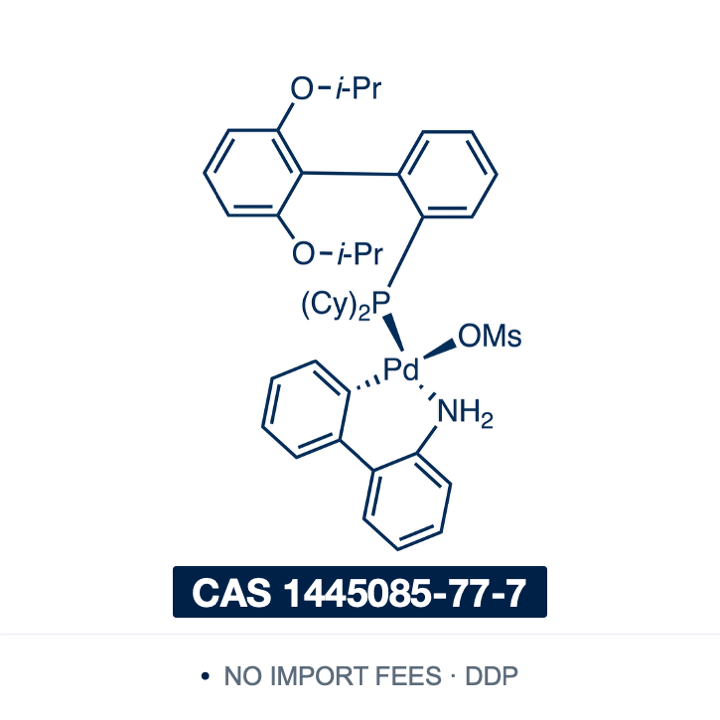
RuPhos Pd G3
RuPhos Pd G3 | CAS 1445085-77-7 | ≥98%
| Pack size | Excl. VAT | Incl. VAT | Add to cart |
|---|---|---|---|
| 250 mg | €29,20 | ||
| 500 mg | €47,20 | ||
| 1.0 g | €84,20 | ||
| 2.0 g | €159,20 | ||
| 5.0 g | €329,20 | ||
| 10 g | €598,20 | ||
| 25 g | €1.489,00 |
Taxes and fees, e.g. VAT, included in the price. Shipping calculated at checkout.Free shipping on EU, UK and EFTA orders above €250, and above €400 to the rest of the world.
Technical Specifications
| CAS Number | 1445085-77-7 |
| EC / EINECS Number | 809-028-5 |
| MDL Number | MFCD22572684 |
| SMILES |
CC(C)OC1=C(C(=CC=C1)OC(C)C)C2=CC=CC=C2P(C3CCCCC3)C4CCCCC4.CS(=O)(=O)O.C1=CC=C([C-]=C1)C2=CC=CC=C2N.[Pd]
|
| InChI | InChI=1S/C30H43O2P.C12H10N.CH4O3S.Pd/c1-22(2)31-27-19-13-20-28(32-23(3)4)30(27)26-18-11-12-21-29(26)33(24-14-7-5-8-15-24)25-16-9-6-10-17-25;13-12-9-5-4-8-11(12)10-6-2-1-3-7-10;1-5(2,3)4;/h11-13,18-25H,5-10,14-17H2,1-4H3;1-6,8-9H,13H2;1H3,(H,2,3,4);/q;-1;; |
| InChIKey | GYTUQNMMIUJBSP-UHFFFAOYSA-N |
| PubChem CID | 117064724 |
| Molecular Formula | C₄₃H₅₆NO₅PPdS |
| Molecular Weight | 836.37 g/mol |
| Melting Point | 188–196 °C (dec.) |
| Solubility | Soluble in polar organic solvents including methanol and dimethyl sulfoxide |
| Purity | ≥98% |
| Physical Form | Light yellow powder |
| HS Code | 2843.90 |
| Shelf Life | Retest period: 36 months from date of manufacture |
| Storage Conditions | Relatively stable in air for weighing and handling. Store refrigerated (2–8 °C) in a tightly closed container, protected from light and under inert gas (N₂ or Ar). |
| SDS / CoA | Download PDF |
Product Description & Scientific Applications
RuPhos Pd G3 is the ready-to-use palladium form of RuPhos: the ligand, a deprotonated 2-aminobiphenyl and a methanesulfonate on one palladium centre, giving a defined 1:1 ligand-to-palladium ratio in a single weighable solid. It releases monoligated LnPd(0) on contact with base, so there is no separate reduction step and no phosphine-to-palladium ratio to optimise. This is the palladium complex and not the free ligand. RuPhos alone is a separate product at 466.6 g/mol against 836.37 here, so a loading calculated from the ligand mass is out by nearly a factor of two.
Applications and Reactions
- Buchwald–Hartwig amination. The principal use. RuPhos is the ligand of choice for secondary amines, coupling functionalised aryl and heteroaryl chlorides, bromides and triflates at low loadings and short reaction times. Substituted morpholines and piperidines couple in high yields and pyrrolidines in moderate yields. Temperature matters for hindered partners: a Boc-protected piperazine rose from 39 to 65% yield on running the reaction at room temperature. On 3-bromo-2-aminopyridine, substituents at the 5 and 6 positions are tolerated while the 4 position is deleterious.
- Negishi coupling. Organozinc reagents with aryl halides, giving hindered biaryls at low catalyst loading with broad functional-group tolerance.
- Suzuki–Miyaura coupling. Boron nucleophiles with aryl and heteroaryl chlorides, including alkyl trifluoroborates. The RuPhos ligand, in a separate palladium system, gave tri- and tetra-substituted biaryls at low catalyst loading in tetrahydrofuran at 70 °C.
Activation. Base deprotonates the palladium-bound amine to give a palladium amido complex, which reductively eliminates carbazole, a methanesulfonate salt and monoligated zerovalent palladium. Until that point the aminobiphenyl is monoanionic and bound through both carbon and nitrogen.
The carbazole byproduct. Its fate is documented in both directions on 2-aminobiphenyl palladacycles. On a related palladacycle, base and the oxidative addition intermediate convert it into an aryl carbazolyl complex that acts as the catalyst resting state and limits palladium decomposition. An inhibiting effect is separately documented in some couplings on this family, and the released carbazole can itself be arylated, consuming starting material.
Documented limits. With a branched primary amine such as cyclopentylamine it gave 47% against 78% for a BrettPhos precatalyst on the same substrate, and alkylamines need heating. The isolated solid described in the literature holds close to one tetrahydrofuran per formula unit, which is a real weighing consideration, and partial decomposition follows storage outside the stated conditions with reduced catalytic performance.
Further reading: For phosphine-ligand selection, palladium sources and precatalysts, and Suzuki–Miyaura and Buchwald–Hartwig reagent choice, see NorrChemica's Lab Journal guide: Choosing a Phosphine Ligand for Cross-Coupling: A Practical Guide.
Shipping Destinations
- EU & UK: Priority delivery, 2–5 business days.
- United States (DDP): 3–7 business days, duties and taxes prepaid.
- EFTA Countries (DDP): 3–7 business days, duties and taxes prepaid.
- Worldwide: 7–14 business days, selected locations.
Safety Information
| GHS Pictograms |

|
| Signal Word | Warning |
| Hazard Class | Not regulated for transport |
| Transport Category | Not classified as dangerous goods for transport (ADR/IATA/IMDG) |
| H-Statements | H315 - H319 - H335 - H412 |
| P-Statements | P273 - P302+P352 - P305+P351+P338 |
Documentation
| Safety Data Sheet | Download PDF |