NorrChemica™
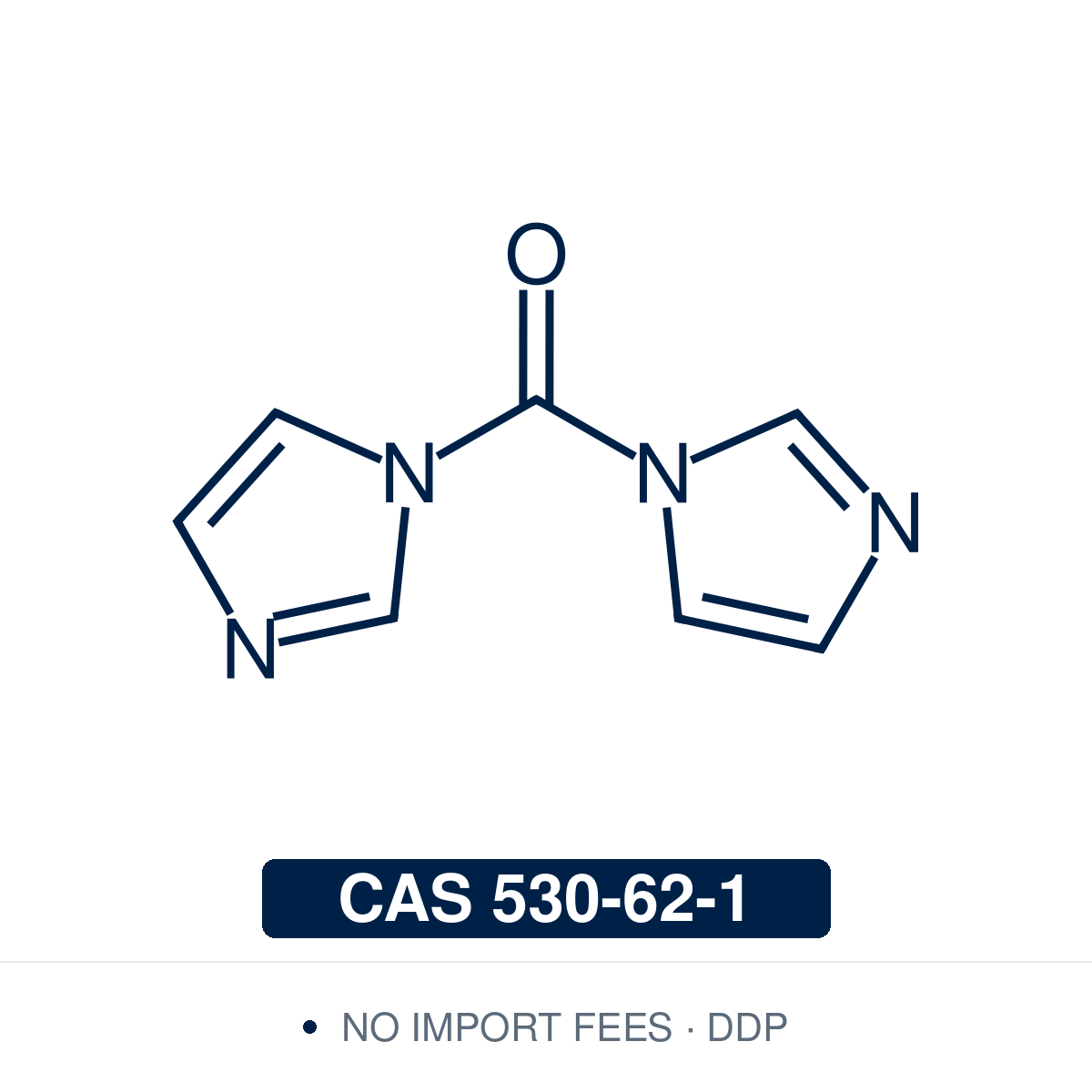
CDI (1,1'-Carbonyldiimidazole)
CDI (1,1'-Carbonyldiimidazole) | CAS 530-62-1 | ≥98%
Couldn't load pickup availability
Technical Specifications
| CAS Number | 530-62-1 |
| EC / EINECS Number | 208-488-9 |
| MDL Number | MFCD00005286 |
| SMILES | C1=CN(C=N1)C(=O)N2C=CN=C2 |
| InChI | InChI=1S/C7H6N4O/c12-7(10-3-1-8-5-10)11-4-2-9-6-11/h1-6H |
| InChIKey | PFKFTWBEEFSNDU-UHFFFAOYSA-N |
| PubChem CID | 68263 |
| Molecular Formula | C₇H₆N₄O |
| Molecular Weight | 162.15 g/mol |
| Melting Point | 115–121 °C |
| Solubility | Soluble in THF, DMF, acetonitrile, dichloromethane; reacts with water (hydrolysis releasing CO₂ and imidazole) |
| Log Pow | -0.41 |
| Purity | ≥98% |
| Physical Form | White to pale yellow crystalline powder |
| HS Code | 2933.29 |
| Shelf Life | Retest period: 36 months from date of manufacture |
| Storage Conditions | Store in a cool, dry place in a tightly sealed container, protected from moisture |
Product Description & Scientific Applications
Carboxylic Acid Activation and Amide Bond Formation
CDI converts carboxylic acids into acyl imidazolides. The acyl imidazolide reacts with primary or secondary amines to give the amide under mild conditions. The only by-products are CO₂ and imidazole, both removed by aqueous wash. Yields are typically 80–95%, and racemisation at α-stereocentres is minimal. DBU accelerates the aminolysis step, particularly with electron-deficient anilines. Imidazole·HCl gives the same rate enhancement through acid catalysis. There are also known mechanochemical variants of this reaction which proceed by ball-milling without the need of a reaction solvent.
Peptide Synthesis
CDI activates N-protected amino acids as acyl imidazolides, which couple with the free amine of the next residue. The reagent scales well: soluble by-products and a clean workup give it an edge over carbodiimides on process scale. The αvβ3 integrin antagonist programme used CDI peptide coupling at hundreds of kilograms in the pilot plant.
Phosgene Substitute — Carbamate, Urea, and Carbonate Synthesis
CDI replaces phosgene (COCl2) in carbamate, urea, and carbonate synthesis. The carbonyl transfers to two nucleophiles in sequence. An alcohol or amine displaces the first imidazole to give an imidazolyl carbonate or carbamoyl-imidazole. A second nucleophile displaces the remaining imidazole to give the product. One pot, no phosgene. Mechanochemical variants of these transformations are also known, proceeding by ball-milling without solvent.
Esterification and Cyclisation
CDI activates carboxylic acids for esterification with alcohols. A catalytic strong base (sodium alkoxide or NaH) or moderate heating drives alcoholysis of the acyl imidazolide. The method works on sterically hindered substrates and delivered the key ester in the total synthesis of halipeptin D. Acyl imidazolides also cyclise intramolecularly to macrolactones. In heterocycle chemistry, CDI carries out tandem coupling and cyclisation as a single reagent, including a continuous-flow route to [1,2,4]triazolo[4,3-a]pyridines.
Pharmaceutical Intermediates and Bioconjugation
CDI appears in the process chemistry of several marketed drugs. Bayer's finerenone synthesis uses CDI with DMAP and aqueous ammonia for the final amide. The GSK/ViiV cabotegravir route couples the acid intermediate with 2,4-difluorobenzylamine through CDI. The Pfizer abrocitinib route uses CDI in an azide-free Lossen rearrangement that takes a hydroxamic acid to the amine. CDI also prepares nucleoside phosphorimidazolides, β-keto sulfones, β-enamino acids, and tetronic acids. In bioconjugation, CDI activates hydroxyl groups on agarose, cellulose, and dextran to form imidazole carbamates. These react with primary amines at pH 9–11 to give stable N-alkylcarbamate linkages. This is the chemistry behind commercial CDI-activated agarose resins, used for immobilising enzymes, antibodies, and affinity ligands on chromatography supports, biosensor surfaces, and superparamagnetic nanoparticle vaccine carriers.
Further Reading
For guidance on selecting between carbodiimides, aminium/uronium salts, phosphonium salts, and other reagent classes for amide and peptide bond formation, see NorrChemica's Lab Journal guide: Choosing a Coupling Reagent for Amide and Peptide Bond Formation.
Shipping Destinations
- EU & UK only: 3–7 business days. Classified as dangerous goods — shipping restrictions apply outside the EU/UK
Safety Information
| GHS Pictograms |


|
| Signal Word | Danger |
| Hazard Class | UN 3259 — Amines, solid, corrosive, n.o.s. (1,1'-carbonyldiimidazole) (Class 8, PG II) |
| Transport Category | Class 8, PG II (ADR/IATA/IMDG) |
| H-Statements | H302 - H314 - H360 |
| P-Statements | P201 - P202 - P260 - P264 - P270 - P280 - P301+P330+P331 - P303+P361+P353 - P305+P351+P338 - P310 - P363 - P405 - P501 |
Documentation
| Safety Data Sheet | Download PDF |