NorrChemica™
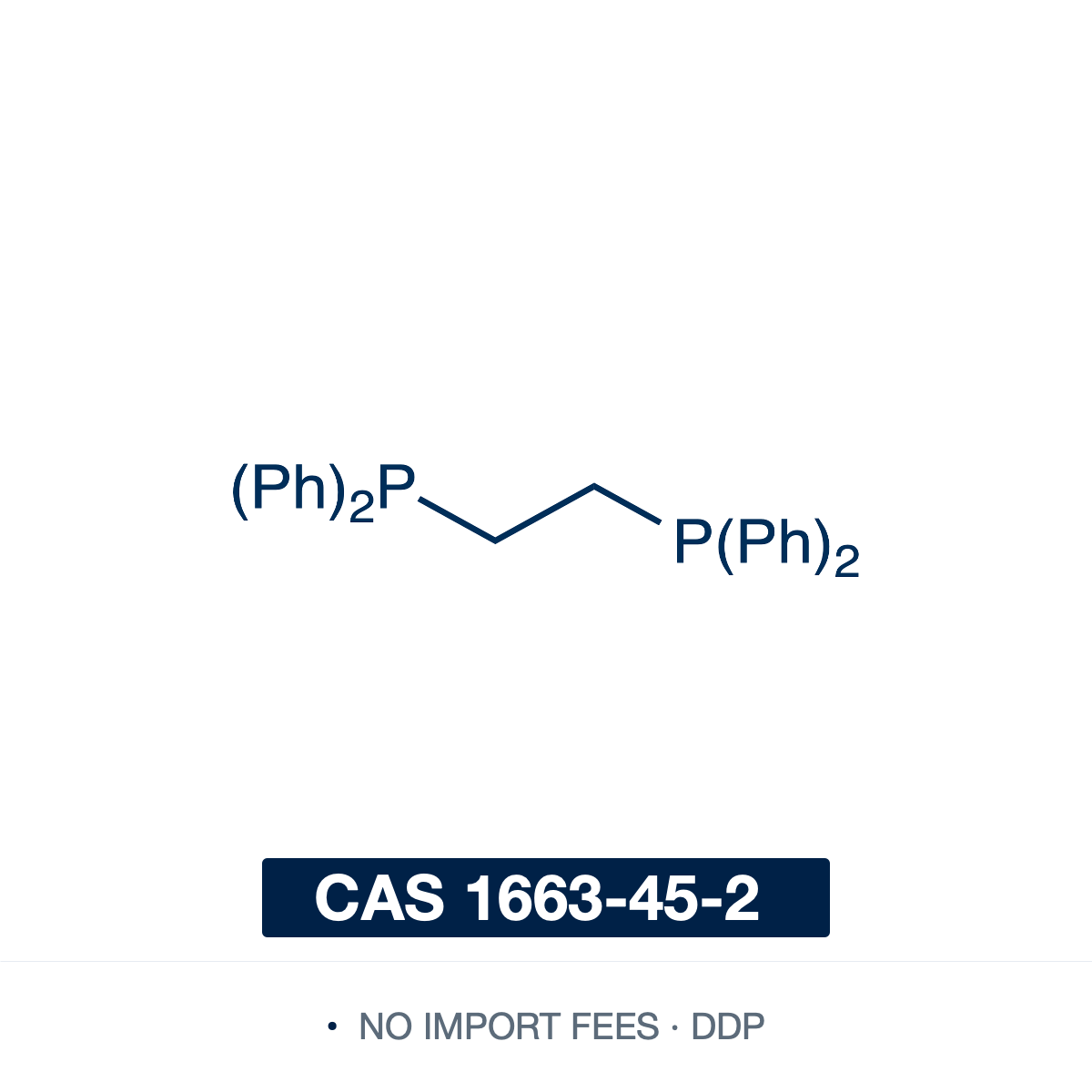
1,2-Bis(diphenylphosphino)ethane (dppe)
1,2-Bis(diphenylphosphino)ethane (dppe) | CAS 1663-45-2 | ≥97%
Couldn't load pickup availability
Technical Specifications
| CAS Number | 1663-45-2 |
| EC / EINECS Number | 216-769-2 |
| MDL Number | MFCD00003047 |
| SMILES | C1=CC=C(C=C1)P(CCP(C2=CC=CC=C2)C3=CC=CC=C3)C4=CC=CC=C4 |
| InChI | InChI=1S/C26H24P2/c1-5-13-23(14-6-1)27(24-15-7-2-8-16-24)21-22-28(25-17-9-3-10-18-25)26-19-11-4-12-20-26/h1-20H,21-22H2 |
| InChIKey | QFMZQPDHXULLKC-UHFFFAOYSA-N |
| PubChem CID | 74267 |
| Molecular Formula | C₂₆H₂₄P₂ |
| Molecular Weight | 398.42 g/mol |
| Melting Point | 138-142 °C |
| Solubility | Insoluble in water, soluble in common organic solvents |
| Purity | ≥97% |
| Physical Form | White to off-white crystalline powder |
| HS Code | 2931.49 |
| Shelf Life | Retest period: 36 months from date of manufacture |
| Storage Conditions | Store under inert gas (N2 or Ar) in a tightly sealed container |
Product Description & Scientific Applications
dppe (1,2-bis(diphenylphosphino)ethane, Ph2PCH2CH2PPh2, also known as DIPHOS) is a classical bidentate diphosphine ligand widely used in transition-metal coordination chemistry and homogeneous catalysis. The two-carbon ethano backbone places the phosphorus donors at a narrow natural bite angle (~85°), forming a stable five-membered P–M–P chelate ring at most transition-metal centres. The ligand binds in κ2-P,P fashion to a broad range of d-block metals, including Ni, Pd, Pt, Rh, Ir, Ru, Mo, W, Fe, Co, Cu, Ag and Au, where the chelate effect stabilises both the metal complex and the associated catalytic intermediates. As with all tertiary aryl phosphines, dppe slowly oxidises to the corresponding mono- and bis-phosphine oxides on prolonged air exposure; for catalytic use it is best handled and stored under an inert atmosphere.
Cross-coupling and C–C bond formation. NiCl2(dppe) and PdCl2(dppe) are routinely employed as well-defined precatalysts in Kumada, Negishi, Suzuki–Miyaura and Heck cross-coupling reactions. The narrow bite angle of the chelate enforces a cis arrangement of substrates at the metal centre, providing well-defined cis-[M(dppe)] intermediates that participate in the oxidative-addition/transmetalation/reductive-elimination cycle, and underpins the use of dppe-supported systems in the construction of biaryl and aryl–alkyl bonds, particularly with Grignard and organozinc nucleophiles. The same bite-angle constraint that stabilises the square-planar M(II) ground state also raises the kinetic barrier to C–N reductive elimination, so dppe is markedly less effective than wider-bite-angle chelates such as DPPF and Xantphos for Buchwald–Hartwig amination.
Coordination chemistry and small-molecule activation. dppe is a benchmark scaffold for the preparation of well-defined cis- and trans-[M(dppe)X2] and [M(dppe)2]n+ complexes across the d-block, including Ni, Pd, Pt, Rh, Ir, Ru, Mo, W, Fe, Co, Cu, Ag and Au. The [M(N2)2(dppe)2] complexes of Mo(0) and W(0) are textbook entries in the Chatt cycle of synthetic nitrogen fixation, in which coordinated N2 is protonated and chemically reduced to ammonia. Related dppe complexes serve as model systems for the activation of CO and H2, and for studies of dihydrogen, hydride, and hydrazide(2−) intermediates.
Hydrogenation, isomerisation and mechanism studies. dppe supports Rh(I)- and Ir(I)-catalysed hydrogenation of alkenes and dehydroamino acids, alkene isomerisation, and decarbonylation chemistry, and is one of the canonical chelating phosphines in Osborn–Schrock-type cationic [Rh(diphosphine)(diene)]+ hydrogenation catalysts. Across this chemistry, [M(dppe)]-type complexes are widely used as substrates for mechanistic studies of oxidative addition, reductive elimination, cis/trans isomerism, and the migratory insertion and β-hydride elimination steps of transition-metal-catalysed C–C and C–H bond formation.
Further reading: For phosphine-ligand selection, palladium sources and precatalysts, and Suzuki–Miyaura and Buchwald–Hartwig reagent choice, see NorrChemica's Lab Journal guide: Choosing a Phosphine Ligand for Cross-Coupling: A Practical Guide.
Shipping Destinations
- EU & UK: Priority delivery, 2–5 business days.
- United States (DDP): 3–7 business days, duties and taxes prepaid.
- EFTA Countries (DDP): 3–7 business days, duties and taxes prepaid.
- Worldwide: 7–14 business days, selected locations.
Safety Information
| GHS Pictograms |

|
| Signal Word | Warning |
| Hazard Class | None — not subject to transport regulations |
| Transport Category | Not classified as dangerous goods for transport (ADR/IATA/IMDG) |
| H-Statements | H315 - H319 - H335 |
| P-Statements | P261 - P264 - P271 - P280 - P302+P352 - P305+P351+P338 - P332+P313 - P337+P313 - P362+P364 - P501 |
Documentation
| Safety Data Sheet | Download PDF |