NorrChemica™
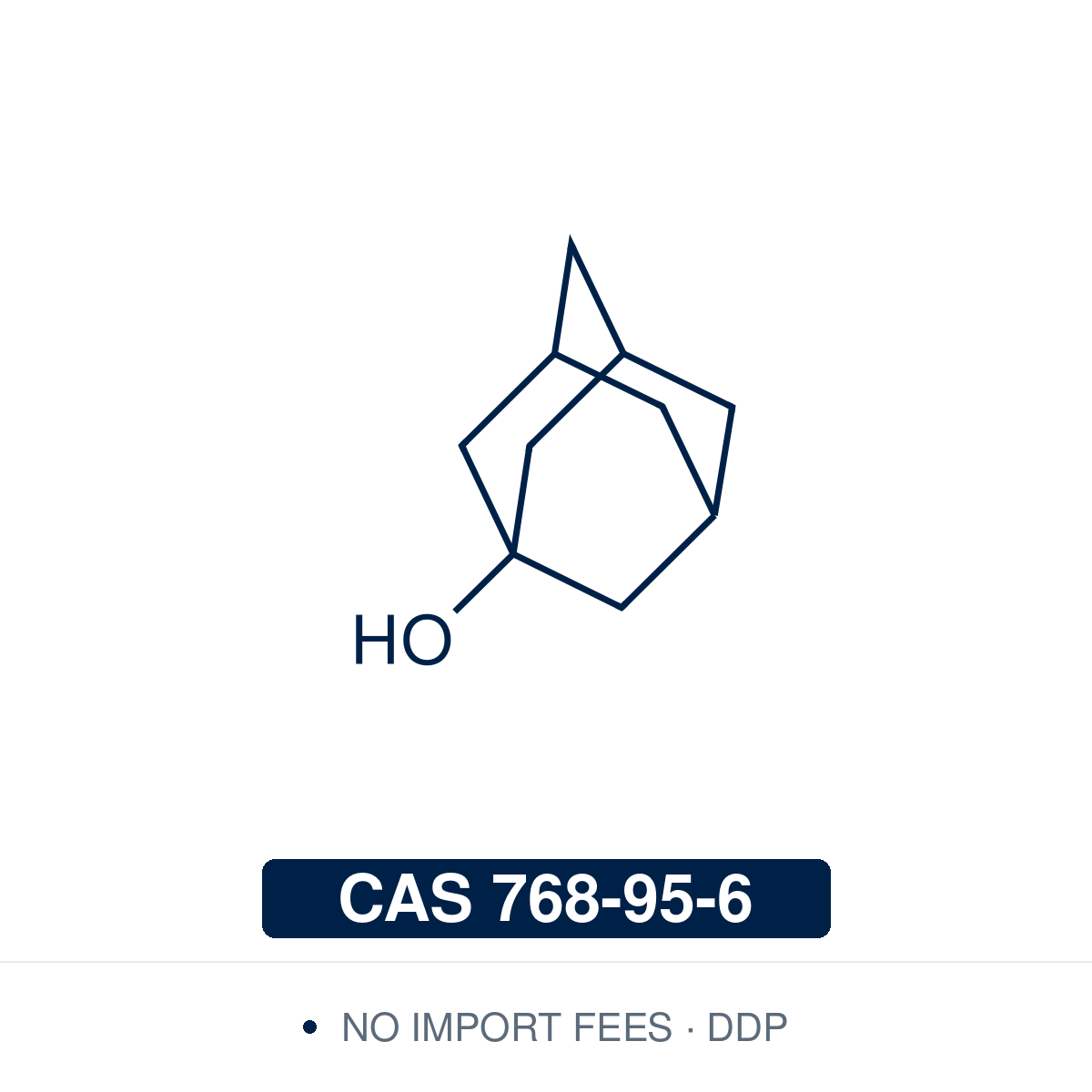
1-Adamantanol
1-Adamantanol | CAS 768-95-6 | ≥99%
Pack sizes & prices
| Pack size | Excl. VAT | Incl. VAT | Add to cart |
|---|---|---|---|
| 5.0 g | €43,90 | ||
| 10 g | €54,20 | ||
| 25 g | €84,20 | ||
| 50 g | €129,20 | ||
| 100 g | €198,20 | ||
| 250 g | €339,20 |
Taxes and fees, e.g. VAT, included in the price. Shipping calculated at checkout.Free shipping on EU, UK and EFTA orders above €250, and above €400 to the rest of the world.
Technical Specifications
| CAS Number | 768-95-6 |
| EC / EINECS Number | 212-202-8 |
| MDL Number | MFCD00074729 |
| RTECS Number | AU4980000 |
| SMILES | C1C2CC3CC1CC(C2)(C3)O |
| InChI | InChI=1S/C10H16O/c11-10-4-7-1-8(5-10)3-9(2-7)6-10/h7-9,11H,1-6H2 |
| InChIKey | VLLNJDMHDJRNFK-UHFFFAOYSA-N |
| PubChem CID | 64152 |
| Molecular Formula | C₁₀H₁₆O |
| Molecular Weight | 152.23 g/mol |
| Melting Point | 247 °C (subl.) (lit.) |
| Solubility | Soluble in methanol, ethanol and diethyl ether. Sparingly soluble in water. |
| Log Pow | 2.14 |
| Purity | ≥99% |
| Physical Form | White crystalline powder |
| HS Code | 2906.19 |
| Shelf Life | Retest period: 36 months from date of manufacture |
| Storage Conditions | Store at room temperature in a tightly sealed container, protected from moisture. |
Shipping Destinations
- EU & UK: Priority delivery, 2–5 business days.
- United States (DDP): 3–7 business days, duties and taxes prepaid.
- EFTA Countries (DDP): 3–7 business days, duties and taxes prepaid.
- Worldwide: 7–14 business days, selected locations.
Product Description & Scientific Applications
1-Adamantanol (adamantan-1-ol, 1-hydroxyadamantane) is used in the manufacture of synthetic adamantane derivatives and adapalene. Combined with a mineral acid, it alkylates phenols under milder conditions than the corresponding haloadamantanes, and often with higher selectivity.
Adamantylation of phenols. Substituted phenols react with adamantanols over a recyclable sulfonic acid ion-exchange resin in acetic acid to give 2-adamantylphenol derivatives. Water is the only by-product. From 4-bromophenol and 1-adamantanol, the method gives 2-(1-adamantyl)-4-bromophenol, the key intermediate of adapalene.
ion-exchange resin
General reaction: 4-bromophenol + 1-adamantanol → 2-(1-adamantyl)-4-bromophenol + water.
Ritter reaction. 1-Adamantanol reacts with arylsulfonyl- and arylthiopropionitriles in the Ritter reaction, which gives the corresponding N-(1-adamantyl)amides.
General reaction: R–C≡N + 1-adamantanol → N-(1-adamantyl)amide; R = arylsulfonyl- or arylthio-substituted propionitrile residue.
Conversion to 1-fluoroadamantane. Pyridinium poly(hydrogen fluoride) converts 1-adamantanol into 1-fluoroadamantane. The same reagent prepares a wide variety of secondary and tertiary alkyl fluorides from the corresponding alcohols.
poly(hydrogen fluoride)
General reaction: 1-adamantanol → 1-fluoroadamantane.
Carboxyl protection of amino acids. With dimethyl sulfite, 1-adamantanol converts the 4-toluenesulfonate salts of N-unprotected L-α-amino acids directly into their 1-adamantyl esters. These esters are a class of carboxy-protected amino acid derivatives. The 1-adamantyl ester has also been used to block the β-carboxyl group of aspartic acid in peptide synthesis.
General reaction: L-α-amino acid (as the 4-toluenesulfonate salt) + 1-adamantanol → amino acid 1-adamantyl ester (4-toluenesulfonate salt).
Hydroxylation to 1,3-adamantanediol. The soil actinomycete Streptomyces sp. SA8 hydroxylates 1-adamantanol to 1,3-adamantanediol, and 1,4-adamantanediol forms as a by-product.
General reaction: 1-adamantanol → 1,3-adamantanediol (1,4-adamantanediol forms as a by-product).
Host–guest chemistry. In the crystal, two 1-adamantanol molecules sit in the cavity of a hydrogen-bonded β-cyclodextrin pair, giving a 2:2 inclusion complex.
Safety Information
| Hazard Class | Not regulated for transport |
| Transport Category | Not classified as dangerous goods for transport (ADR/IATA/IMDG) |
Documentation
| Safety Data Sheet | Download PDF |
Share