NorrChemica™
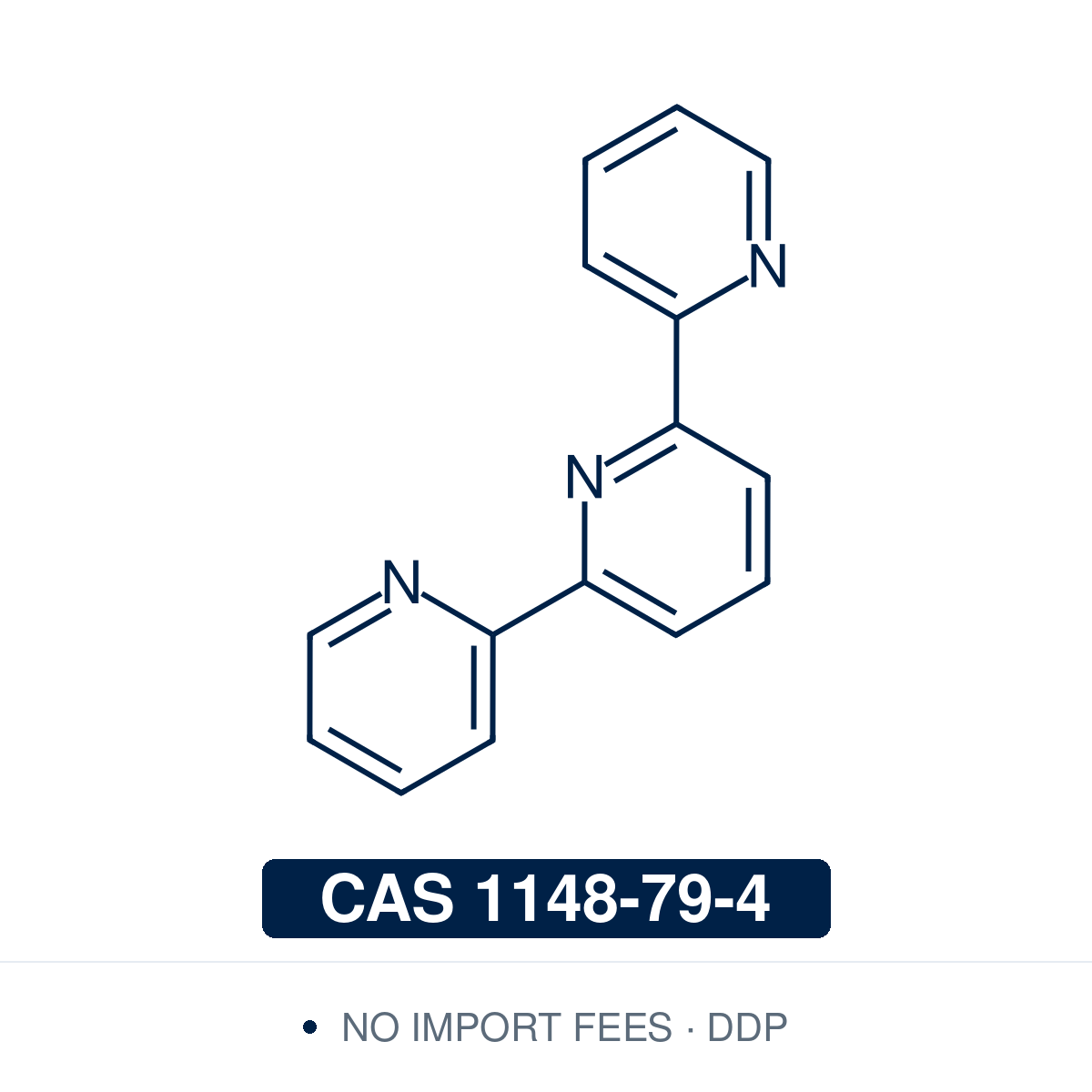
2,2',6',2''-Terpyridine
2,2',6',2''-Terpyridine | CAS 1148-79-4 | ≥97%
| Pack size | Excl. VAT | Incl. VAT | Add to cart |
|---|---|---|---|
| 250 mg | €59,20 | ||
| 500 mg | €98,20 | ||
| 1.0 g | €179,20 | ||
| 2.0 g | €349,20 | ||
| 5.0 g | €879,20 |
Taxes and fees, e.g. VAT, included in the price. Shipping calculated at checkout.Free shipping on EU, UK and EFTA orders above €250, and above €400 to the rest of the world.
Technical Specifications
| CAS Number | 1148-79-4 |
| EC / EINECS Number | 214-559-5 |
| MDL Number | MFCD00006213 |
| SMILES | C1=CC=NC(=C1)C2=NC(=CC=C2)C3=CC=CC=N3 |
| InChI | InChI=1S/C15H11N3/c1-3-10-16-12(6-1)14-8-5-9-15(18-14)13-7-2-4-11-17-13/h1-11H |
| InChIKey | DRGAZIDRYFYHIJ-UHFFFAOYSA-N |
| PubChem CID | 70848 |
| Molecular Formula | C₁₅H₁₁N₃ |
| Molecular Weight | 233.27 g/mol |
| Melting Point | 89–91 °C |
| Solubility | Slightly soluble in water, soluble in most organic solvents |
| Log Pow | 2.4 |
| Purity | ≥97% |
| Physical Form | Pale yellow to brown crystalline powder |
| HS Code | 2933.39 |
| Shelf Life | Retest period: 36 months from date of manufacture |
| Storage Conditions | Store in a cool, dry place in a tightly sealed container |
Product Description & Scientific Applications
2,2':6',2''-Terpyridine, also sold as tripyridine, and its derivatives are the most used planar, tridentate ligand class in coordination chemistry.
Its three chelating pyridine rings raise the ligand-to-metal binding constant relative to bidentate analogues and give octahedral 2:1 complexes with no enantiomers, unlike those formed with bipyridine or phenanthroline. It is an unusually strong electron acceptor among N-donors, and is oxidatively and thermally robust. The ligand is redox non-innocent: in nickel alkyl–alkyl coupling the reduction of the alkyl halide is a ligand-based process.
Applications and Reactions
- Nickel-catalysed Negishi coupling: with NiCl₂·glyme in DMA, secondary propargylic bromides couple to secondary alkylzinc reagents at room temperature in 89% yield. Esters, ethers, carbamates and olefins are tolerated, the last without E/Z isomerisation.
- Cobalt hydroboration: a cobalt-alkyl NNN pincer complex of terpyridine hydroborates styrene with pinacolborane at 1 mol%, favouring Markovnikov regiochemistry.
- Iron hydrosilylation: iron(II) terpyridine complexes, after in situ reduction, catalyse hydrosilylation of terminal alkenes with primary and secondary silanes, giving linear products without competitive dehydrosilylation.
- Dye-sensitised solar cells: ruthenium(II) tris-thiocyanate complexes bearing a chelating terpyridine ligand act as panchromatic sensitisers, one reaching 10.3% solar conversion efficiency.
- Water oxidation: mononuclear [Mn(terpy)₂]²⁺ and dinuclear terpyridine-manganese complexes have been investigated electrochemically in aqueous solution.
- Ligand screening: in nickel-catalysed esterification with (−)-menthol, terpyridine gave 24% yield where bipyridine and phenanthroline gave none.
Shipping Destinations
- EU & UK: Priority delivery, 3–5 business days.
- Switzerland (DDP): 3–7 business days, duties and taxes prepaid.
Safety Information
| GHS Pictograms |


|
| Signal Word | Danger |
| Hazard Class | UN 2811 — Toxic solid, organic, n.o.s. (2,2':6',2''-terpyridine) (Class 6.1, PG I) |
| Transport Category | Class 6.1, PG I (ADR/IATA/IMDG) |
| H-Statements | H300+H310 - H315 - H318 - H335 |
| P-Statements | P261 - P262 - P264 - P270 - P280 - P301+P310 - P302+P352+P310 - P305+P351+P338 - P330 - P332+P313 - P337+P313 - P361+P364 - P405 - P501 |
Documentation
| Safety Data Sheet | Download PDF |