NorrChemica™
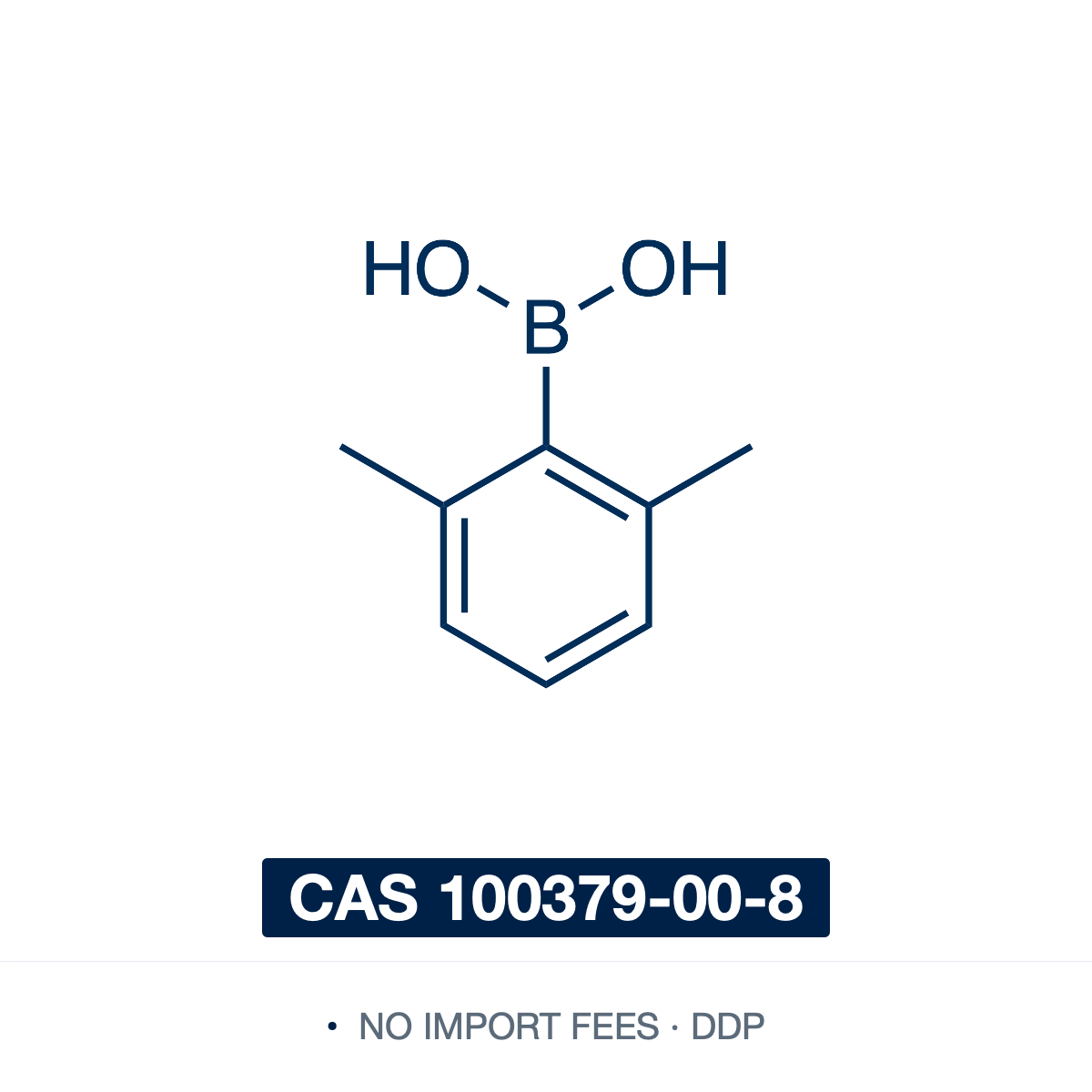
2,6-Dimethylphenylboronic Acid
2,6-Dimethylphenylboronic Acid | CAS 100379-00-8 | ≥98%
Couldn't load pickup availability
Technical Specifications
| CAS Number | 100379-00-8 |
| EC / EINECS Number | 600-084-4 |
| MDL Number | MFCD01009693 |
| SMILES | B(C1=C(C=CC=C1C)C)(O)O |
| InChI | InChI=1S/C8H11BO2/c1-6-4-3-5-7(2)8(6)9(10)11/h3-5,10-11H,1-2H3 |
| InChIKey | ZXDTWWZIHJEZOG-UHFFFAOYSA-N |
| PubChem CID | 583322 |
| Molecular Formula | C₈H₁₁BO₂ |
| Molecular Weight | 149.98 g/mol |
| Melting Point | 105 °C |
| Solubility | Soluble in methanol, ethanol, DMSO, DMF, chloroform, dichloromethane, and THF. |
| Purity | ≥98%. May contain varying amounts of the corresponding boronic acid anhydrides |
| Physical Form | White to off-white crystalline powder |
| HS Code | 2931.90 |
| Country of Origin | Finland |
| Shelf Life | Retest period: 36 months from date of manufacture |
| Storage Conditions | Store in a cool, dry place in a tightly sealed container |
Product Description & Scientific Applications
2,6-Dimethylphenylboronic Acid (2,6-dimethylbenzeneboronic acid, m-xylene-2-boronic acid) is sterically hindered: the two methyl groups make it substantially less reactive in cross-coupling than unsubstituted or para-substituted arylboronic acids.
In the solid state it may contain varying amounts of the cyclic anhydride, 2,6-dimethylphenylboroxine. Acid and boroxine re-equilibrate under aqueous or basic coupling conditions, but batch composition affects assay and effective stoichiometry.
Transmetalation of a doubly ortho-substituted arylboronic acid to palladium is slower than oxidative addition of a hindered aryl bromide, so transmetalation is rate-determining. Ligands electron-rich and bulky enough to drive oxidative addition slow it further, and protodeboronation competes for the reagent. In 2,6-disubstituted systems, base-catalysed deprotonation of the boronate opens a second decomposition route. Ortho substitution also decouples protodeboronation rate from Lewis acidity, so an electron-rich ring is no guide to stability.
Applications and Reactions
- Suzuki–Miyaura coupling: Installs the 2,6-dimethylphenyl group into aryl, heteroaryl and alkenyl scaffolds. SPhos couples 2,6-substituted aryl bromides at elevated palladium loading; flexible-bulk N-heterocyclic carbenes in aqueous tetrahydrofuran couple aryl chlorides at room temperature, giving di- and tri-ortho-substituted biaryls.
- Hindered and axially chiral biaryls: Ortho-substituted biaryls recur in bioactive compounds and organic materials. The tetra-ortho-substituted case under mild conditions is unsolved. Asymmetric Suzuki coupling reaches axially chiral biaryls with catalytic chiral ligand.
- Slow-release protocols: Gradual release holds the boron concentration low and suppresses protodeboronation and oxidative homocoupling.
- Protected boronate ester preparation: Precursor to pinacol, neopentyl glycol and MIDA 2,6-dimethylphenylboronates where a more stable or chromatographically tractable building block is needed.
- Ipso-nitration: Converts to the nitroarene in one pot.
- Nickel-catalysed coupling: Couples with chromene acetals under nickel catalysis.
Further Reading
Shipping Destinations
- EU & UK: Priority delivery, 2–5 business days.
- United States (DDP): 3–7 business days, duties and taxes prepaid.
- EFTA Countries (DDP): 3–7 business days, duties and taxes prepaid.
- Worldwide: 7–14 business days, selected locations.
Safety Information
| GHS Pictograms |

|
| Signal Word | Warning |
| Hazard Class | Not regulated for transport |
| Transport Category | Not classified as dangerous goods for transport (ADR/IATA/IMDG) |
| H-Statements | H315 - H319 - H335 |
| P-Statements | P261 - P264 - P271 - P280 - P302+P352 - P304+P340 - P305+P351+P338 - P332+P313 - P337+P313 - P362+P364 - P501 |
Documentation
| Safety Data Sheet | Download PDF |