NorrChemica™
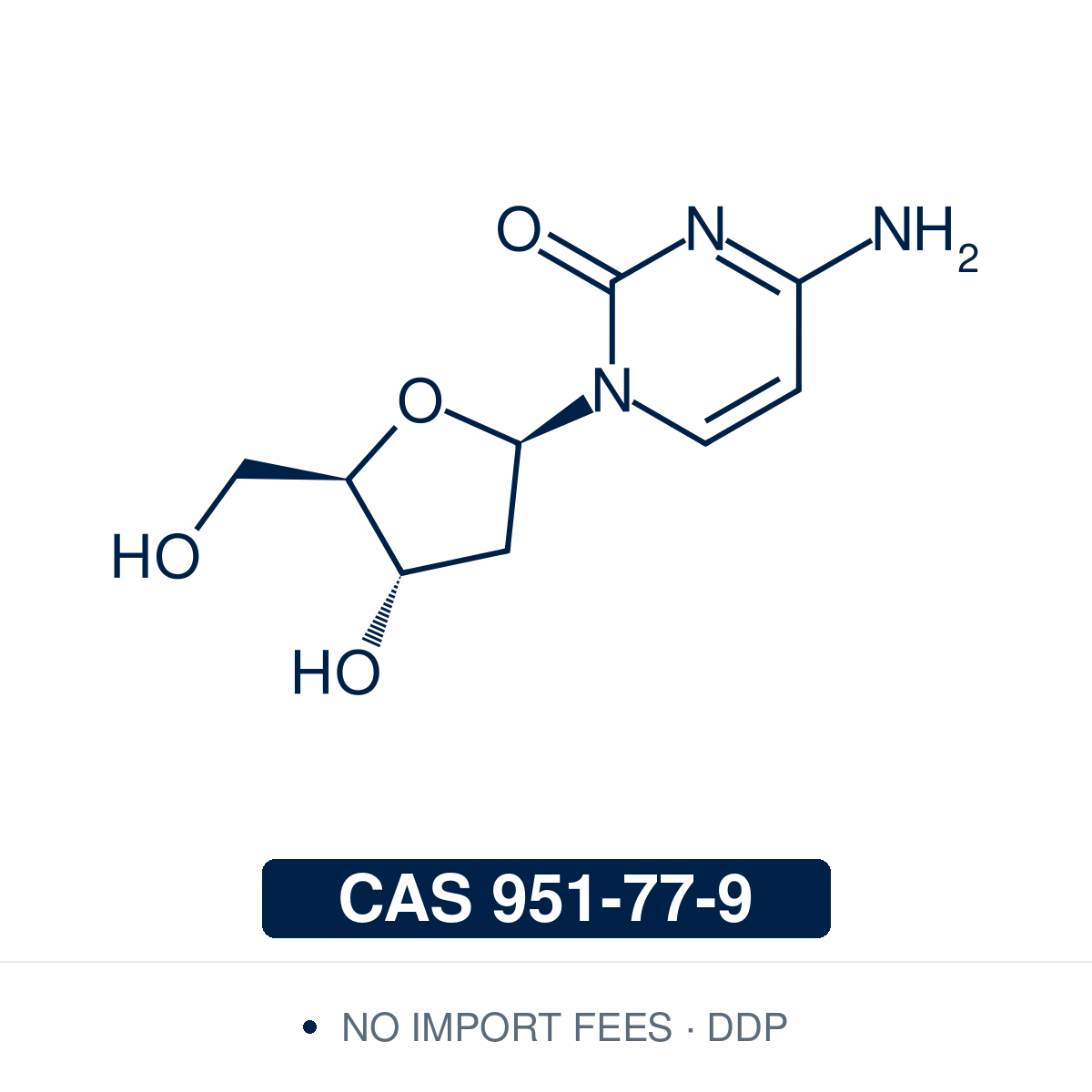
2′-Deoxycytidine
2′-Deoxycytidine | CAS 951-77-9 | ≥98%
Couldn't load pickup availability
Technical Specifications
| CAS Number | 951-77-9 |
| EC / EINECS Number | 213-454-1 |
| MDL Number | MFCD00006547 |
| RTECS Number | HA3800000 |
| SMILES | C1[C@@H]([C@H](O[C@H]1N2C=CC(=NC2=O)N)CO)O |
| InChI | InChI=1S/C9H13N3O4/c10-7-1-2-12(9(15)11-7)8-3-5(14)6(4-13)16-8/h1-2,5-6,8,13-14H,3-4H2,(H2,10,11,15)/t5-,6+,8+/m0/s1 |
| InChIKey | CKTSBUTUHBMZGZ-SHYZEUOFSA-N |
| PubChem CID | 13711 |
| Molecular Formula | C₉H₁₃N₃O₄ |
| Molecular Weight | 227.22 g/mol |
| Melting Point | 192–202 °C |
| Solubility | Soluble in water; sparingly soluble in ethanol; practically insoluble in diethyl ether |
| Purity | ≥98% |
| Physical Form | White to off-white crystalline powder |
| HS Code | 2934.99 |
| Shelf Life | Retest period: 36 months from date of manufacture |
| Storage Conditions | Store at room temperature in a tightly sealed container, protected from moisture |
Product Description & Scientific Applications
2′-Deoxycytidine (dC, dCyd) is one of the four canonical DNA deoxyribonucleosides: cytosine linked to 2-deoxy-β-D-ribofuranose by a β-N1-glycosidic bond. Deoxycytidine kinase (dCK) phosphorylates it to dCMP, which downstream kinases convert to dCDP and dCTP for DNA replication and repair. UV absorption peaks at λmax ≈ 271 nm; cytosine N3 protonates with pKa ≈ 4.2–4.3, the handle for low-pH ion-exchange separation.
Analytical reference standard. dC is a primary standard for HPLC, LC-MS, and LC-MS/MS quantification of canonical deoxyribonucleosides in DNA digests, cell extracts, and pool studies, resolving dC, dA, dG, dT, dU, and modified deoxycytidines in one run. Co-quantification of dC and 2′-deoxyuridine reads out CDA deamination flux directly.
dCK substrate. dC is the principal substrate of deoxycytidine kinase, the rate-limiting kinase that initiates pyrimidine deoxyribonucleoside salvage, with KM(dC) ≈ 0.94 μM. It is the benchmark in dCK kinetic and mechanistic studies.
CDA substrate. dC is a substrate of cytidine deaminase, a Zn²⁺-dependent hydrolase that deaminates it to 2′-deoxyuridine; the resulting dU feeds the thymidylate route, making dC→dU a regulatory junction in dCTP/dTTP balance.
Spontaneous deamination. Non-enzymatic deamination of cytosine to uracil is a major mutagenic DNA lesion, running at roughly 100–500 events per cell per day; the U:G mismatch is corrected by base excision repair (UNG), and unrepaired events drive C→T transitions. The same chemistry on 5-methyl-dC gives thymine, making methylated CpG sites mutational hotspots.
Methylation standard. dC is the unmethylated parent of 5-methyl-dC and the TET-derived oxidised forms; the dC:5-mdC ratio by LC-MS gives a direct methylation readout, and dC is the target base of cytidine base editors that deliver programmed C→T edits.
Cell culture. dC is a salvage-pathway supplement for controlled dNTP-pool manipulation.
Shipping Destinations
- EU & UK: Priority delivery, 2–5 business days.
- United States (DDP): 3–7 business days, duties and taxes prepaid.
- EFTA Countries (DDP): 3–7 business days, duties and taxes prepaid.
- Worldwide: 7–14 business days, selected locations.
Safety Information
| Hazard Class | None — not subject to transport regulations |
| Transport Category | Not classified as dangerous goods for transport (ADR/IATA/IMDG) |
Documentation
| Safety Data Sheet | Download PDF |
Share