NorrChemica™
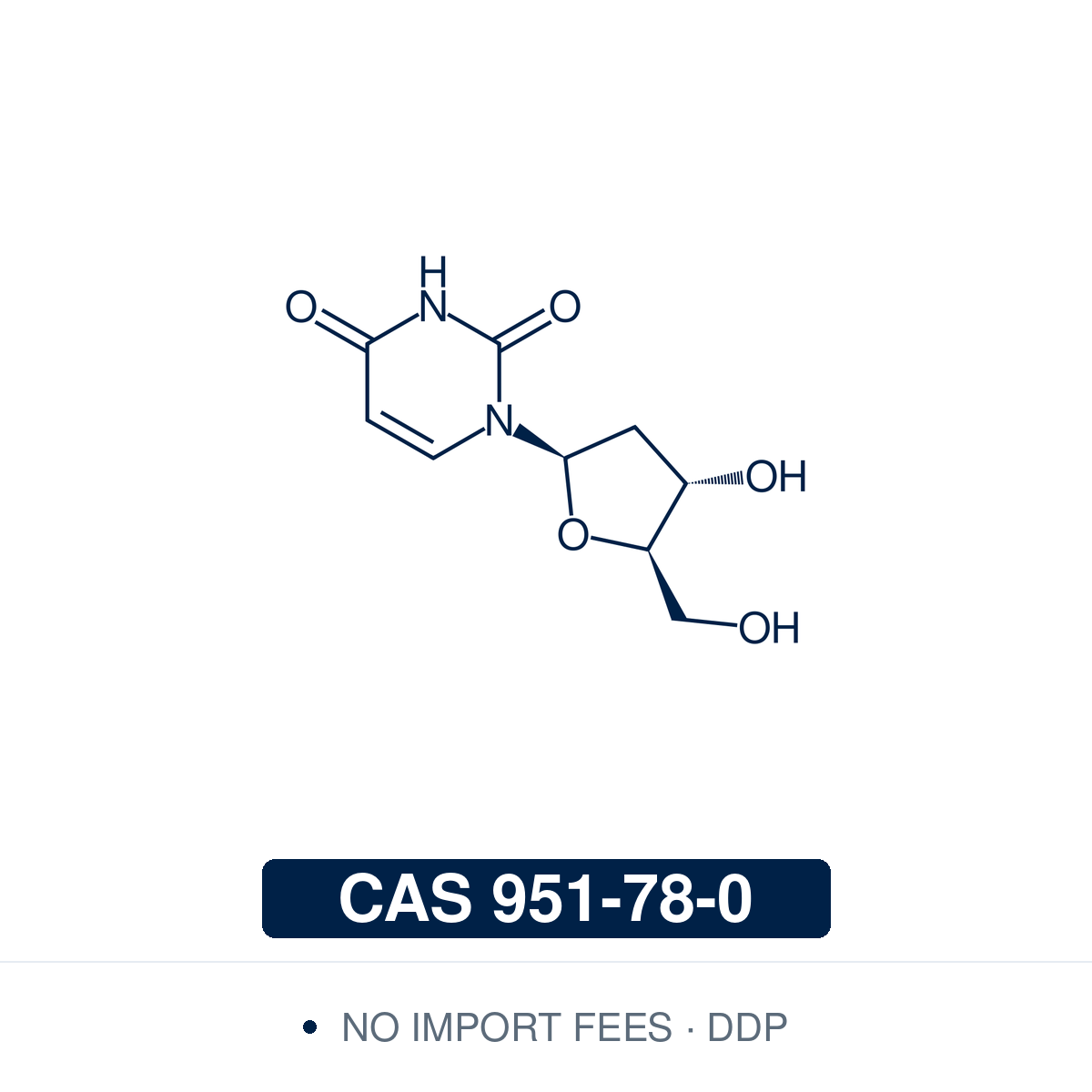
2′-Deoxyuridine
2′-Deoxyuridine | CAS 951-78-0 | ≥98%
Pack sizes & prices
| Pack size | Excl. VAT | Incl. VAT | Add to cart |
|---|---|---|---|
| 5.0 g | €59,20 | ||
| 10 g | €94,20 | ||
| 25 g | €149,20 | ||
| 50 g | €274,20 | ||
| 100 g | €479,20 | ||
| 250 g | €995,00 | ||
| 500 g | €1.695,00 |
Taxes and fees, e.g. VAT, included in the price. Shipping calculated at checkout.Free shipping on EU, UK and EFTA orders above €250, and above €400 to the rest of the world.
Technical Specifications
| CAS Number | 951-78-0 |
| EC / EINECS Number | 213-455-7 |
| MDL Number | MFCD00006527 |
| RTECS Number | YU7490000 |
| SMILES | C1[C@@H]([C@H](O[C@H]1N2C=CC(=O)NC2=O)CO)O |
| InChI | InChI=1S/C9H12N2O5/c12-4-6-5(13)3-8(16-6)11-2-1-7(14)10-9(11)15/h1-2,5-6,8,12-13H,3-4H2,(H,10,14,15)/t5-,6+,8+/m0/s1 |
| InChIKey | MXHRCPNRJAMMIM-SHYZEUOFSA-N |
| PubChem CID | 13712 |
| Molecular Formula | C₉H₁₂N₂O₅ |
| Molecular Weight | 228.20 g/mol |
| Melting Point | 164–167 °C |
| Solubility | Soluble in water (50 mg/mL). |
| Log Pow | -1.51 |
| Purity | ≥98% |
| Physical Form | White to almost white powder or crystals |
| HS Code | 2934.99 |
| Shelf Life | Retest period: 36 months from date of manufacture |
| Storage Conditions | Store in a cool, dry place in a tightly sealed container. |
Product Description & Scientific Applications
2′-Deoxyuridine (dUrd) is the 2′-deoxyribonucleoside of uracil: uracil bound through N1 to 2-deoxy-β-D-ribofuranose. Its 5′-monophosphate, dUMP, is the substrate of thymidylate synthase, which methylates it to dTMP; the methyl group comes from methylenetetrahydrofolate (CH₂H₄folate), which becomes dihydrofolate (H₂folate). dTMP is then converted to dTTP for DNA synthesis.
Reaction catalysed by thymidylate synthase: dUMP (left), the 5′-monophosphate of 2′-deoxyuridine, is methylated at C5 of uracil to give dTMP (right). Methylenetetrahydrofolate (CH₂H₄folate) is the methyl source and is converted to dihydrofolate (H₂folate).
Deoxyuridine suppression test. The deoxyuridine suppression test measures how strongly exogenous deoxyuridine inhibits the incorporation of [³H]thymidine into DNA. In a series of marrow samples from one hospital, all abnormal results came from patients with vitamin B12 or folate deficiency. The test was of particular value in diagnosing these deficiencies in non-anaemic patients with macrocytosis and equivocal changes in marrow morphology, and in patients whose serum vitamin B12 or red cell folate levels were within the normal range. A later study found that it identified subtle cobalamin deficiency in patients without typical megaloblastic anaemia. A study in stimulated lymphocytes showed that the suppression is caused only in part by expansion of the cell's pools of non-radioactive dTMP and dTTP. Deoxyuridine also competitively inhibits thymidine kinase. The authors concluded that exogenous deoxyuridine has several effects on [³H]thymidine incorporation, and that these must be considered when the test results are interpreted.
Marker of thymidylate synthase inhibition. A rise in plasma 2′-deoxyuridine is a surrogate marker of thymidylate synthase inhibition. It has been followed after administration of 5-fluorouracil and of specific thymidylate synthase inhibitors, with plasma deoxyuridine measured by reverse-phase HPLC. Inhibition of thymidylate synthase depletes dTTP and, at least in some cell lines, leads to accumulation of dUTP and misincorporation of uracil into DNA. How far the dUTP pool expands is largely determined by the expression of the pyrophosphatase dUTPase.
Thymidine phosphorylase deficiency. 2′-Deoxyuridine is a substrate of thymidine phosphorylase. Mutations in the thymidine phosphorylase gene cause mitochondrial neurogastrointestinal encephalomyopathy (MNGIE). In a study of patients with MNGIE, deoxyuridine accumulated in the circulation, but it was undetectable in mutation carriers and in controls. In a post-mortem study, thymidine and deoxyuridine were present in all tissues of MNGIE patients but absent from control tissues. This indicates that, without thymidine phosphorylase activity, tissues accumulate these nucleosides and excrete them into plasma.
Related thymidine analogues. Halogenated 2′-deoxyuridines are used as thymidine analogues in studies of DNA synthesis: 5-chloro-, 5-bromo- and 5-iodo-2′-deoxyuridine (CldU, BrdU and IdU) are used as labelling substrates. 5-Ethynyl-2′-deoxyuridine and 5-hydroxymethyl-2′-deoxyuridine are other analogues of 2′-deoxyuridine.
Shipping Destinations
- EU & UK: Priority delivery, 2–5 business days.
- United States (DDP): 3–7 business days, duties and taxes prepaid.
- EFTA Countries (DDP): 3–7 business days, duties and taxes prepaid.
- Worldwide: 7–14 business days, selected locations.
Safety Information
| Hazard Class | Not regulated for transport |
| Transport Category | Not classified as dangerous goods for transport (ADR/IATA/IMDG) |
Documentation
| Safety Data Sheet | Download PDF |
Share