NorrChemica™
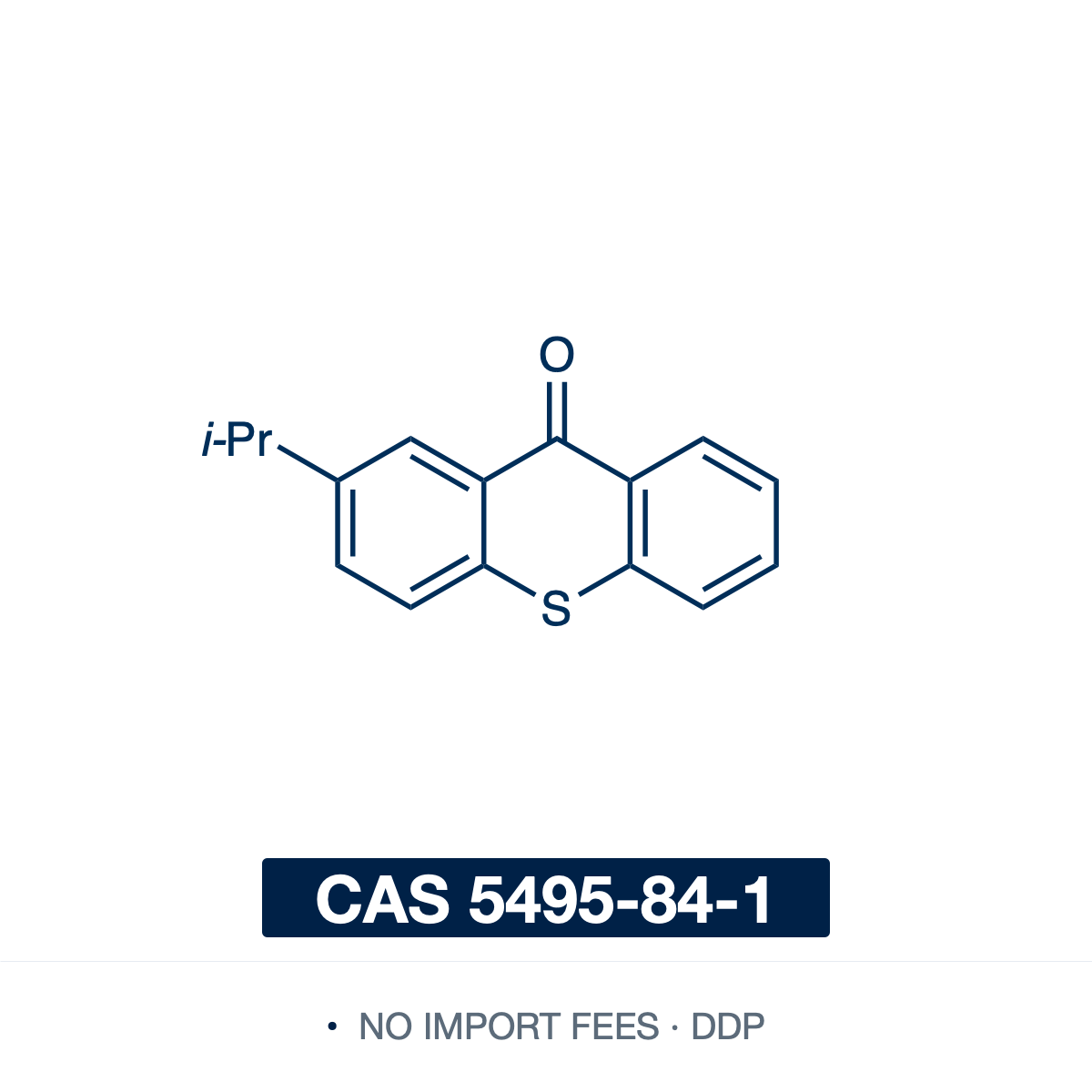
2-Isopropylthioxanthone ITX
2-Isopropylthioxanthone ITX | CAS 5495-84-1 | ≥98%
Couldn't load pickup availability
Technical Specifications
| CAS Number | 5495-84-1 |
| EC / EINECS Number | 226-827-9 |
| MDL Number | MFCD00055658 |
| SMILES | CC(C)C1=CC2=C(C=C1)SC3=CC=CC=C3C2=O |
| InChI | InChI=1S/C16H14OS/c1-10(2)11-7-8-15-13(9-11)16(17)12-5-3-4-6-14(12)18-15/h3-10H,1-2H3 |
| InChIKey | KTALPKYXQZGAEG-UHFFFAOYSA-N |
| PubChem CID | 79633 |
| Molecular Formula | C₁₆H₁₄OS |
| Molecular Weight | 254.35 g/mol |
| Melting Point | 75-76 °C |
| Solubility | Practically insoluble in water. Soluble in common organic solvents, including acetone, chloroform, toluene, and ethanol. |
| Log Pow | 5.59 |
| Purity | ≥98% |
| Physical Form | Light yellow to yellow-green powder to crystals |
| HS Code | 2934.99 |
| Shelf Life | Retest period: 36 months from date of manufacture |
| Storage Conditions | Store in a cool, dry place in a tightly sealed container, protected from light |
Product Description & Scientific Applications
ITX (2-isopropyl-9H-thioxanthen-9-one) is a Norrish Type II photoinitiator built on the thioxanthone chromophore. It forms initiating radicals bimolecularly, through its photoexcited triplet, and so it operates alongside a co-initiator.
Light absorption and excited states. ITX absorbs across the ultraviolet and into the visible, with maxima near 258 nm and 386 nm in dichloromethane and a tail to roughly 420 nm. Thioxanthone photoinitiators absorb between 380 and 420 nm, so ITX matches light-emitting-diode sources and sunlight. Absorbed light populates the excited singlet, and intersystem crossing carries the molecule to the triplet. The triplet is the reactive state and is detected by laser flash photolysis on the microsecond timescale.
Radical generation. ITX abstracts hydrogen from its triplet state rather than fragmenting, so it needs a hydrogen-donor co-initiator, and tertiary amines are the most efficient partner. The triplet and the amine form an exciplex, an electron transfers from the amine to ITX, and a proton then transfers from the carbon adjacent to nitrogen. This yields a thioxanthone ketyl radical and an α-aminoalkyl radical. The conjugated ketyl radical does not initiate polymerization and terminates chains instead; the α-aminoalkyl radical is the initiating species. The triplet abstracts hydrogen directly from alcohols and ethers as well.
Cationic sensitisation and energy transfer. The thioxanthone triplet also behaves as a photosensitiser. Transferring an electron to an onium salt, ITX sensitises iodonium and sulfonium photoinitiators for cationic polymerization, generating a thioxanthone radical cation and an initiating onium-derived radical. The combination of ITX with phosphonium salts ranks among the most efficient systems for ring-opening cationic polymerization. By triplet energy transfer, thioxanthones also sensitise other photoinitiators and cycloaddition reactions.
Applications. ITX is a commercial Type II photoinitiator for free-radical ultraviolet curing of coatings and printing inks. It also acts as the photoinitiator in negative-tone radical photoresists for multiphoton polymerization and three-dimensional microfabrication.
Limitations in coatings and UV curing. In cured films, the amine co-initiator can introduce odour, yellowing, and migration of photolysis byproducts. ITX itself is a small molecule and migrates out of cured films together with its photolytic products; for migration-critical coating applications, higher-molecular-weight and polymeric photoinitiators are the usual alternative.
Shipping Destinations
-
EU & UK: Priority delivery, 3–5 business days. United States (DDP): 3–7 business days, duties and taxes prepaid. EFTA Countries (DDP): 3–7 business days, duties and taxes prepaid. Worldwide: 7–14 business days, selected locations.
Safety Information
| GHS Pictograms |

|
| Signal Word | Warning |
| Hazard Class | None — not subject to transport regulations |
| Transport Category | Not classified as dangerous goods for transport (ADR/IATA/IMDG) |
| H-Statements | H302 |
| P-Statements | P264 - P270 - P301+P312 - P330 - P501 |
Documentation
| Safety Data Sheet | Download PDF |