NorrChemica™
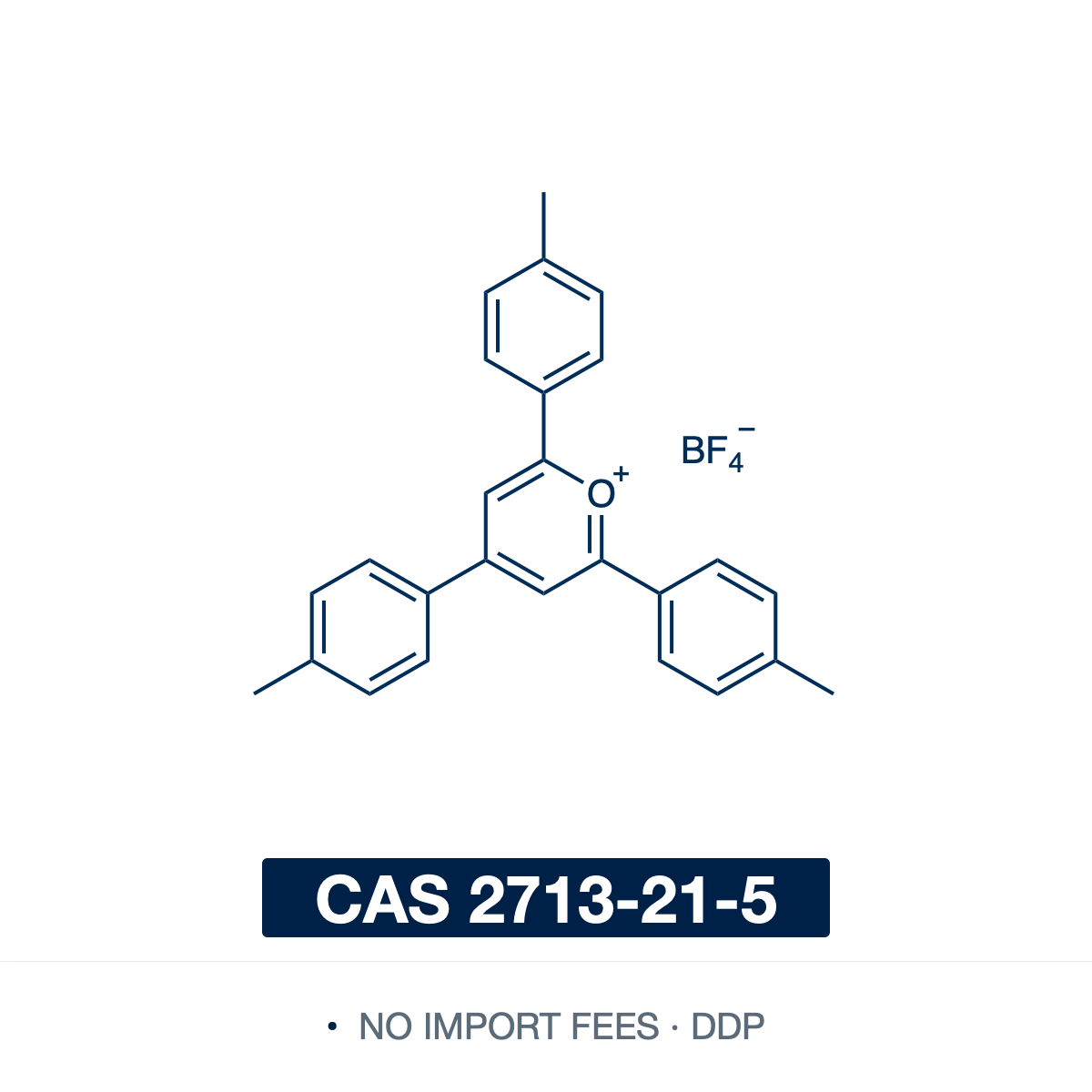
2,4,6-Tri-p-tolylpyrylium tetrafluoroborate
2,4,6-Tri-p-tolylpyrylium tetrafluoroborate | CAS 2713-21-5 | ≥98%
Couldn't load pickup availability
Technical Specifications
| CAS Number | 2713-21-5 |
| MDL Number | MFCD00972530 |
| SMILES | [B-](F)(F)(F)F.CC1=CC=C(C=C1)C2=CC(=[O+]C(=C2)C3=CC=C(C=C3)C)C4=CC=C(C=C4)C |
| InChI | InChI=1S/C26H23O.BF4/c1-18-4-10-21(11-5-18)24-16-25(22-12-6-19(2)7-13-22)27-26(17-24)23-14-8-20(3)9-15-23;2-1(3,4)5/h4-17H,1-3H3;/q+1;-1 |
| InChIKey | BWOXOWBZXLPNEN-UHFFFAOYSA-N |
| PubChem CID | 13902521 |
| Molecular Formula | C₂₆H₂₃BF₄O |
| Molecular Weight | 438.26 g/mol |
| Melting Point | 298-303 °C |
| Solubility | Soluble in acetonitrile, dichloromethane, and DMSO. Sensitive to hydrolysis in water and basic media. |
| Purity | ≥98% |
| Physical Form | Yellow crystalline powder |
| HS Code | 2932.99 |
| Shelf Life | Retest period: 36 months from date of manufacture |
| Storage Conditions | Store at 2–8 °C in a tightly sealed container, protected from light and moisture. |
Product Description & Scientific Applications
2,4,6-Tri-p-tolylpyrylium tetrafluoroborate is a triarylpyrylium salt: a cationic, metal-free organic photoredox catalyst carrying a tetrafluoroborate counterion. It functions as a single-electron photooxidant.
Photoredox mechanism. Visible light excites the pyrylium to a strong excited-state oxidant; triarylpyrylium salts reach excited-state reduction potentials above +1.7 V versus SCE. The excited catalyst removes one electron from an electron-rich substrate, generating a substrate radical cation and a neutral pyranyl radical. A single-electron transfer then regenerates the pyrylium, either from the pyranyl radical or from a further substrate molecule in a chain. Triarylpyrylium salts do not readily sensitise singlet oxygen, so reactivity proceeds through the substrate radical cation rather than an oxygen-sensitisation route.
Cation-radical cycloadditions and endoperoxidation. Triarylpyrylium photocatalysts are productive in cation-radical [4 + 2] and [2 + 2] cycloadditions, oxygenations and rearrangements. In a cyclisation–endoperoxidation cascade, 470 nm irradiation in oxygen-saturated dichloromethane oxidises a 1,5-diene to its radical cation. Cyclisation forms a stabilised distonic radical cation, molecular oxygen intercepts it, and a final single-electron reduction delivers a bicyclic 1,2-dioxane endoperoxide. A productive diene requires an oxidisable alkene and a second alkene that traps the radical cation; several substrates give endoperoxides in yields up to 79%.
Newman–Kwart rearrangement. The same photooxidation drives the Newman–Kwart rearrangement at ambient temperature. Catalytic single-electron oxidation converts O-aryl carbamothioates to S-aryl carbamothioates, the key step in preparing thiophenols from phenols. This replaces the high temperatures required by the thermal rearrangement.
Living cationic polymerisation. As a photoinitiator, 2,4,6-tri-p-tolylpyrylium tetrafluoroborate drives metal-free living cationic polymerisation of 4-methoxystyrene under visible light with methanol present. The methanol concentration sets the molecular weight and dispersity. Mechanistic analysis indicates that methanol regulates the cationic chain end by reversible chain transfer, analogous to RAFT polymerisation.
Shipping Destinations
- EU & UK: Priority delivery, 2–5 business days.
- United States (DDP): 3–7 business days, duties and taxes prepaid.
- EFTA Countries (DDP): 3–7 business days, duties and taxes prepaid.
- Worldwide: 7–14 business days, selected locations.
Safety Information
| GHS Pictograms |

|
| Signal Word | Warning |
| Hazard Class | Not regulated for transport |
| Transport Category | Not classified as dangerous goods for transport (ADR/IATA/IMDG) |
| H-Statements | H315 - H319 - H335 |
| P-Statements | P261 - P264 - P271 - P280 - P302+P352 - P304+P340 - P305+P351+P338 - P332+P313 - P337+P313 - P362+P364 - P403+P233 - P405 - P501 |
Documentation
| Safety Data Sheet | Download PDF |