NorrChemica™
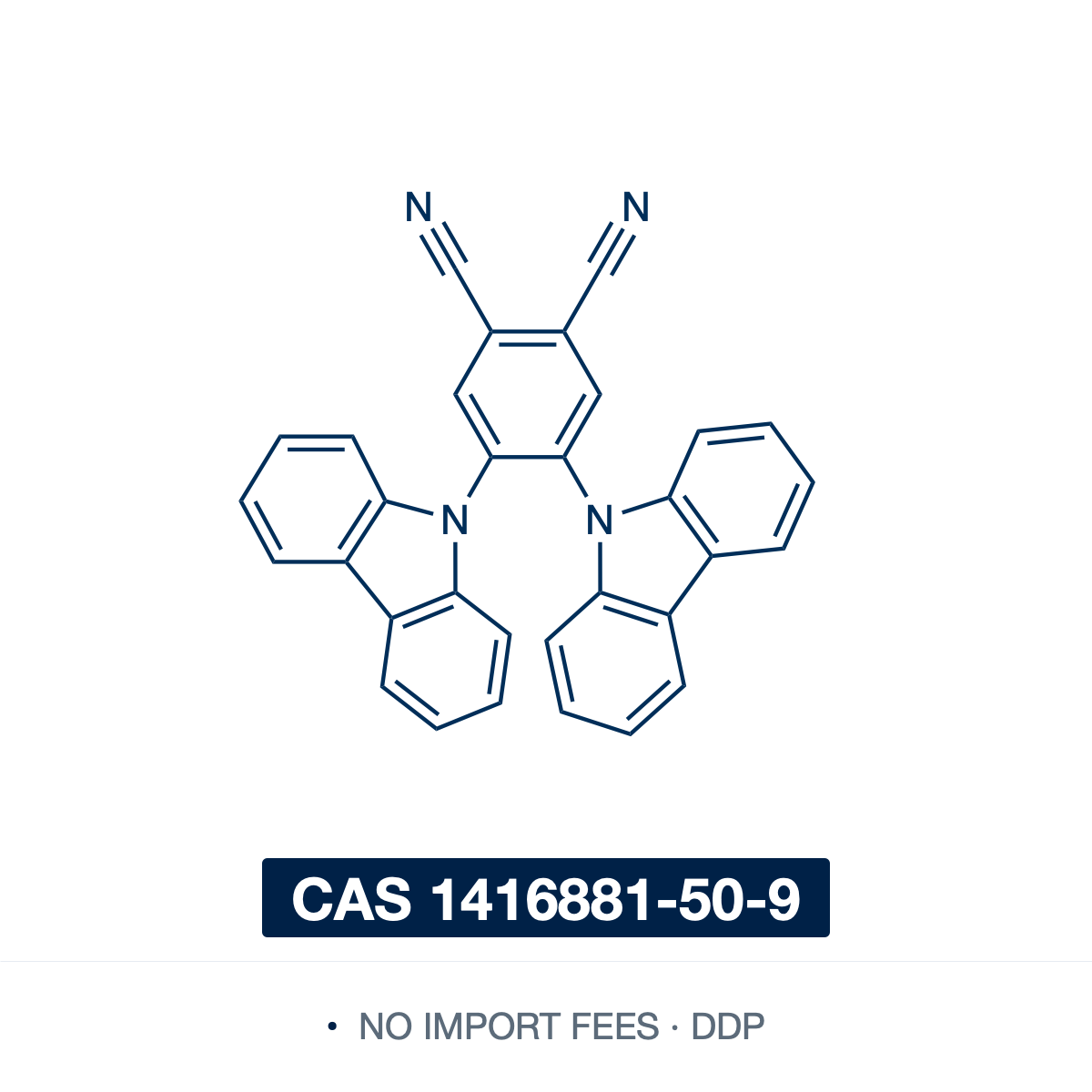
2CzPN
2CzPN | CAS 1416881-50-9 | ≥97%
Couldn't load pickup availability
Technical Specifications
| CAS Number | 1416881-50-9 |
| EC / EINECS Number | 891-325-4 |
| MDL Number | MFCD28369264 |
| SMILES | C1=CC=C2C(=C1)C3=CC=CC=C3N2C4=C(C=C(C(=C4)C#N)C#N)N5C6=CC=CC=C6C7=CC=CC=C75 |
| InChI | InChI=1S/C32H18N4/c33-19-21-17-31(35-27-13-5-1-9-23(27)24-10-2-6-14-28(24)35)32(18-22(21)20-34)36-29-15-7-3-11-25(29)26-12-4-8-16-30(26)36/h1-18H |
| InChIKey | BSQBWXBFVYTYOL-UHFFFAOYSA-N |
| PubChem CID | 101136486 |
| Molecular Formula | C₃₂H₁₈N₄ |
| Molecular Weight | 458.52 g/mol |
| Solubility | Soluble in toluene. Practically insoluble in water. |
| Purity | ≥97% |
| Physical Form | Pale yellow crystalline powder |
| HS Code | 2933.99 |
| Shelf Life | Retest period: 36 months from date of manufacture |
| Storage Conditions | Store at ambient temperature in a well-ventilated place, protected from light. Keep the container tightly closed. |
Product Description & Scientific Applications
2CzPN (1,2-bis(carbazol-9-yl)-4,5-dicyanobenzene) is a metal-free organic emitter that generates light by thermally activated delayed fluorescence (TADF). It belongs to the carbazolyl-dicyanobenzene (CDCB) family, pairing carbazole electron donors with an electron-accepting dicyanobenzene core.
Delayed-fluorescence mechanism. The donor–acceptor construction holds the two carbazoles at a large steric twist to the dicyanobenzene plane, separating the highest occupied molecular orbital on the donors from the lowest unoccupied molecular orbital on the acceptor. That separation shrinks the singlet–triplet energy gap between the lowest excited singlet (S1) and triplet (T1) states. Once the gap is small enough, triplet excitons draw on thermal energy at room temperature and up-convert to the singlet by reverse intersystem crossing. The recovered singlets decay as delayed fluorescence, so the emitter harvests both the singlet and triplet excitons formed under electrical excitation in a 1:3 ratio. Emitters built on this CDCB design reach fluorescence efficiencies above 90%; 2CzPN itself has a photoluminescence quantum yield of 47% in toluene.
Excited-state character. The two excited states of 2CzPN differ in nature. Doped at 5 wt% in a 1,3-bis(9-carbazolyl)benzene host, its fluorescence red-shifts as the host is made more polar, identifying S1 as a charge-transfer state. The phosphorescence holds its position, identifying T1 as a locally excited state. Because only S1 follows the host polarity, a polar matrix lowers S1 alone and narrows the gap, the reduction reaching about 65 meV.
Emission. 2CzPN is a sky-blue emitter with a photoluminescence maximum at 473 nm in toluene. It carries fewer carbazole donors than the green emitter 4CzIPN, weakening the donor strength and shifting the emission to shorter wavelength.
Applications. 2CzPN is used as a sky-blue emissive dopant in organic light-emitting diodes; a host of higher triplet energy confines its triplet excitons. In a sky-blue device of this kind it reached an external quantum efficiency of about 8%.
Shipping Destinations
- EU & UK: Priority delivery, 2–5 business days.
- United States (DDP): 3–7 business days, duties and taxes prepaid.
- EFTA Countries (DDP): 3–7 business days, duties and taxes prepaid.
- Worldwide: 7–14 business days, selected locations.
Safety Information
| GHS Pictograms |

|
| Signal Word | Warning |
| Hazard Class | Not regulated for transport |
| Transport Category | Not classified as dangerous goods for transport (ADR/IATA/IMDG) |
| H-Statements | H315 - H319 - H335 |
| P-Statements | P261 - P264 - P271 - P280 - P302+P352 - P304+P340 - P305+P351+P338 - P312 - P337+P313 - P501 |
Documentation
| Safety Data Sheet | Download PDF |