NorrChemica™
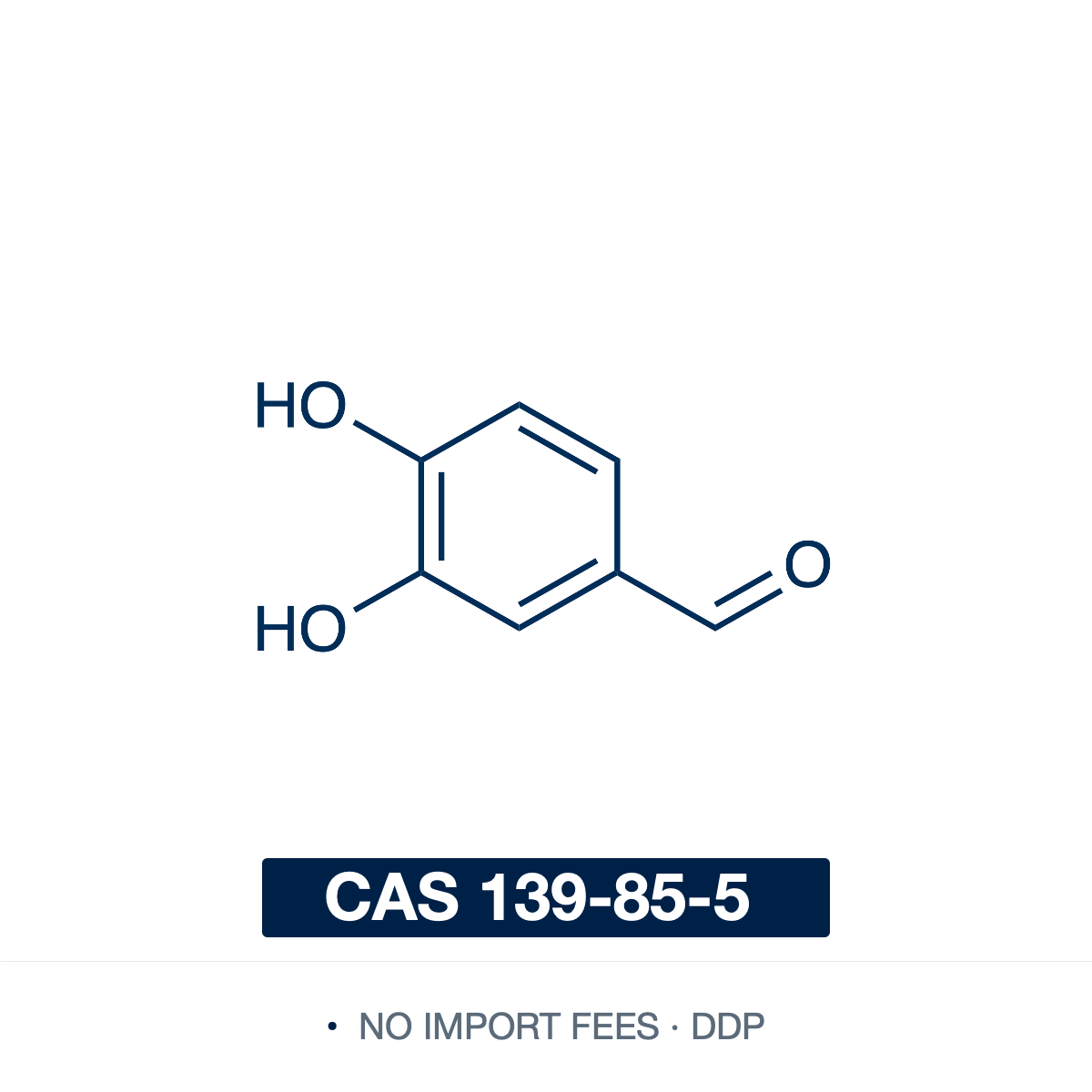
3,4-Dihydroxybenzaldehyde (Protocatechualdehyde)
3,4-Dihydroxybenzaldehyde (Protocatechualdehyde) | CAS 139-85-5 | ≥98%
Couldn't load pickup availability
Technical Specifications
| CAS Number | 139-85-5 |
| EC / EINECS Number | 205-377-7 |
| MDL Number | MFCD00003370 |
| RTECS Number | UL0380000 |
| SMILES | C1=CC(=C(C=C1C=O)O)O |
| InChI | InChI=1S/C7H6O3/c8-4-5-1-2-6(9)7(10)3-5/h1-4,9-10H |
| InChIKey | IBGBGRVKPALMCQ-UHFFFAOYSA-N |
| PubChem CID | 8768 |
| Molecular Formula | C₇H₆O₃ |
| Molecular Weight | 138.12 g/mol |
| Melting Point | 150 - 157 °C (lit.) |
| Solubility | Freely soluble in ethanol, acetone, ethyl acetate, and diethyl ether; moderately soluble in hot water and cold water; insoluble in benzene and toluene. |
| Purity | ≥98% |
| Physical Form | Beige powder |
| HS Code | 2912.49 |
| Country of Origin | Finland |
| Shelf Life | Retest period: 36 months from date of manufacture |
| Storage Conditions | Store in a cool, dry place in a tightly sealed container, protected from light |
Product Description & Scientific Applications
3,4-Dihydroxybenzaldehyde (protocatechualdehyde, 4-formylcatechol) is a bifunctional coupling reagent: the aldehyde grafts it onto amine-bearing polymers through Schiff base formation, leaving the catechol free to do the adhesion, crosslinking and metal binding.
Catechol chemistry. The ortho-diol establishes reversible redox equilibria at moderate potentials and pH, chelates di- and trivalent metals — Fe³⁺ in particular, as the tris complex — and interacts with surfaces of widely different chemical and physical character. Under alkaline conditions it oxidises to semiquinone and o-quinone, which react onward with amines and thiols by Michael addition and Schiff base formation to give irreversible crosslinks. Because the metal coordination is reversible where the oxidative crosslinking is not, catechol materials can be made self-healing.
Mussel-inspired adhesives. It is a one-step DOPA surrogate from cheap commercially available starting materials. Condensed with poly(vinyl alcohol) it gives a hot-curing adhesive reaching 17.3 MPa on stainless steel. With polyethyleneimine it forms a Schiff-base supramolecular adhesive with a maximum shear strength of 5.20 ± 0.39 MPa on wood, exceeding commercial chloroprene rubber and poly(vinyl acetate) adhesives while emitting fewer volatile organics.
Polymer functionalisation. Grafted onto chitosan by aldehyde–amine coupling, it introduces the catechol groups that give wetness-resistant adhesion to silicon surfaces in lithium-ion anode binders.
Tyrosinase assay. It is the final product measured in the continuous spectrophotometric assay for tyrosinase diphenolase activity. Its absorbance maximum shifts bathochromically as pH rises.
Shipping Destinations
- EU & UK: Priority delivery, 2–5 business days.
- United States (DDP): 3–7 business days, duties and taxes prepaid.
- EFTA Countries (DDP): 3–7 business days, duties and taxes prepaid.
- Worldwide: 7–14 business days, selected locations.
Safety Information
| GHS Pictograms |

|
| Signal Word | Warning |
| Hazard Class | Not regulated for transport |
| Transport Category | Not classified as dangerous goods for transport (ADR/IATA/IMDG) |
| H-Statements | H315 - H319 - H335 |
| P-Statements | P261 - P264 - P271 - P280 - P302+P352 - P305+P351+P338 - P332+P313 - P337+P313 - P362+P364 - P501 |
Documentation
| Safety Data Sheet | Download PDF |