NorrChemica™
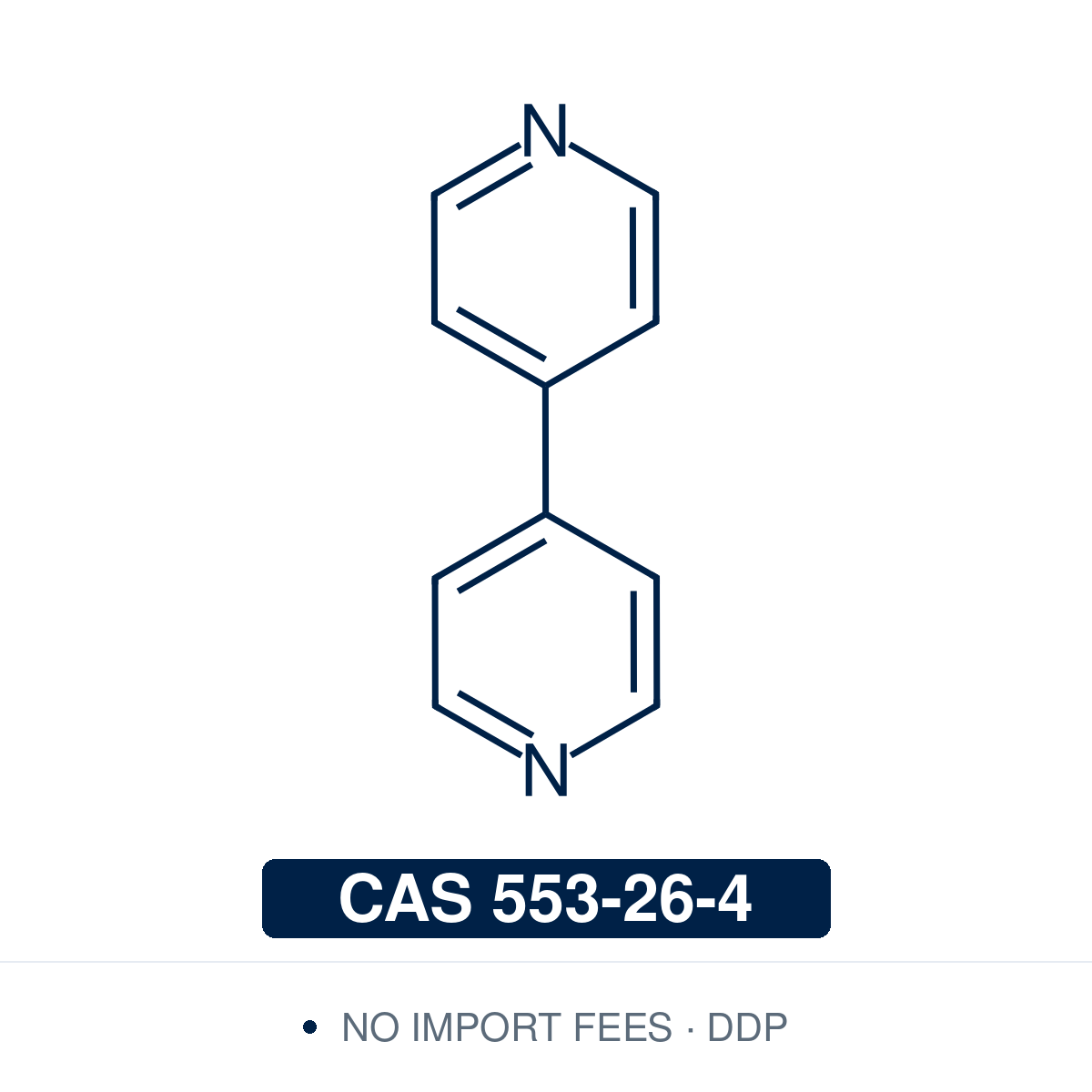
4,4′-Bipyridine
4,4′-Bipyridine | CAS 553-26-4 | ≥98%
Couldn't load pickup availability
Technical Specifications
| CAS Number | 553-26-4 |
| EC / EINECS Number | 209-036-3 |
| MDL Number | MFCD00006416 |
| RTECS Number | DW1760000 |
| SMILES | C1=CN=CC=C1C2=CC=NC=C2 |
| InChI | InChI=1S/C10H8N2/c1-5-11-6-2-9(1)10-3-7-12-8-4-10/h1-8H |
| InChIKey | MWVTWFVJZLCBMC-UHFFFAOYSA-N |
| PubChem CID | 11107 |
| Molecular Formula | C₁₀H₈N₂ |
| Molecular Weight | 156.18 g/mol |
| Melting Point | 110-114 °C |
| Solubility | Slightly soluble in water (4.5 g/L), soluble in most of common organic solvent |
| Log Pow | 1.06 |
| Purity | ≥98% |
| Physical Form | Colourless to pale yellow crystalline solid |
| HS Code | 2933.39 |
| Country of Origin | Finland |
| Shelf Life | Retest period: 36 months from date of manufacture |
| Storage Conditions | Store in a cool, dry place in a tightly sealed container |
Product Description & Scientific Applications
4,4'-Bipyridine (4,4'-dipyridyl, 4,4'-bipy, γ,γ'-dipyridyl, 4-(pyridin-4-yl)pyridine) is a rigid, rod-like ditopic N-donor in which two pyridine rings are joined by a single C–C bond at their 4-positions. The two pyridyl nitrogens point outward in opposite directions, so — unlike the 2,2'-isomer, whose adjacent nitrogens chelate a single metal — 4,4'-bipyridine acts as two independent monodentate donors that bridge separate metal centres. In many solid-state structures the two rings adopt a twisted conformation rather than a fully coplanar geometry; coordination, protonation, and hydrogen bonding can change this torsion angle and tune conjugation across the biaryl axis. It is also a weak ditopic base and a reliable double hydrogen-bond acceptor, properties that underpin its dual role in coordination and supramolecular chemistry.
Building block for metal–organic frameworks and coordination polymers
4,4'-Bipyridine is a classic rigid ditopic ligand that can act as a bridging and piillar linker for one-, two-, and three-dimensional coordination polymers and metal–organic frameworks, connecting metal nodes such as Cu(II), Zn(II), Co(II), Ni(II), and Cd(II) with defined, near-linear spacing. Its fixed geometry templates predictable topologies — zigzag and linear chains, ladders, square grids, and interpenetrated three-dimensional nets — and, combined with carboxylate or other ditopic co-ligands, builds pillared-layer frameworks studied for gas adsorption, separation, sensing, catalysis, and framework flexibility such as gate-opening and breathing. In discrete bimetallic and mixed-valence complexes, coplanar 4,4'-bipyridine bridges can mediate through-ligand electronic coupling, making the ligand useful in electron-transfer and molecular-wire model studies.
Ditopic linker in crystal engineering and cocrystals
Beyond metal coordination, the two pyridyl nitrogens make 4,4'-bipyridine a reliable hydrogen-bond acceptor for organic crystal engineering. With carboxylic acids and phenols it forms O–H···N heterosynthons, assembling one-dimensional chains and pillared hydrogen-bonded networks, and it is widely used as a rigid coformer in cocrystal design, where its predictable two-point connectivity controls packing and stoichiometry.
Precursor to viologen redox materials
Double quaternisation of the two pyridyl nitrogens with alkyl halides converts 4,4'-bipyridine into 4,4'-bipyridinium salts — the viologens — of which methyl viologen is the archetype. Viologens undergo reversible one-electron reduction to intensely coloured radical cations and further reduction to neutral forms, a fast, reversible redox couple that makes viologens widely used electron-transfer mediators and redox-active components of functional materials.
Beyond synthesis
- Electrochromic and energy-storage materials: the reversible, strongly coloured viologen redox couple underpins electrochromic displays and windows and serves as a redox-active anolyte/negolyte in aqueous organic redox-flow batteries; viologens are also studied in molecular electronics and solar-energy conversion.
- Electron-transfer mediator in solar-fuel models: methyl viologen and related viologens serve as electron relays in photocatalytic assemblies, including Ru(bpy)₃²⁺-sensitised hydrogen-evolution and CO₂-reduction model systems, where the MV²⁺/MV•⁺ couple transfers reducing equivalents to catalytic sites.
- Photochromic and stimuli-responsive MOF frameworks: bipyridinium-derived and related 4,4'-bipyridyl ligands are incorporated into coordination polymers and MOFs where electron-transfer-generated radical species give photochromic, vapochromic, or analyte-responsive behaviour.
- Host–guest and molecular-machine chemistry: viologen units derived from 4,4'-bipyridine act as electron-poor recognition sites for electron-rich macrocycles, supporting rotaxane, catenane, and mechanically interlocked molecular architectures.
Shipping Destinations
- EU & UK: Priority delivery, 2–5 business days, duties and taxes prepaid.
Safety Information
| GHS Pictograms |


|
| Signal Word | Danger |
| Hazard Class | UN 2811 — Toxic solid, organic, n.o.s. (4,4′-Bipyridine) (Class 6.1, PG III) |
| Transport Category | Class 6.1, PG III (ADR/IATA/IMDG) |
| H-Statements | H301+H311 - H411 |
| P-Statements | P280 - P301+P330+P331 - P302+P352 - P312 - P405 - P501 |
Documentation
| Safety Data Sheet | Download PDF |