NorrChemica™
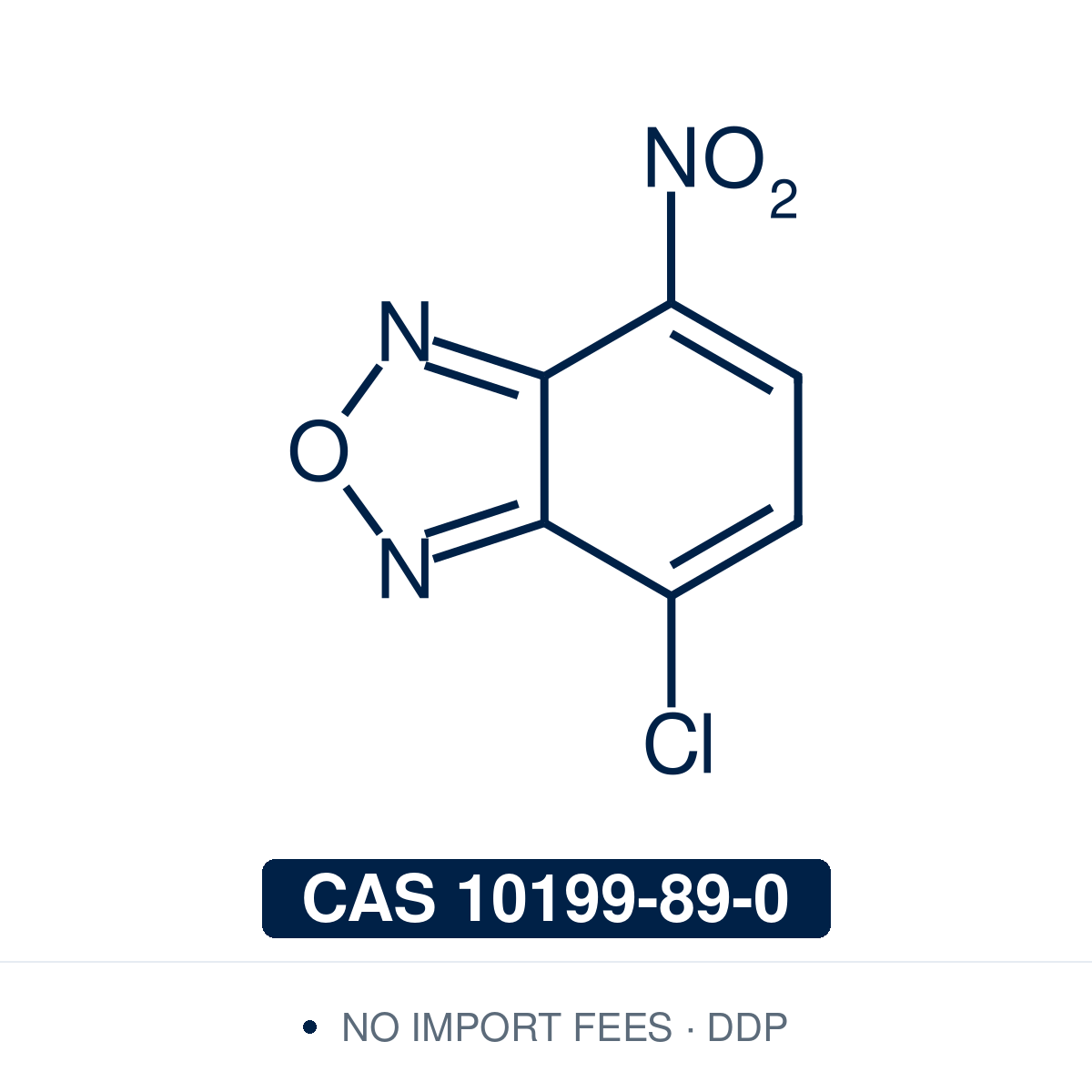
4-Chloro-7-nitrobenzofurazan (NBD-Cl)
4-Chloro-7-nitrobenzofurazan (NBD-Cl) | CAS 10199-89-0 | ≥98%
Couldn't load pickup availability
Technical Specifications
| CAS Number | 10199-89-0 |
| EC / EINECS Number | 233-496-4 |
| MDL Number | MFCD00005808 |
| RTECS Number | DF8002400 |
| SMILES | C1=C(C2=NON=C2C(=C1)Cl)[N+](=O)[O-] |
| InChI | InChI=1S/C6H2ClN3O3/c7-3-1-2-4(10(11)12)6-5(3)8-13-9-6/h1-2H |
| InChIKey | IGHBXJSNZCFXNK-UHFFFAOYSA-N |
| PubChem CID | 25043 |
| Molecular Formula | C6H2ClN3O3 |
| Molecular Weight | 199.55 g/mol |
| Melting Point | 96-99 °C |
| Solubility | Soluble in methanol, ethanol, acetonitrile, DMF, and DMSO; sparingly soluble in water. Solutions hydrolyse slowly under aqueous conditions. |
| Purity | ≥98% |
| Physical Form | Orange to brown crystalline powder |
| HS Code | 2934.99 |
| Country of Origin | Finland |
| Shelf Life | Retest period: 36 months from date of manufacture |
| Storage Conditions | Store refrigerated (2–8 °C) in a tightly sealed container, protected from light and moisture. |
Product Description & Scientific Applications
NBD-Cl (4-chloro-7-nitro-2,1,3-benzoxadiazole; 4-chloro-7-nitrobenzofurazan; NBD chloride) is a small electrophilic fluorogenic labelling reagent of the 7-nitrobenzofurazan family used for covalent derivatisation of primary and secondary amines, thiols, and other nucleophiles for fluorescence- and absorbance-based detection in chromatography, capillary electrophoresis, and protein chemistry. The chloride leaving group is activated towards nucleophilic aromatic substitution by the strongly electron-withdrawing nitrobenzofurazan core; the reagent itself is non-fluorescent and converts on reaction into fluorescent NBD-amine adducts with excitation near 470 nm and emission in the 510–540 nm region. NBD-amine adduct fluorescence is strongly environment-sensitive, intensifying in nonpolar or aprotic media and falling in water, which makes the NBD group a polarity-reporting fluorophore. NBD-thiol adducts show shorter-wavelength absorbance near 420 nm and much weaker fluorescence than the amine adducts. The compound is supplied as a yellow to light-yellow crystalline powder, soluble in methanol, DMF, DMSO, and chloroform, with limited stability in aqueous media owing to competing hydrolysis to the corresponding NBD-OH.
Fluorogenic Derivatisation of Amines and Thiols for Chromatographic Analysis
NBD-Cl reacts with primary and secondary amines by nucleophilic aromatic substitution to form NBD-amine adducts that are fluorescent under excitation near 470 nm, providing sensitive detection chemistry for amino acids, biogenic amines, amino sugars, amine-bearing pharmaceuticals, and other low-molecular-weight nucleophiles separated by reversed-phase HPLC, capillary electrophoresis, or thin-layer chromatography. It is widely used in pre-column and post-column derivatisation workflows for the quantification of amines and amino acids in biological fluids, food, and environmental samples, especially where analytes have weak native UV or fluorescence response. The reagent also derivatises thiols and other weakly UV-absorbing analytes, yielding coloured products with well-defined absorbance suitable for spectrophotometric or electrochemical detection where fluorescence is not required. Reaction selectivity, yield, and background signal are governed by buffered alkaline pH, analyte concentration, reaction temperature, and control of NBD-Cl hydrolysis.
Site-Selective Labelling of Nucleophilic Residues in Proteins
In protein chemistry, NBD-Cl labels accessible cysteine sulfhydryl groups under mildly acidic to neutral conditions and lysine ε-amino and N-terminal amino groups under neutral to alkaline conditions, with tyrosine phenols giving adducts of distinct absorbance. The thiol, amine, and phenol adducts have spectroscopically distinct absorbance and fluorescence, allowing the site of modification to be discriminated within a single sample. The reagent is used as a probe of accessible nucleophiles in folded proteins, as an active-site-directed inhibitor of certain ATPases and other enzymes through residue-specific modification, and as a trapping reagent for cysteine sulfenic acids. Because NBD emission shifts with local polarity, the label also reports on the microenvironment of the residue to which it is attached. Its compact size and environment-sensitive emission make it complementary to larger fluorescent tags in solution biochemistry.
Building Block for Fluorescent Probes and Lipid Conjugates
Beyond analytical derivatisation, the NBD fluorophore is an established building block in the design of small-molecule fluorescent probes and labelled conjugates. NBD-Cl is the starting material for environment-sensitive fluorescent tags and for thiol-, hydrogen-sulfide-, and biothiol-responsive probes, in which nucleophilic aromatic substitution at the NBD centre switches fluorescence on or transfers the NBD group to a reporter fluorophore. It is also used to prepare NBD-labelled lipids, fatty acids, and phospholipid derivatives for membrane and trafficking studies, and NBD-functionalised amino acids and maleimides for site-specific bioconjugation. The combination of compact size, fluorogenic switching, and polarity-sensitive emission underlies the continued use of the NBD motif across chemical biology and fluorescence-sensing research.
Shipping Destinations
- EU & UK: Priority delivery, 2–5 business days.
- United States (DDP): 3–7 business days, duties and taxes prepaid.
- EFTA Countries (DDP): 3–7 business days, duties and taxes prepaid.
- Worldwide: 7–14 business days, selected locations.
Safety Information
| GHS Pictograms |

|
| Signal Word | Warning |
| Hazard Class | Not regulated for transport |
| Transport Category | Not classified as dangerous goods for transport (ADR/IATA/IMDG) |
| H-Statements | H315 - H319 |
| P-Statements | P264 - P280 - P302+P352 - P305+P351+P338 - P332+P313 - P337+P313 - P362+P364 - P501 |
Documentation
| Safety Data Sheet | Download PDF |