NorrChemica™
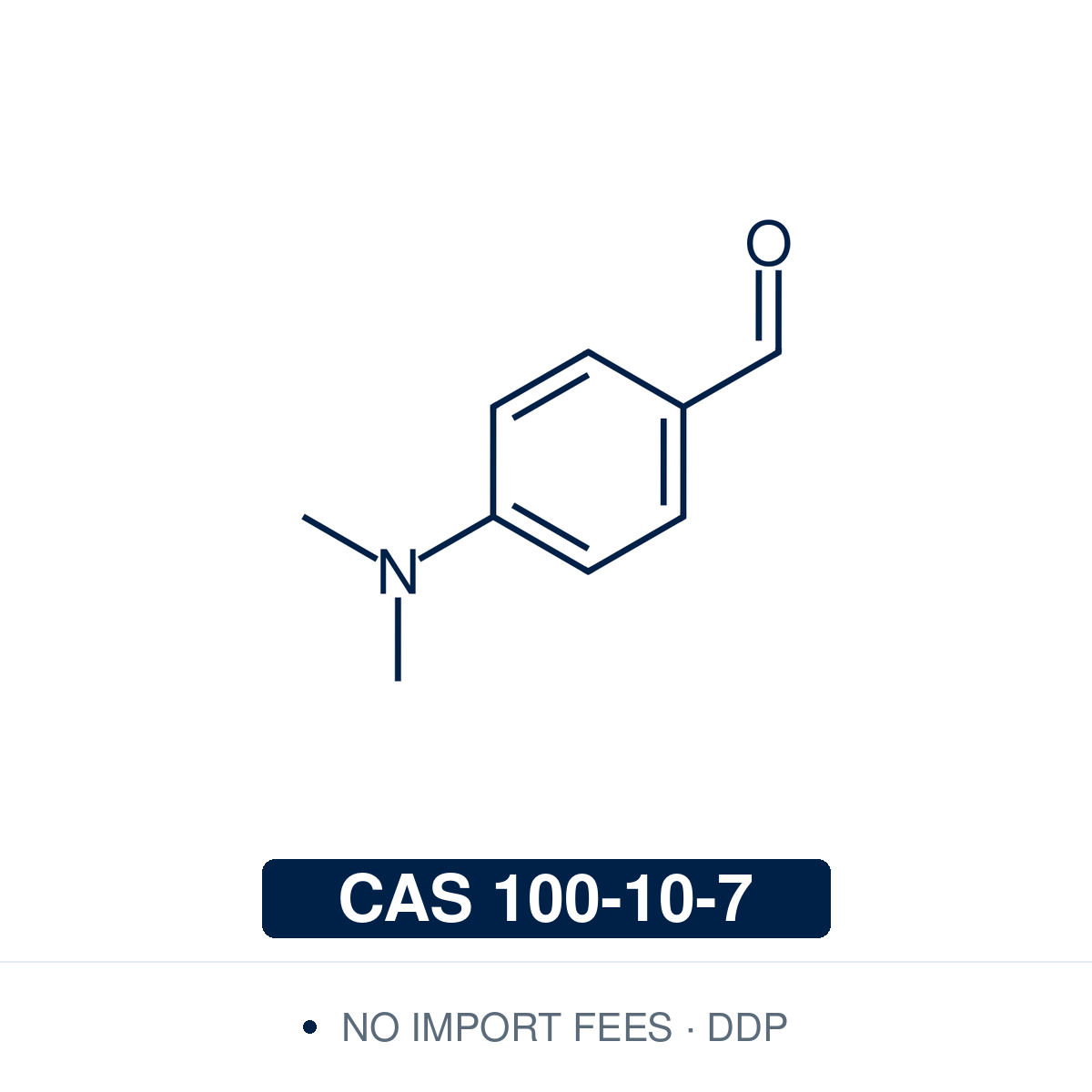
4-(Dimethylamino)benzaldehyde
4-(Dimethylamino)benzaldehyde | CAS 100-10-7 | ≥97%
| Pack size | Excl. VAT | Incl. VAT | Add to cart |
|---|---|---|---|
| 50 g | €39,90 | ||
| 100 g | €49,20 | ||
| 250 g | €64,20 | ||
| 500 g | €98,20 | ||
| 1 kg | €169,20 |
Taxes and fees, e.g. VAT, included in the price. Shipping calculated at checkout.Free shipping on EU, UK and EFTA orders above €250, and above €400 to the rest of the world.
Technical Specifications
| CAS Number | 100-10-7 |
| EC / EINECS Number | 202-819-0 |
| MDL Number | MFCD00003381 |
| RTECS Number | CU5775000 |
| SMILES | CN(C)C1=CC=C(C=C1)C=O |
| InChI | InChI=1S/C9H11NO/c1-10(2)9-5-3-8(7-11)4-6-9/h3-7H,1-2H3 |
| InChIKey | BGNGWHSBYQYVRX-UHFFFAOYSA-N |
| PubChem CID | 7479 |
| Molecular Formula | C₉H₁₁NO |
| Molecular Weight | 149.19 g/mol |
| Melting Point | 72–75 °C |
| Solubility | Soluble in ethanol, diethyl ether, chloroform and acetic acid; slightly soluble in water. |
| Purity | ≥97% |
| Physical Form | White to light yellow to green powder or crystals |
| HS Code | 2922.39 |
| Shelf Life | Retest period: 36 months from date of manufacture |
| Storage Conditions | Store in a cool, dry place in a tightly sealed container, protected from light. |
Product Description & Scientific Applications
4-(Dimethylamino)benzaldehyde (p-dimethylaminobenzaldehyde, DMAB) is the active component of the Ehrlich reagent. In this reagent DMAB is dissolved in ethanol with hydrochloric acid, which catalyses its condensation on the indole ring.
Reaction with indoles. With indole, the reaction takes place at the 3-position. Two indole molecules bind to one aldehyde molecule to form a bis(indolyl)methane, as shown by a crystal structure. With indoles substituted at the 3-position, the reaction is more likely to take place at the 2-position. The reaction needs strongly acidic conditions and the presence of an alcohol. The identity of the coloured product is still unclear.
Reaction with indole: two indole molecules bind at the 3-position to one aldehyde, giving a bis(indol-3-yl)methane. The coloured species formed in the test is not drawn.
Other analytes. The Ehrlich reagent also detects pyrroles, porphobilinogen and hydrazine.
Indole test for bacteria. Kovács' reagent contains DMAB together with isoamyl alcohol and concentrated hydrochloric acid. The reagent is used to test whether bacteria break down tryptophan to indole with the enzyme tryptophanase. After the reagent is added, a red colour in the surface layer shows a positive result and a yellow colour a negative result.
Hydrazine determination. Hydrazine reacts with DMAB to form an azine. Strong acids convert the azine into a quinoid form with an intense orange-red colour. This reaction has been used in a spectrophotometric method for the determination of hydrazine in environmental water.
General reaction: hydrazine + 2 4-(dimethylamino)benzaldehyde → azine. Strong acids convert the azine into the orange-red quinoid form (not drawn).
Schiff bases. DMAB condenses with primary amines to give coloured Schiff bases, and it also gives coloured products with pyrroles.
General reaction: R–NH₂ (primary amine) + 4-(dimethylamino)benzaldehyde → Schiff base (imine).
Sulfonamide determination. Sulfonamides have been determined spectrophotometrically through their condensation with an excess of DMAB in aqueous solution, in the presence of hydrochloric acid and the surfactant sodium dodecyl sulfate (SDS). The reaction has also been used to determine sulfonamide residues in milk.
Hemicyanine dyes. Condensation of a quaternised 2-methylbenzothiazole with DMAB has been used as a route to unsymmetrical hemicyanine dyes. These dyes were tested as visible-light photoinitiators for the free-radical polymerisation of vinyl monomers.
Condensation of a quaternised 2-methylbenzothiazolium salt with 4-(dimethylamino)benzaldehyde gives a hemicyanine dye (structure not drawn); R = N-substituent, X⁻ = counter-ion.
Shipping Destinations
- EU & UK: Priority delivery, 2–5 business days.
- United States (DDP): 3–7 business days, duties and taxes prepaid.
- EFTA Countries (DDP): 3–7 business days, duties and taxes prepaid.
- Worldwide: 7–14 business days, selected locations.
Safety Information
| GHS Pictograms |

|
| Signal Word | Warning |
| Hazard Class | Not regulated for transport |
| Transport Category | Not classified as dangerous goods for transport (ADR/IATA/IMDG) |
| H-Statements | H317 |
| P-Statements | P261 - P272 - P280 - P302+P352 - P333+P313 - P362+P364 - P501 |
Documentation
| Safety Data Sheet | Download PDF |