NorrChemica™
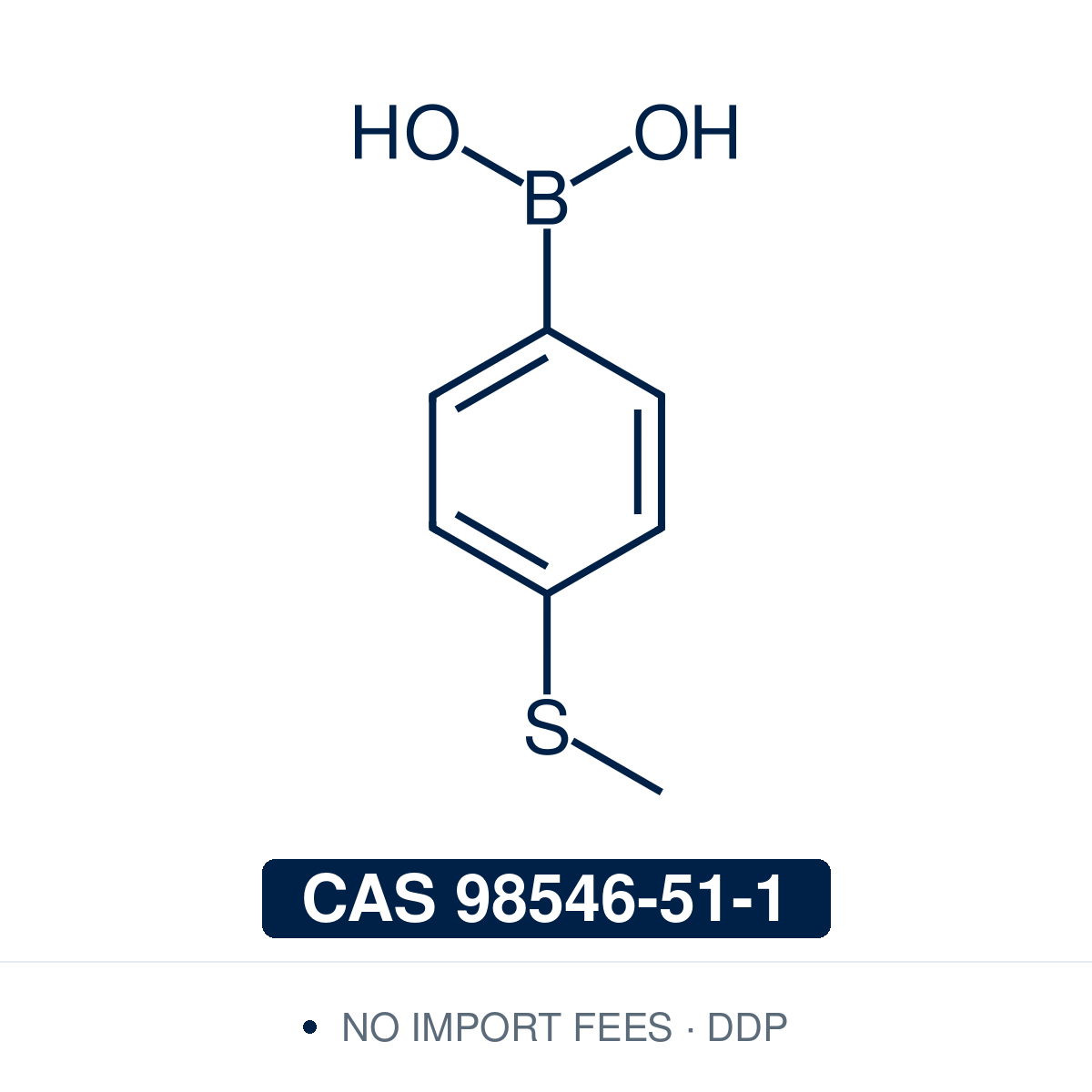
4-(Methylthio)phenylboronic Acid
4-(Methylthio)phenylboronic Acid | CAS 98546-51-1 | ≥97%
Couldn't load pickup availability
Technical Specifications
| CAS Number | 98546-51-1 |
| EC / EINECS Number | 619-361-6 |
| MDL Number | MFCD00093410 |
| SMILES | B(C1=CC=C(C=C1)SC)(O)O |
| InChI | InChI=1S/C7H9BO2S/c1-11-7-4-2-6(3-5-7)8(9)10/h2-5,9-10H,1H3 |
| InChIKey | IVUHTLFKBDDICS-UHFFFAOYSA-N |
| PubChem CID | 2733959 |
| Molecular Formula | C7H9BO2S |
| Molecular Weight | 168.03 g/mol |
| Melting Point | 210-214 °C |
| Solubility | Soluble in methanol |
| Purity | ≥97%. May contain small amounts of the corresponding boronic acid anhydride |
| Physical Form | Off-white to pale beige crystalline powder |
| HS Code | 2931.90 |
| Shelf Life | Retest period: 36 months from date of manufacture |
| Storage Conditions | Store in a cool, dry place in a tightly sealed container |
Product Description & Scientific Applications
4-(Methylthio)phenylboronic acid (4-thioanisoleboronic acid; 4-(methylsulfanyl)phenylboronic acid) is a para-substituted arylboronic acid carrying a methylthio thioether group. The substituent is close to electronically neutral at the para position (σp ≈ 0.00), as sulfur resonance donation and inductive withdrawal largely offset one another, so the reagent sits between the electron-rich 4-alkoxy arylboronic acids and the electron-poor 4-cyano and 4-trifluoromethyl members of the family. Consistent with this near-neutral effect, its boronic acid acidity is expected to remain close to that of unsubstituted phenylboronic acid rather than shifting toward the electron-rich or electron-poor extremes. The methylthio group is a useful chemical handle: a soft donor that can influence transition-metal coordination in sensitive systems, and a sulfide that can be oxidised after coupling, most directly to the corresponding sulfoxide and, under stronger oxidation conditions, to the sulfone. It is useful wherever a para-methylthioaryl unit, an oxidisable sulfide handle, or a thioether-bearing arylboronic acid coupling partner is required.
May contain small amounts of the cyclic anhydride 4-(methylthio)phenylboroxine. Under aqueous or basic coupling conditions the two forms re-equilibrate and the impact on yield is minor.
Applications and Reactions
- Suzuki–Miyaura coupling: installs the 4-(methylthio)phenyl group into aryl, alkenyl, and alkynyl frameworks; reported examples include cross-coupling with 2-aryl-1-bromo-1-nitroethenes and with alkynyl bromides. The thioether is generally compatible with coupling chemistry but may influence catalyst choice through sulfur coordination in sensitive systems.
- Methylthio as an oxidisable handle: the aryl sulfide undergoes sulfoxidation to the corresponding sulfoxide, allowing the electronic character and polarity of the coupled aryl group to be modified after installation.
- Addition to naphthyridine N-oxides: addition reactions with naphthyridine N-oxides provide access to arylated N-heterocyclic scaffolds.
- Oxyarylation of Heck intermediates: oxyarylation of Heck-reaction intermediates provides access to tetrahydrofuran (THF) derivatives.
- Copper-catalysed halogenation: reported copper-catalysed halogenation chemistry provides access to halogenated para-methylthioarene derivatives from the boronic acid handle.
Further Reading
For boronic acids, boronic esters, protodeboronation, boroxine content, and Suzuki–Miyaura reagent selection, see NorrChemica's Lab Journal guide: Choosing Your Boron Source for Suzuki–Miyaura Coupling.
Shipping Destinations
- EU & UK: Priority delivery, 2–5 business days.
- United States (DDP): 3–7 business days, duties and taxes prepaid.
- EFTA Countries (DDP): 3–7 business days, duties and taxes prepaid.
- Worldwide: 7–14 business days, selected locations.
Safety Information
| GHS Pictograms |

|
| Signal Word | Warning |
| Hazard Class | Not regulated for transport |
| Transport Category | Not classified as dangerous goods for transport (ADR/IATA/IMDG) |
| H-Statements | H315 - H319 - H335 |
| P-Statements | P261 - P264 - P271 - P280 - P302+P352 - P305+P351+P338 - P332+P313 - P337+P313 - P362+P364 - P501 |
Documentation
| Safety Data Sheet | Download PDF |