NorrChemica™
4-Methylumbelliferone
4-Methylumbelliferone | CAS 90-33-5 | ≥98%
Couldn't load pickup availability
Technical Specifications
| CAS Number | 90-33-5 |
| EC / EINECS Number | 201-986-7 |
| MDL Number | MFCD00006866 |
| SMILES | CC1=CC(=O)OC2=C1C=CC(=C2)O |
| InChI | InChI=1S/C10H8O3/c1-6-4-10(12)13-9-5-7(11)2-3-8(6)9/h2-5,11H,1H3 |
| InChIKey | HSHNITRMYYLLCV-UHFFFAOYSA-N |
| PubChem CID | 5280567 |
| Molecular Formula | C₁₀H₈O₃ |
| Molecular Weight | 176.17 g/mol |
| Melting Point | 188–192 °C |
| Solubility | Soluble in ethanol, methanol, DMSO, DMF, and dilute aqueous alkali; sparingly soluble in water at neutral pH; gives strong blue fluorescence under near-UV excitation. |
| Purity | ≥98% |
| Physical Form | Colourless to off-white crystalline powder |
| HS Code | 2932.20 |
| Country of Origin | Finland |
| Shelf Life | Retest period: 36 months from date of manufacture |
| Storage Conditions | Store in a cool, dry place in a tightly sealed container, protected from light |
Product Description & Scientific Applications
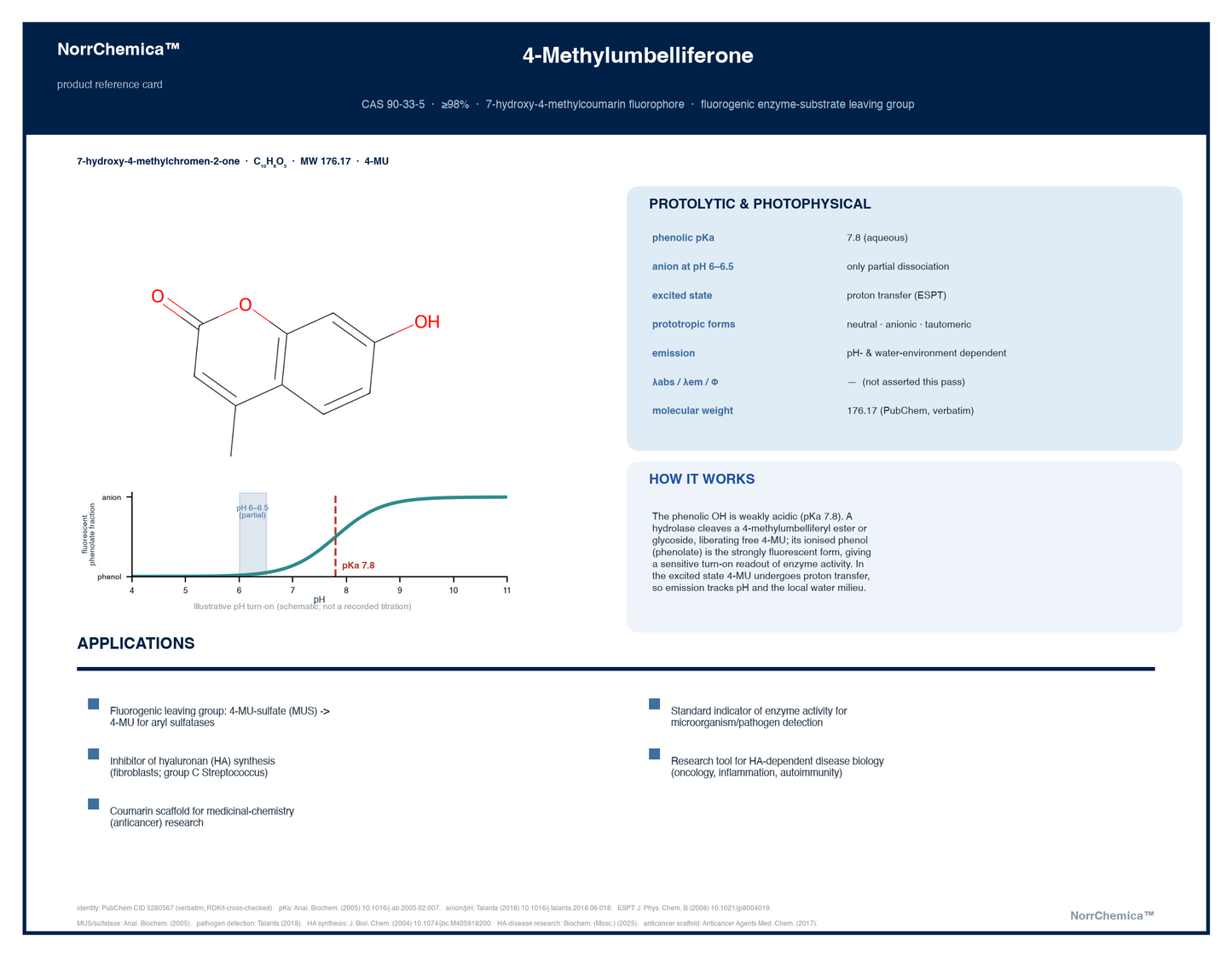
4-Methylumbelliferone (4-MU), 7-hydroxy-4-methylcoumarin, is a hydroxycoumarin fluorophore whose phenolic OH is weakly acidic, with a pKa of 7.8. Because this pKa is relatively high, the fluorescent anion only partially dissociates under the near-neutral conditions (pH 6–6.5) at which many enzymes are most active.
Excited-state proton transfer. In the excited state 4-MU undergoes proton transfer, and neutral, anionic and tautomeric prototropic forms can be identified, so its emission depends on pH and on the local water environment.
Fluorogenic enzyme substrates. Its most established use is as the fluorogenic leaving group of enzyme substrates: 4-methylumbelliferyl glycosides, sulfate and phosphate esters are cleaved by the corresponding hydrolases to release 4-MU, whose ionised phenol is strongly fluorescent, giving a sensitive readout of enzyme activity. 4-Methylumbelliferyl sulfate (MUS) is the common fluorogenic substrate for aryl sulfatases, and 4-MU-releasing substrates are standard indicators of enzymatic activity for detecting microorganisms and pathogens.
Hyaluronan-synthesis inhibition. 4-MU is also an inhibitor of hyaluronan synthesis, demonstrated in human skin fibroblasts and in group C Streptococcus. On this basis it is used in drug-discovery research as a hyaluronan-synthesis-inhibitor tool to study hyaluronan-dependent disease biology across oncology, inflammation and autoimmunity.
Coumarin scaffold. 4-MU also serves as a coumarin scaffold from which derivatives are synthesised and evaluated in anticancer research.
Shipping Destinations
- EU & UK: Priority delivery, 2–5 business days.
- United States (DDP): 3–7 business days, duties and taxes prepaid.
- EFTA Countries (DDP): 3–7 business days, duties and taxes prepaid.
- Worldwide: 7–14 business days, selected locations.
Safety Information
| GHS Pictograms |

|
| Signal Word | Warning |
| Hazard Class | Not regulated for transport |
| Transport Category | Not classified as dangerous goods for transport (ADR/IATA/IMDG) |
| H-Statements | H315 - H319 - H335 |
| P-Statements | P261 - P264 - P271 - P280 - P302+P352 - P304+P340 - P305+P351+P338 - P332+P317 - P337+P317 - P403+P233 - P405 - P501 |
Documentation
| Safety Data Sheet | Download PDF |