NorrChemica™
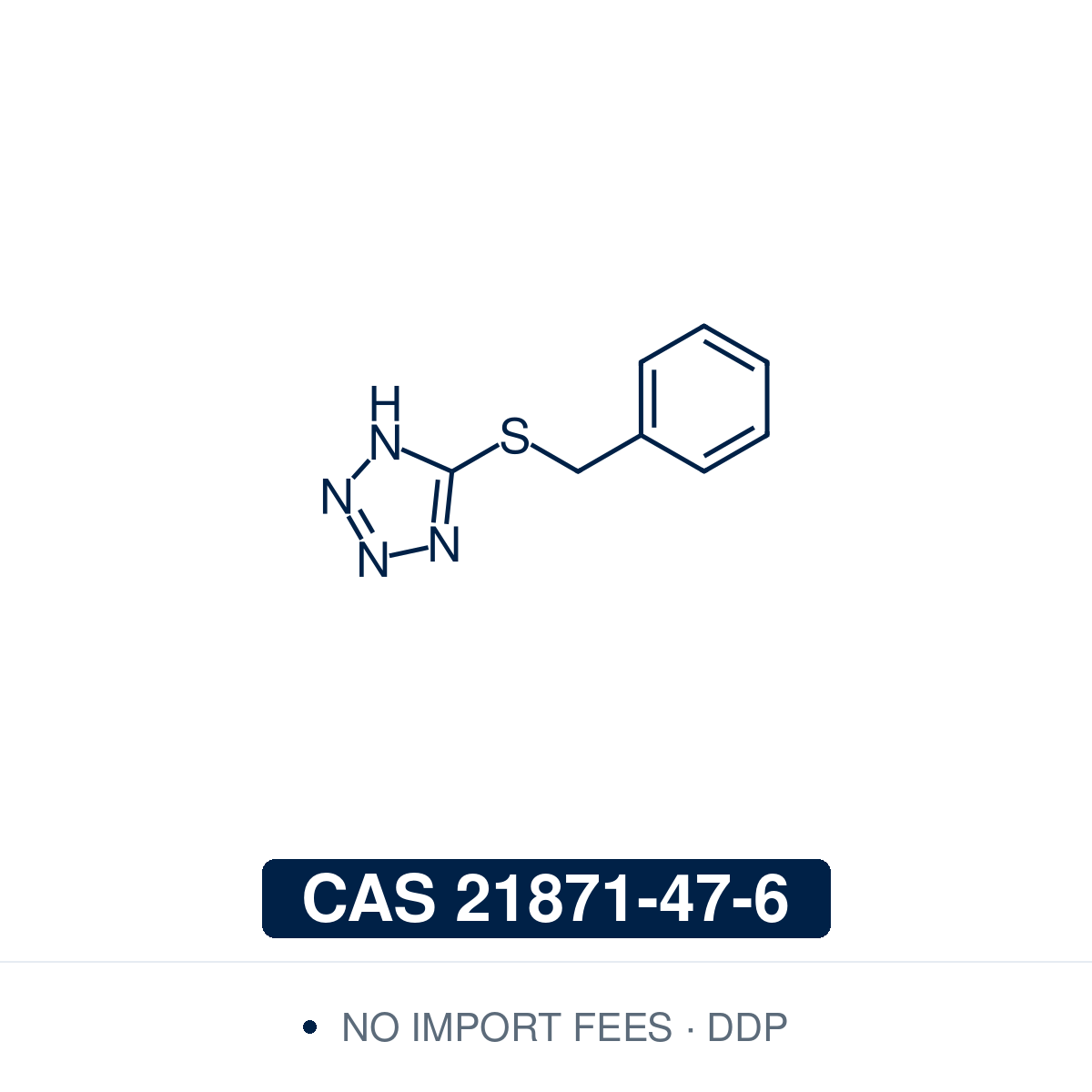
5-(Benzylthio)-1H-tetrazole (BTT)
5-(Benzylthio)-1H-tetrazole (BTT) | CAS 21871-47-6 | ≥98%
Pack sizes & prices
| Pack size | Excl. VAT | Incl. VAT | Add to cart |
|---|---|---|---|
| 1.0 g | €74,20 | ||
| 5.0 g | €89,20 | ||
| 25 g | €179,20 |
Taxes and fees, e.g. VAT, included in the price. Shipping calculated at checkout.Free shipping on EU, UK and EFTA orders above €250, and above €400 to the rest of the world.
Technical Specifications
| CAS Number | 21871-47-6 |
| EC / EINECS Number | 606-853-0 |
| MDL Number | MFCD00068731 |
| SMILES | C1=CC=C(C=C1)CSC2=NNN=N2 |
| InChI | InChI=1S/C8H8N4S/c1-2-4-7(5-3-1)6-13-8-9-11-12-10-8/h1-5H,6H2,(H,9,10,11,12) |
| InChIKey | GXGKKIPUFAHZIZ-UHFFFAOYSA-N |
| PubChem CID | 323185 |
| Molecular Formula | C₈H₈N₄S |
| Molecular Weight | 192.24 g/mol |
| Melting Point | 135–138 °C |
| Solubility | Soluble in acetonitrile and methanol. Insoluble in water. |
| Purity | ≥98% |
| Physical Form | White crystalline powder |
| HS Code | 2933.99 |
| Shelf Life | Retest period: 36 months from date of manufacture |
| Storage Conditions | Store in a cool, dry place in a tightly sealed container. |
Product Description & Scientific Applications
5-(Benzylthio)-1H-tetrazole (BTT) is a tetrazole with a benzylthio group at C-5. It is an activator for the coupling step of phosphoramidite oligonucleotide synthesis and is used in place of 1H-tetrazole.
How BTT activates the coupling. In each synthesis cycle, the activator first protonates the nucleoside phosphoramidite. Its anion then displaces diisopropylamine, and the activated monomer couples with the free 5′-hydroxyl group of the support-bound chain to give a phosphite triester. BTT works in the same way as 1H-tetrazole, as an acid and as a nucleophile, but it is more acidic. It is used as a solution in anhydrous acetonitrile, typically at 0.25–0.3 M.
BTT activates a nucleoside 3′-phosphoramidite (R¹ = protected nucleoside) for coupling with the free 5′-hydroxyl group of the growing chain (R² = support-bound oligonucleotide). The product is a phosphite triester.
RNA synthesis. Common RNA monomers carry a silyl-based protecting group on the 2′-oxygen: TBDMS (tert-butyldimethylsilyl) or TOM ([(triisopropylsilyl)oxy]methyl). BTT is widely used as the activator for both types. With 2′-O-TBDMS monomers, which couple slowly with 1H-tetrazole, BTT shortens the coupling time.
A 5′-O-DMT-2′-O-TBDMS ribonucleoside 3′-phosphoramidite (B = nucleobase, protected where needed), the type of RNA monomer that BTT activates.
Choice of activator. BTT is more acidic than 1H-tetrazole and ETT (5-ethylthio-1H-tetrazole). During coupling, the activator can also remove the 5′-DMT (dimethoxytrityl) group from part of the monomer. This side reaction increases with the acidity of the activator and can give n+1 by-products. Like ETT, BTT is recommended as a general-purpose activator and for short oligonucleotides at small to medium scale. Suppliers describe it as an activator for both DNA and RNA synthesis.
Shipping Destinations
- EU & UK: Priority delivery, 2–5 business days.
- United States (DDP): 3–7 business days, duties and taxes prepaid.
- EFTA Countries (DDP): 3–7 business days, duties and taxes prepaid.
- Worldwide: 7–14 business days, selected locations.
Safety Information
| Hazard Class | Not regulated for transport |
| Transport Category | Not classified as dangerous goods for transport (ADR/IATA/IMDG) |
Documentation
| Safety Data Sheet | Download PDF |
Share