NorrChemica™
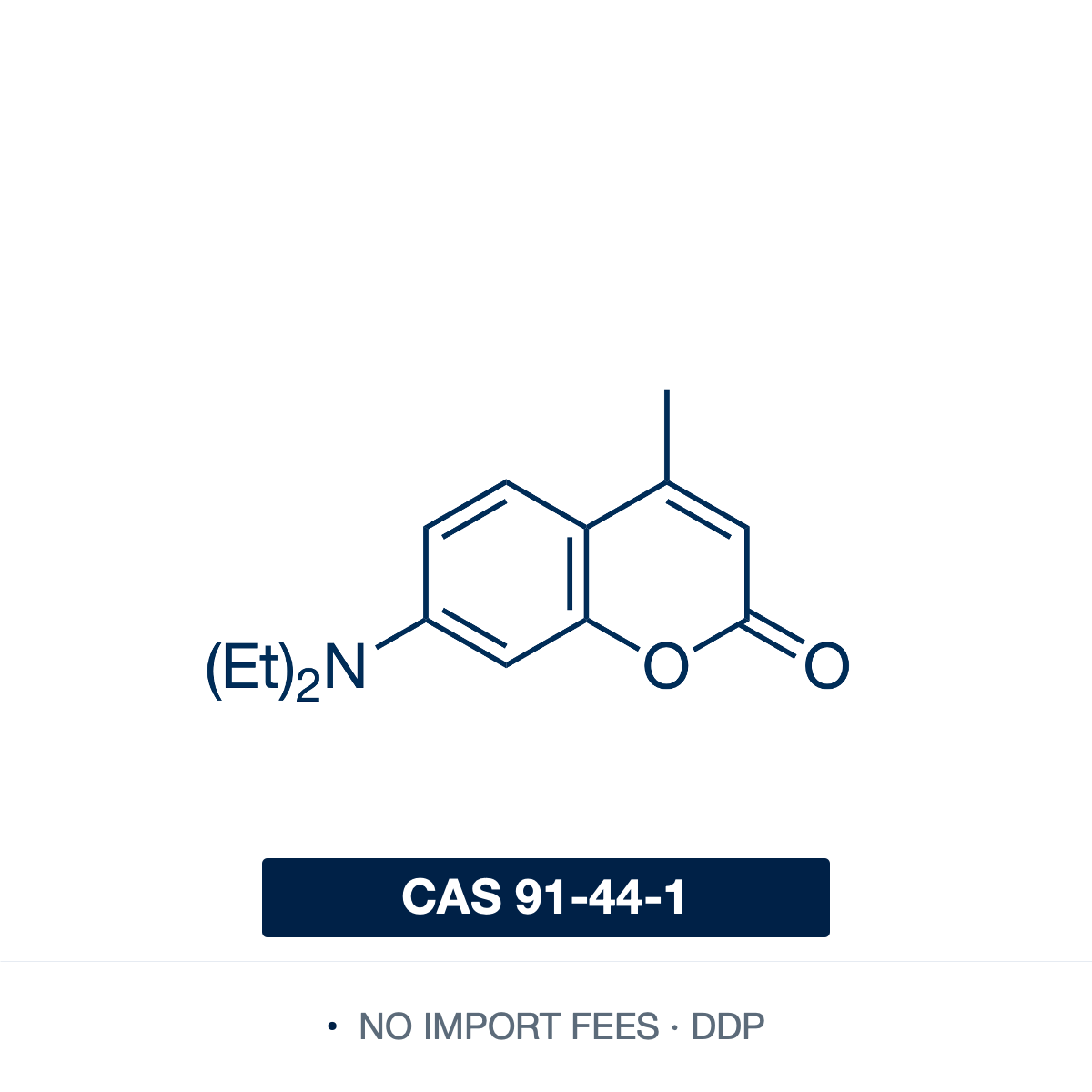
Coumarin 1
Coumarin 1 | CAS 91-44-1 | ≥98%
Couldn't load pickup availability
Technical Specifications
| CAS Number | 91-44-1 |
| EC / EINECS Number | 202-068-9 |
| MDL Number | MFCD00006864 |
| RTECS Number | GN6370000 |
| SMILES | CCN(CC)C1=CC2=C(C=C1)C(=CC(=O)O2)C |
| InChI | InChI=1S/C14H17NO2/c1-4-15(5-2)11-6-7-12-10(3)8-14(16)17-13(12)9-11/h6-9H,4-5H2,1-3H3 |
| InChIKey | AFYCEAFSNDLKSX-UHFFFAOYSA-N |
| PubChem CID | 7050 |
| Molecular Formula | C₁₄H₁₇NO₂ |
| Molecular Weight | 231.29 g/mol |
| Melting Point | 72–75 °C |
| Solubility | Soluble in methanol, chloroform, ethanol, and DMSO; practically insoluble in water |
| Purity | ≥98% |
| Physical Form | Light tan to amber crystalline powder |
| HS Code | 2932.20 |
| Country of Origin | Finland |
| Shelf Life | Retest period: 36 months from date of manufacture |
| Storage Conditions | Store at room temperature in a tightly sealed container, protected from moisture |
Product Description & Scientific Applications
7-Diethylamino-4-methylcoumarin (Coumarin 1; also Coumarin 47 and Coumarin 460 in laser-dye catalogues; C.I. Fluorescent Brightener 140; C.I. 551100) is a classic 7-aminocoumarin chromophore built on the 2H-chromen-2-one lactone scaffold, with an electron-donating diethylamino group at C7 and a methyl group at C4. Its photophysics shows strong donor–acceptor / intramolecular charge-transfer (ICT) character between the 7-NEt₂ donor and the coumarin lactone carbonyl acceptor, giving strong absorption near 373–375 nm and blue fluorescence/emission in the ~446–460 nm region depending on solvent, measurement mode, and laser-dye dataset.
Photophysics: spectral anchors and Stokes shift
In ethanol, the lowest absorption band of Coumarin 1 is centred near 373 nm with a molar decadic extinction coefficient ε ≈ 23,500 M⁻¹ cm⁻¹, and the corresponding fluorescence maximum is reported in the ~446–460 nm region depending on dataset and measurement conditions. This gives a large solvent-dependent Stokes shift of approximately 4,200–5,100 cm⁻¹ (~70–90 nm in ethanol), suppressing excitation–emission spectral overlap and producing the well-separated blue fluorescence characteristic of strong donor–acceptor 7-aminocoumarins. Reported ethanol fluorescence quantum yields vary substantially with source and oxygenation: PhotochemCAD entries report 0.50 and 0.73, while oxygen-, air-, and argon-saturated ethanol measurements span approximately 0.57–0.85, illustrating the importance of oxygen quenching and measurement conditions. Time-resolved measurements place Coumarin 1 fluorescence in ethanol near 3.1 ns, while broader substituted-coumarin and polymer-matrix studies show subnanosecond-to-few-nanosecond lifetimes depending on structure and environment. The Stokes shift originates in a substantial increase in molecular dipole moment on excitation: solvatochromic shift analyses, including Lippert–Mataga and related multi-parameter correlations, place the relaxed S₁ dipole moment substantially above the ground-state value, consistent with the ICT character.
ICT, TICT, and solvatochromic behaviour
In aprotic and weakly hydrogen-bonding media, Coumarin 1 fluoresces from a planar locally-excited/ICT manifold with moderate-to-high quantum yield and nanosecond fluorescence lifetimes. In polar protic and strongly hydrogen-bonding environments, carbonyl solvation and rotation of the dialkylamino group are commonly interpreted in terms of a lower-emissive twisted intramolecular charge-transfer (TICT) state, suppressing radiative decay and shifting the emission response; solvent polarity, hydrogen-bond donor/acceptor strength, microviscosity, and dissolved oxygen all measurably modulate Φf, fluorescence lifetime, and Stokes shift. These properties make Coumarin 1 a working probe of polarity, hydrogen-bonding environment, and confined or heterogeneous media such as polymer matrices, micelles, and cyclodextrin cavities, as well as a benchmark donor–acceptor chromophore for testing multi-parameter solvatochromic models.
Blue dye-laser operation and photonics
Coumarin 1 is one of the seminal aminocoumarin laser dyes for the blue spectral region. Under near-UV pulsed pumping — nitrogen laser (337 nm), XeCl excimer (308 nm), Nd:YAG third harmonic (355 nm), XeF excimer (351 nm), or flashlamp excitation — ethanolic or methanolic solutions of Coumarin 1 lase efficiently in the blue, with peak output typically near 457–462 nm and gain ranges commonly spanning approximately 440–490 nm depending on pump wavelength, solvent, concentration, and cavity configuration. The dye is therefore a classic, well-characterised blue laser dye in dye-laser studies, photonics, and photochemical excitation experiments requiring a well-defined blue-emitting chromophore.
Visible-light photoinitiator sensitiser chemistry
Coumarin 1 functions as a light-harvesting sensitiser in defined photoinitiating systems rather than as a standalone universal initiator. In Coumarin 1/iodonium systems under 405 nm LED irradiation, photoinduced electron transfer drives the cationic polymerisation of epoxide and epoxy-silicone resins, including UV/visible-light curing and 3D-printing resin research. Closely related coumarin derivatives — ketocoumarins and 3-acyl/3-carboxy push–pull coumarins — extend the same chromophore logic to iodonium/amine three-component systems that generate aryl and amine-derived radicals for free-radical polymerisation of acrylates and methacrylates, and to cationic polymerisation of oxetanes, vinyl ethers, and glycidyl ethers.
Aminocoumarin scaffold for fluorescent probe development
The 7-diethylamino-4-methylcoumarin core is a classic parent/reference scaffold of fluorescent-probe chemistry. Coumarin 1 itself is not an activated bioconjugation reagent but a parent/reference 7-aminocoumarin chromophore for comparison with functionalised derivatives: 3-carboxylic-acid and 3-carbaldehyde coumarins that introduce handles for amide-coupling, NHS-ester, hydrazone, or click-chemistry conjugation; π-extended benzo- and naphtho-coumarins for red-shifted and two-photon-active emission; and donor–acceptor coumarins designed as photosensitisers for dye-sensitised solar-cell and molecular-rotor research. It also serves as a synthetic intermediate to π-extended sensitisers and fluorescent-label coumarins.
Applied photonics and luminescent materials
Beyond solution-phase applications, Coumarin 1 is reported as an optical brightener for selected fibre, paper, coating, and polymer applications, converting absorbed near-UV light into visible blue fluorescence. In materials and photonics research it is employed as a luminescent dopant in polymer films, hydrogels, and porous-host matrices; as a model two-photon-absorption (TPA) chromophore in nonlinear-optical and optical-limiting research; and as a secondary fluorescent solute in organic liquid scintillators for radiation detection, where the dye's blue emission shifts primary scintillator output to a wavelength better matched to photomultiplier-tube response. The same blue-emissive D-π-A architecture has been exploited in dye-encapsulated terbium metal–organic-framework composites for ratiometric temperature sensing.
Further applications
- Reference compound for spectral and quantum-yield comparisons in the 7-aminocoumarin series.
- Blue-emitting donor chromophore in donor–acceptor photophysics studies in solution, polymer films, and supramolecular assemblies.
- Fluorescent probe in supramolecular host–guest systems, cyclodextrin cavities, and confined media.
- Fluorescent reporter for picosecond and ultrafast time-resolved spectroscopy of excited-state dynamics, amplified emission, and fluorescence anisotropy.
Shipping Destinations
- EU & UK: Priority delivery, 2–5 business days.
- United States (DDP): 3–7 business days, duties and taxes prepaid.
- EFTA Countries (DDP): 3–7 business days, duties and taxes prepaid.
- Worldwide: 7–14 business days, selected locations.
Safety Information
| Hazard Class | None — not subject to transport regulations |
| Transport Category | Not classified as dangerous goods for transport (ADR/IATA/IMDG) |
Documentation
| Safety Data Sheet | Download PDF |
Share