NorrChemica™
Adenine
Adenine | CAS 73-24-5 | ≥98%
| Pack size | Excl. VAT | Incl. VAT | Add to cart |
|---|---|---|---|
| 5.0 g | €69,20 | ||
| 10 g | €89,20 | ||
| 25 g | €129,20 |
Taxes and fees, e.g. VAT, included in the price. Shipping calculated at checkout.Free shipping on EU, UK and EFTA orders above €250, and above €400 to the rest of the world.
Technical Specifications
| CAS Number | 73-24-5 |
| EC / EINECS Number | 200-796-1 |
| MDL Number | MFCD00041790 |
| RTECS Number | AU6125000 |
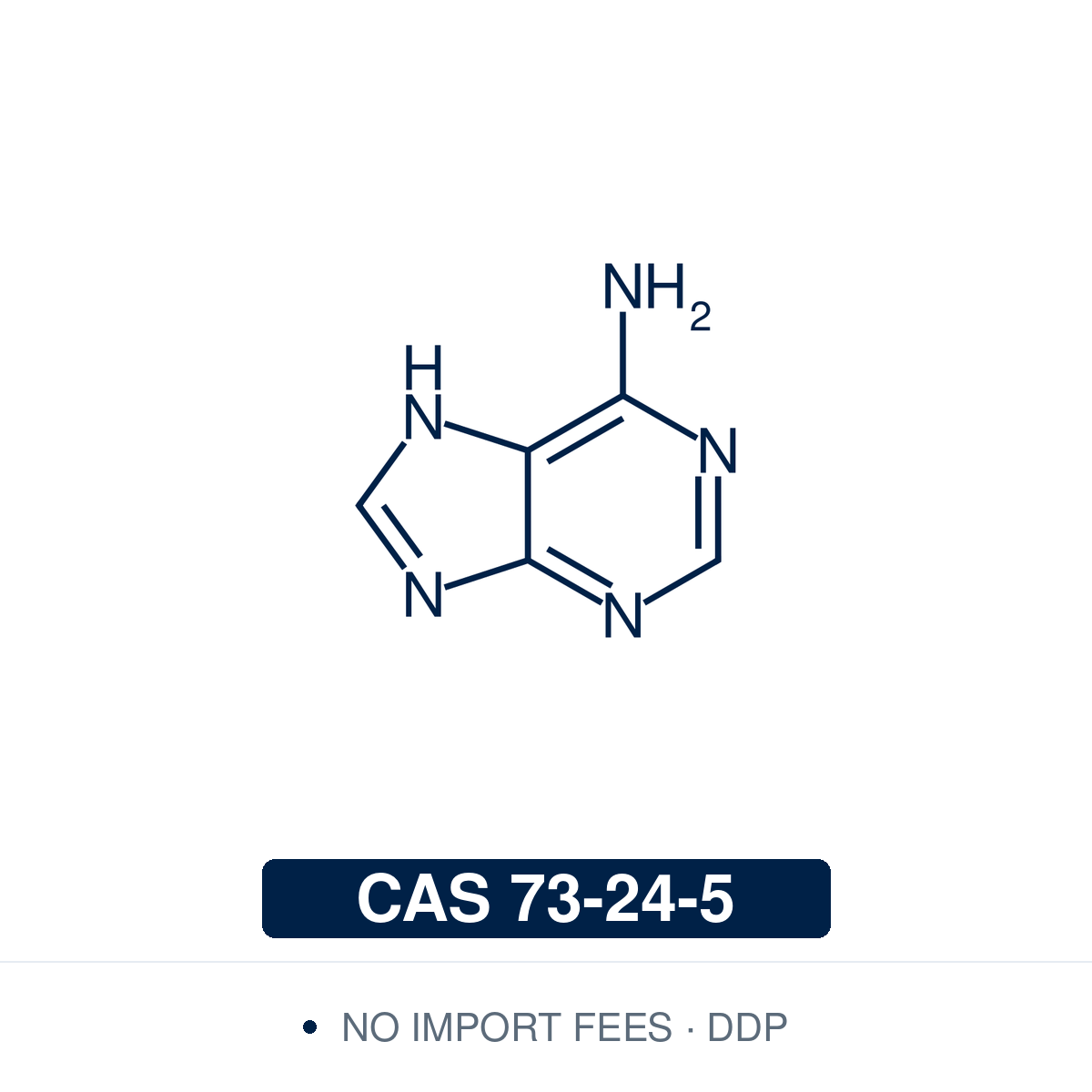
| SMILES | C1=NC2=NC=NC(=C2N1)N |
| InChI | InChI=1S/C5H5N5/c6-4-3-5(9-1-7-3)10-2-8-4/h1-2H,(H3,6,7,8,9,10) |
| InChIKey | GFFGJBXGBJISGV-UHFFFAOYSA-N |
| PubChem CID | 190 |
| Molecular Formula | C₅H₅N₅ |
| Molecular Weight | 135.13 g/mol |
| Melting Point | 360 °C (dec.) |
| Solubility | Soluble in hot water, methanol and ethanol. Slightly soluble in cold water. Insoluble in diethyl ether |
| Purity | ≥98% |
| Physical Form | White to off-white powder |
| HS Code | 2933.59 |
| Shelf Life | Retest period: 36 months from date of manufacture |
| Storage Conditions | Keep containers tightly closed in a dry, cool and well-ventilated place |
Product Description & Scientific Applications
Adenine is a purine nucleobase, one of the two purines in DNA and RNA, and pairs with thymine or uracil through Watson–Crick hydrogen bonding. Its rigid structure and strong metal-binding ability have been widely studied and support its use as a ligand in metal-based catalysis.
N9 versus N3 alkylation. Under basic conditions, adenine is benzylated at N9 and N3: polar aprotic solvents such as DMSO, DMF and acetonitrile favour the N9 product, while polar protic solvents such as water favour the N3 isomer. With other electrophiles the minor isomer differs: the N7 isomer forms alongside the N9 product when adenine is alkylated with the iodide reagent of the adefovir synthesis, and the exocyclic amino group is alkylated as a by-product with (R)-4-methyl-1,3-dioxolan-2-one.
Antiviral nucleotide analogues. Tenofovir disoproxil fumarate and tenofovir alafenamide are manufactured from adenine. Its alkylation with (R)-4-methyl-1,3-dioxolan-2-one gives (R)-9-(2-hydroxypropyl)adenine, which is then alkylated with a tosylated hydroxymethylphosphonate diester. In the synthesis of adefovir, alkylation of adenine with an iodide reagent gives the phosphonate directly.
Nucleoside synthesis. Glycosylation of adenine with peracylated sugar precursors gives nucleoside analogues, including trifluoromethyl- and dideoxy-substituted adenosine derivatives evaluated for antiviral activity.
Coordination polymers. With silver ions, adenine forms coordination frameworks whose nuclearity depends on the N9 substituent, from dinuclear complexes to linear polymeric chains.
Corrosion inhibition. Adenine is a natural inhibitor of mild-steel corrosion in NaCl solution when co-encapsulated with benzimidazole in a bio-metal–organic framework.
Peptide conjugates. Propargyladenine, coupled to homoazidoalanine by copper-catalysed azide–alkyne cycloaddition, gives nucleopeptide monomers for triazole-linked adenine peptides that recognise U-rich HIV RNA motifs.
Supramolecular templating. Oligoadenine templates (dA20, dA40) direct thymine-substituted donor–acceptor π-conjugated monomers to self-assemble into tubular nanostructures through complementary adenine–thymine hydrogen bonding, an initial step towards DNA-templated polymerisation of synthetic DNA-mimetic polymers.
Shipping Destinations
- EU & UK only: 3–7 business days.
Safety Information
| GHS Pictograms |

|
| Signal Word | Danger |
| Hazard Class | UN 2811 — Toxic solid, organic, n.o.s. (Adenine) (Class 6.1, PG III) |
| Transport Category | Class 6.1, PG III (ADR/IATA/IMDG) |
| H-Statements | H301 |
| P-Statements | P264 - P270 - P301+P310 - P405 - P501 |
Documentation
| Safety Data Sheet | Download PDF |