NorrChemica™
Alcian Blue 8GX
Alcian Blue 8GX | CAS 33864-99-2 | Dye Content ≥80%
Couldn't load pickup availability
Technical Specifications
| CAS Number | 33864-99-2 |
| EC / EINECS Number | 251-705-7 |
| MDL Number | MFCD00010720 |
| RTECS Number | AY9950000 |
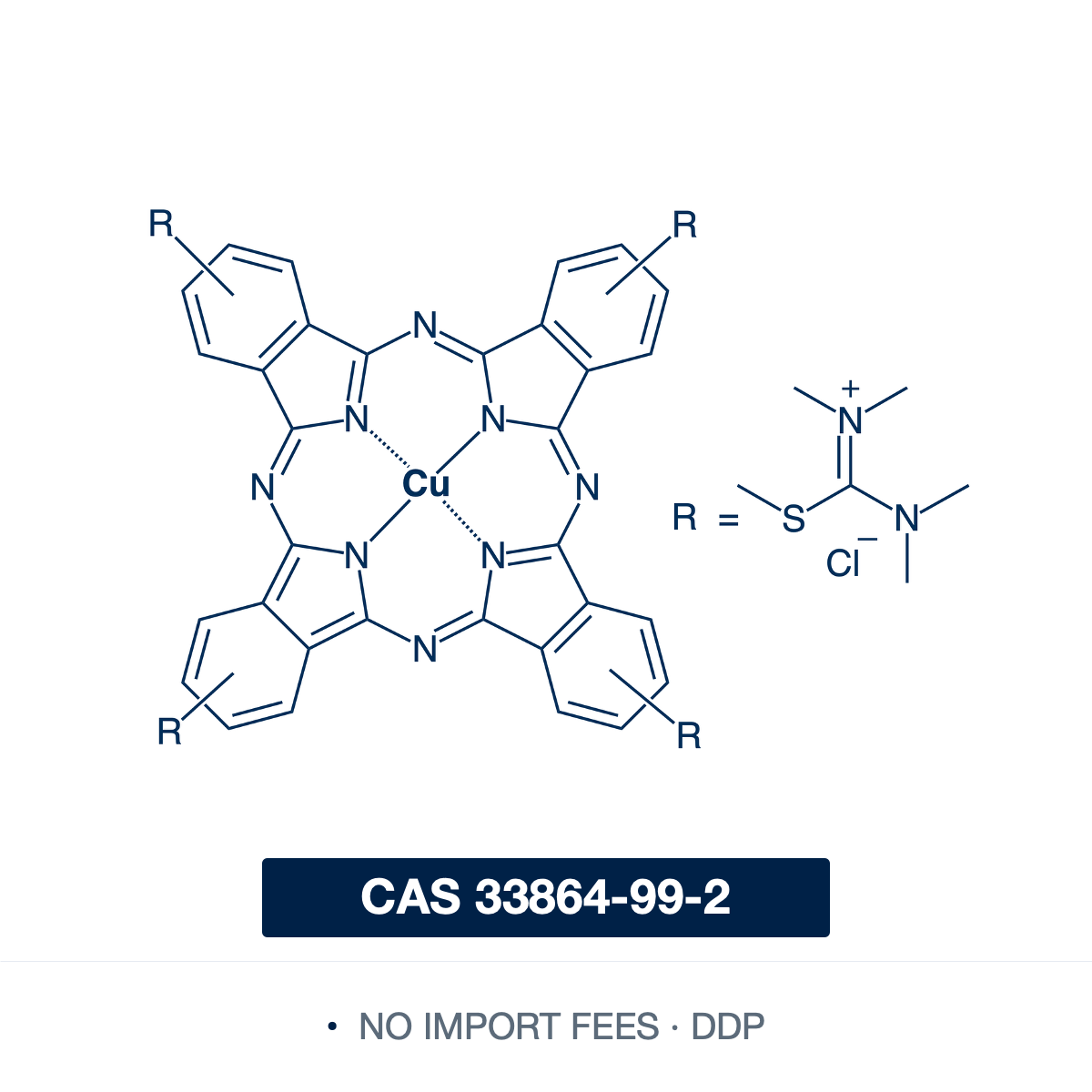
| SMILES | CN(C)C(=[N+](C)C)SCC1=CC2=C(C=C1)C3=NC4=NC(=NC5=C6C=C(C=CC6=C([N-]5)N=C7C8=C(C=CC(=C8)CSC(=[N+](C)C)N(C)C)C(=N7)N=C2[N-]3)CSC(=[N+](C)C)N(C)C)C9=C4C=C(C=C9)CSC(=[N+](C)C)N(C)C.[Cl-].[Cl-].[Cl-].[Cl-].[Cu+2] |
| InChI | InChI=1S/C56H68N16S4.4ClH.Cu/c1-65(2)53(66(3)4)73-29-33-17-21-37-41(25-33)49-57-45(37)62-50-43-27-35(31-75-55(69(9)10)70(11)12)19-23-39(43)47(59-50)64-52-44-28-36(32-76-56(71(13)14)72(15)16)20-24-40(44)48(60-52)63-51-42-26-34(18-22-38(42)46(58-51)61-49)30-74-54(67(5)6)68(7)8;;;;;/h17-28H,29-32H2,1-16H3;4*1H;/q+2;;;;;+2/p-4 |
| InChIKey | CKLBXIYTBHXJEH-UHFFFAOYSA-J |
| PubChem CID | 16211091 |
| Molecular Formula | C₅₆H₆₈Cl₄CuN₁₆S₄ |
| Molecular Weight | 1298.86 g/mol |
| Melting Point | ~148 °C |
| Solubility | Soluble in water (~8 mg/mL), ethanol (~1 mg/mL), ethylene glycol, cellosolve; practically insoluble in xylene |
| Purity | Dye content ≥80% |
| Physical Form | Dark blue to purple crystalline powder |
| HS Code | 3204.19 |
| Country of Origin | Finland |
| Shelf Life | Retest period: 36 months from date of manufacture |
| Storage Conditions | Store refrigerated (2–8 °C) in a tightly sealed container, protected from light and moisture |
Product Description & Scientific Applications
Alcian Blue 8GX (Ingrain Blue 1; C.I. 74240) is a water-soluble cationic copper phthalocyanine dye used in histology, cell biology, plant science, microbiology, and analytical chemistry as a selective stain for acidic mucins, glycosaminoglycans, and proteoglycan-rich extracellular matrix. The phthalocyanine core is decorated with cationic methylene-tetramethyl-isothiouronium chloride substituents through thioether linkages, giving multivalent positive character and strong electrostatic affinity for anionic sulfate and carboxylate groups on acidic carbohydrates; the average molecule carries three to four such side chains, and commercial material is specified by dye content rather than chemical purity to reflect this. It is supplied as a dark blue to blue-green powder that dissolves in water to clear blue to turquoise-blue solutions.
Histochemical staining of acidic mucins and glycosaminoglycans. Alcian Blue 8GX visualises acidic mucins, glycosaminoglycans, and proteoglycan-rich matrix in both light- and electron-microscopic tissue sections. Its cationic isothiouronium groups bind the ionised sulfate and carboxylate groups of chondroitin-4-sulfate, chondroitin-6-sulfate, dermatan sulfate, keratan sulfate, heparan sulfate, hyaluronan, and acidic epithelial mucins, producing intense blue staining of mucin-rich epithelia, connective-tissue matrix, and cartilage. Selectivity is controlled by pH: at pH 2.5 in dilute acetic acid, both carboxylate and sulfate are ionised and acidic mucins and proteoglycans stain broadly; at pH 1.0 in dilute HCl, carboxyl ionisation is suppressed and staining is restricted to strongly sulfated mucopolysaccharides, discriminating sulfate-rich from carboxylate-rich substrates. In sequential Alcian Blue–PAS, acidic mucins stain blue and neutral carbohydrates magenta; with Safranin O it discriminates mast-cell granule populations in connective-tissue research.
Whole-mount cartilage and skeletal staining. Alcian Blue 8GX is the standard cartilage stain in dual whole-mount skeletal preparations of embryos, larvae, and small vertebrates, used with Alizarin Red S to visualise cartilaginous and mineralised skeletal elements in transparent cleared specimens. It binds the sulfated proteoglycans of cartilage matrix, including chondroitin-sulfate and keratan-sulfate components, while Alizarin Red S binds Ca²⁺ in the hydroxyapatite of mineralised bone, giving a blue-cartilage, red-bone preparation in KOH- or enzymatically cleared specimens. The dual stain is foundational for skeletal-morphology assessment, cartilage- and bone-patterning studies, developmental biology, comparative and evolutionary anatomy, developmental-toxicity studies, and skeletal phenotyping in transgenic and CRISPR-edited mouse lines, resolving three-dimensional skeletal anatomy without serial histological sectioning.
Critical electrolyte concentration and glycosaminoglycan analysis. The CEC approach uses electrolyte competition to modulate Alcian Blue binding to acidic polysaccharides. At a fixed near-neutral pH (≈5.5–5.8), rising concentrations of magnesium chloride or salts such as NaCl, KCl, or LiBr let the smaller competing cation displace dye from weaker anionic sites, so binding restricts progressively to more strongly anionic substrates. Different glycosaminoglycan classes have characteristic CEC thresholds, comparing charge density across cartilage, connective tissue, mast-cell granules, stromal matrix, and vascular glycocalyx. Beyond tissue sections, its binding underpins quantitative glycosaminoglycan and proteoglycan assays — precipitation, electrophoretic, and densitometric — in which insoluble dye–glycosaminoglycan complexes give the analytical readout.
Further applications.
- Plant cell-wall pectin and acidic-polysaccharide localisation in plant histology and cell biology.
- Capsular and extracellular polysaccharide staining of bacteria in microbiological research.
- Detection and quantification of transparent exopolymer particles (TEP) in marine, freshwater, and water-treatment research.
- Glycocalyx staining of sialylated cell-surface carbohydrates for cell-biology research.
- Heavy-atom contrast staining for transmission electron microscopy of acidic polysaccharides, exploiting the central Cu²⁺ of the phthalocyanine core for direct electron-density signal in cartilage matrix, glycocalyx, and proteoglycan-rich structures.
Shipping Destinations
- EU & UK: Priority delivery, 2–5 business days.
- United States (DDP): 3–7 business days, duties and taxes prepaid.
- EFTA Countries (DDP): 3–7 business days, duties and taxes prepaid.
- Worldwide: 7–14 business days, selected locations.
Safety Information
| Hazard Class | None — not subject to transport regulations |
| Transport Category | Not classified as dangerous goods for transport (ADR/IATA/IMDG) |
Documentation
| Safety Data Sheet | Download PDF |
Share