NorrChemica™
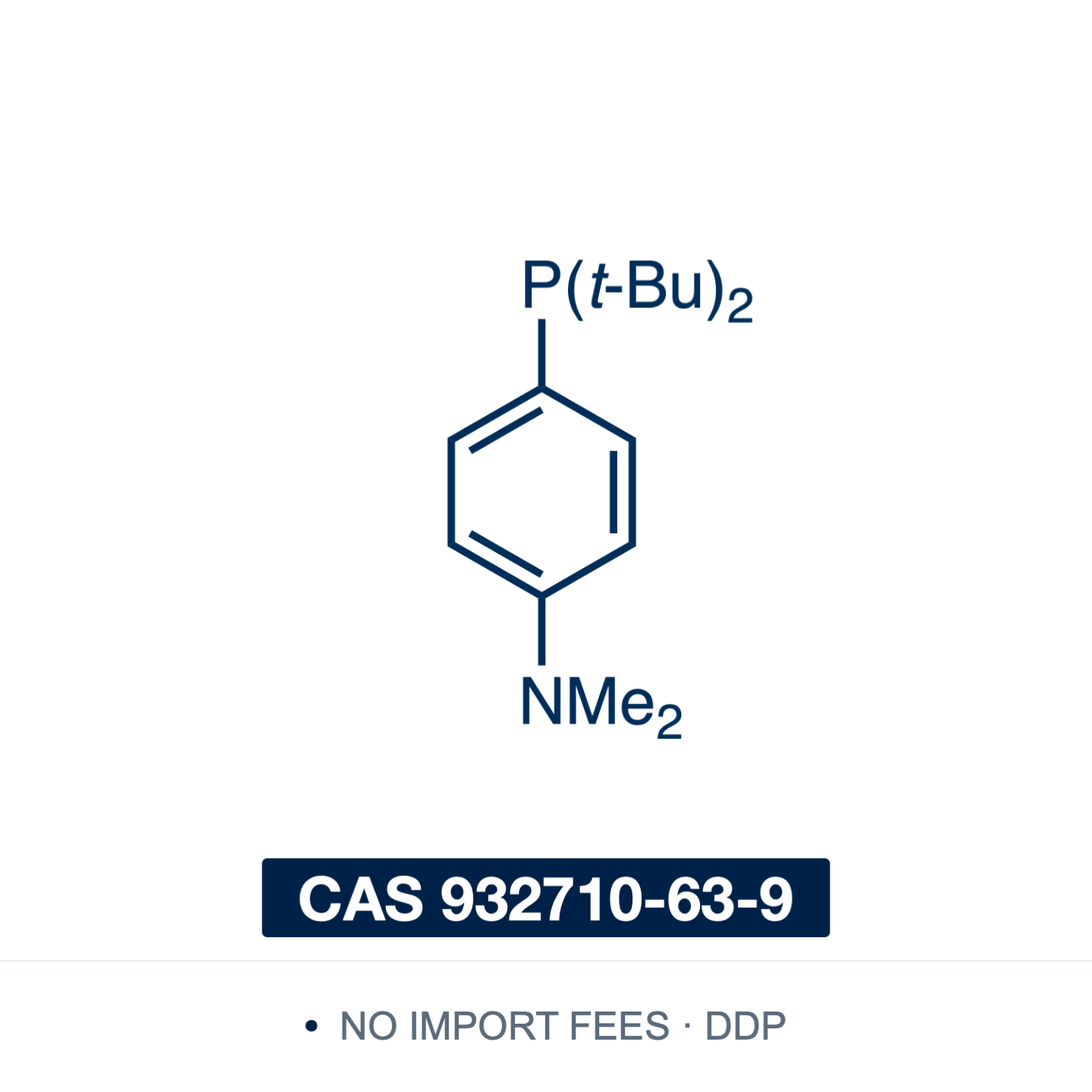
Amphos (Di-tert-butyl(4-dimethylaminophenyl)phosphine)
CAS 932710-63-9
≥97%
Amphos (Di-tert-butyl(4-dimethylaminophenyl)phosphine) | CAS 932710-63-9 | ≥97%
Regular price
€39,20 EUR (incl. VAT)
Regular price
Sale price
€39,20 EUR
Taxes included.
Shipping calculated at checkout.
Quantity
Couldn't load pickup availability
Technical Specifications
| CAS Number | 932710-63-9 |
| EC / EINECS Number | 802-197-6 |
| MDL Number | MFCD09265102 |
| SMILES | CC(C)(C)P(C1=CC=C(C=C1)N(C)C)C(C)(C)C |
| InChI | InChI=1S/C16H28NP/c1-15(2,3)18(16(4,5)6)14-11-9-13(10-12-14)17(7)8/h9-12H,1-8H3 |
| InChIKey | IQTHEAQKKVAXGV-UHFFFAOYSA-N |
| PubChem CID | 11714598 |
| Molecular Formula | C₁₆H₂₈NP |
| Molecular Weight | 265.37 g/mol |
| Melting Point | 57 - 61 °C |
| Solubility | Insoluble in water as the free phosphine; soluble in acetone and common organic solvents |
| Purity | ≥97% |
| Physical Form | White to light yellow crystalline powder |
| HS Code | 2931.90 |
| Shelf Life | Retest period: 36 months from date of manufacture |
| Storage Conditions | Store in a cool, dry place in a tightly sealed container under inert atmosphere |
Product Description & Scientific Applications
AmPhos (A-taPhos) is strongly electron-donating: the para-dimethylamino group makes it the most electron-rich of the PtBu₂(p-R-C₆H₄) phosphines, and the reason its palladium complexes turn over heteroaryl chlorides.
The free ligand oxidises slowly to the phosphine oxide in air and is best handled under inert gas. The derived PdCl₂(AmPhos)₂ complex is air-stable and bench-weighable, and is often used in preference to generating the catalyst in situ.
Applications and Reactions
- Suzuki–Miyaura coupling of heteroaryl chlorides: air-stable palladium dichloride complexes of this ligand class couple arylboronic acids with aryl halides, with five-membered heteroaryl halides, and with six-membered heteroaryl chlorides bearing heteroatom substituents. Isolated yields of 89–99% and turnover numbers reaching 10,000 are reported, under both anhydrous and aqueous conditions.
- Coupling in water: Negishi couplings in water are best done using this ligand on palladium. The nanoparticle catalyst forms from palladium acetate and this ligand in tetrahydrofuran, treated with methylmagnesium chloride.
- Suppressing hydride elimination: in a reductive cross-coupling this ligand was pivotal in minimising hydride elimination, all other ligands examined giving lower yields. In vinylation the mechanism prevents build-up of the vinylpalladium intermediate that forms after oxidative addition, reducing homocoupling to butadiene.
- Stoichiometric azide chemistry: it forms a stable phosphazide with an azide, the basis of an azide protection strategy. Michael addition onto that phosphazide cleaves the nitrogen–nitrogen bond and delivers a diazo compound rather than returning the azide.
- Polymerisation: the AmPhos Pd G2 precatalyst polymerises a fluorene monomer, the palladium(0) generated from it initiating slowly.
Further Reading
Practical guidance on choosing a phosphine ligand for palladium- and nickel-catalysed cross-coupling in NorrChemica's Lab Journal: Phosphine Ligands for Cross-Coupling.
Shipping Destinations
- EU & UK: Priority delivery, 2–5 business days.
- United States (DDP): 3–7 business days, duties and taxes prepaid.
- EFTA Countries (DDP): 3–7 business days, duties and taxes prepaid.
- Worldwide: 7–14 business days, selected locations.
Safety Information
| GHS Pictograms |


|
| Signal Word | Warning |
| Hazard Class | Not regulated for transport |
| Transport Category | Not classified as dangerous goods for transport (ADR/IATA/IMDG) |
| H-Statements | H315 - H319 - H341 |
| P-Statements | P201 - P202 - P264 - P280 - P302+P352 - P305+P351+P338 - P308+P313 - P332+P313 - P337+P313 - P362+P364 - P405 - P501 |
Documentation
| Safety Data Sheet | Download PDF |