NorrChemica™
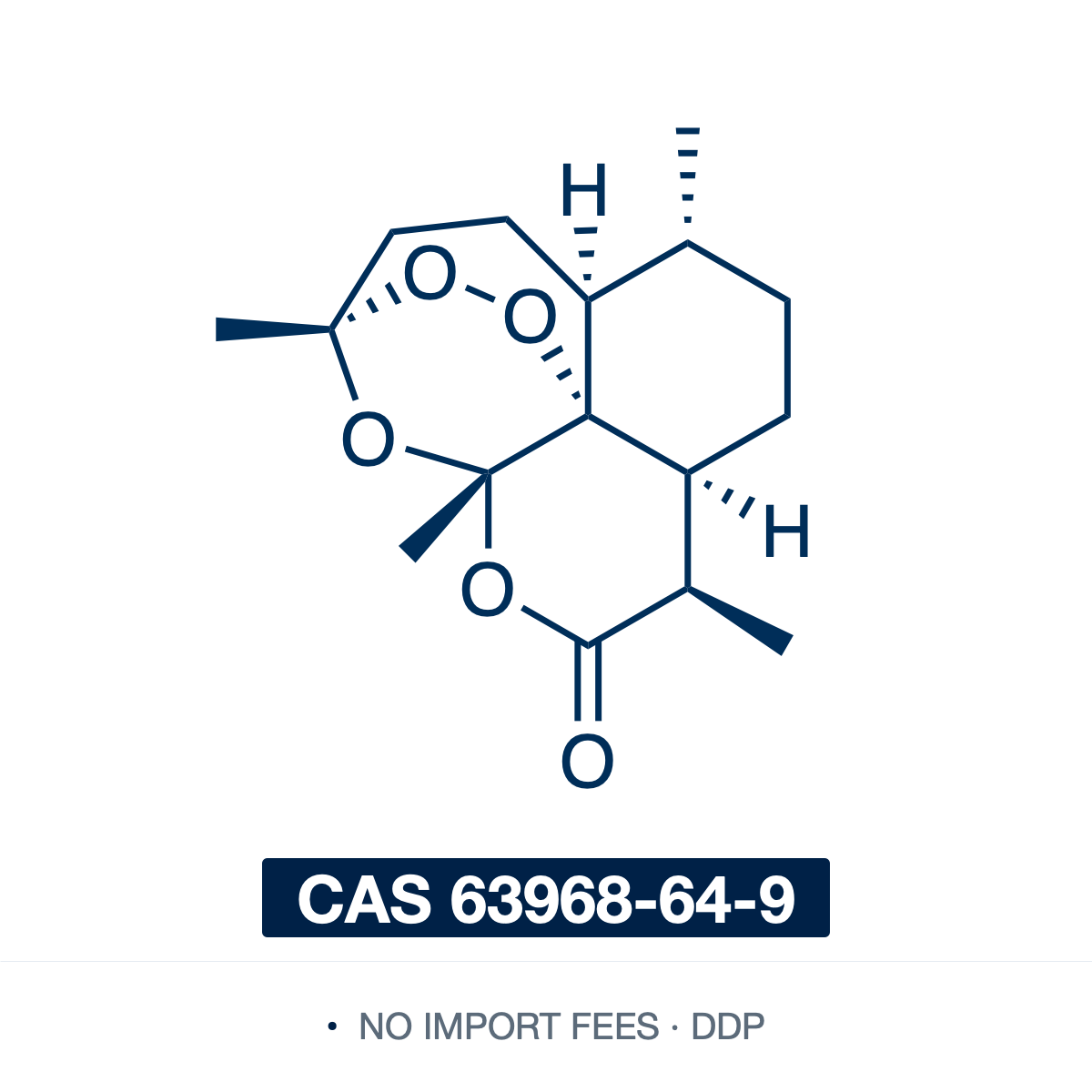
Artemisinin
Artemisinin | CAS 63968-64-9 | ≥97%
Couldn't load pickup availability
Technical Specifications
| CAS Number | 63968-64-9 |
| EC / EINECS Number | 700-290-5 |
| MDL Number | MFCD00081057 |
| RTECS Number | KD4170000 |
| SMILES | C[C@@H]1CC[C@H]2[C@H](C(=O)O[C@H]3[C@@]24[C@H]1CC[C@](O3)(OO4)C)C |
| InChI | InChI=1S/C15H22O5/c1-8-4-5-11-9(2)12(16)17-13-15(11)10(8)6-7-14(3,18-13)19-20-15/h8-11,13H,4-7H2,1-3H3/t8-,9-,10+,11+,13-,14-,15-/m1/s1 |
| InChIKey | BLUAFEHZUWYNDE-NNWCWBAJSA-N |
| PubChem CID | 68827 |
| Molecular Formula | C₁₅H₂₂O₅ |
| Molecular Weight | 282.33 g/mol |
| Melting Point | 156–157 °C |
| Solubility | Soluble in methanol, ethanol, and DMSO. Sparingly soluble in water. |
| Purity | ≥97% |
| Physical Form | White to off-white crystalline solid |
| HS Code | 2932.99 |
| Shelf Life | Retest period: 36 months from date of manufacture |
| Storage Conditions | Store in a tightly sealed container in a cool, dark place below 15 °C. |
Product Description & Scientific Applications
Artemisinin (qinghaosu, arteannuin) is the 1,2,4-trioxane sesquiterpene lactone of Artemisia annua. The endoperoxide is the warhead: desoxo analogues are inactive. Synthetic endoperoxides vary it as 1,2-dioxanes, 1,2,4-trioxolanes and 1,2,4,5-tetraoxanes.
Activation and alkylation. Iron(II) heme cleaves the peroxide bond homolytically to an oxygen-centred radical, which rearranges by C3–C4 homolysis to a carbon-centred radical at C4. That radical alkylates the heme macrocycle at the α, β or δ meso positions. Hemin conversion reaches 85–90% in 20–30 minutes. Heme is both trigger and target. Human haemoglobin A0 is alkylated at the same positions in vitro without added protease, with excess non-heme protein, and in haemolysed whole blood.
Protein targets. Click-chemistry activity-based protein profiling in P. falciparum 3D7 identified 59 alkylated proteins at high confidence, across the glycolytic, haemoglobin-degradation, antioxidant-defence, protein-synthesis and protein-stress pathways; an earlier alkyne probe reported 124. The alkylation signature overlaps roughly 90% with that of the 1,2,4-trioxolanes, hence the cross-resistance concern. PfTCTP and the calcium ATPase PfATP6/SERCA are proposed discrete targets.
Iron dependence and selectivity. Non-heme-iron-selective chelators antagonise activity, implicating parasite iron pools alongside digestive-vacuole heme. Endoperoxides are not activated in mammalian cell lines. Selectivity therefore follows from parasite-specific activation rather than target recognition. An alternative route has ferrous iron as a Lewis acid: heterolytic ring-opening to an unsaturated hydroperoxide, then Fenton-like reduction to hydroxyl radical.
Resistance. Whole-genome sequencing of a resistant line identified k13. Thirteen non-synonymous mutations are linked to slow parasite clearance, and partial resistance has emerged in East Africa. k13 is the standard marker in field surveillance and in vitro selection.
Cancer models. Cancer cells synthesise heme heavily in mitochondria, and heme is again the principal activator: a biosynthetic precursor raises potency, an inhibitor lowers it. Primary cultures and cell lines show inhibition of proliferation, metastasis and angiogenesis; xenografts show reduced tumour volume and progression. Models span breast, colon, renal, lung, liver, prostate, ovarian, leukaemia and brain. Mechanistic work centres on autophagy, mitophagy and ferritinophagy.
Other reported activities. Artemisinins are gephyrin ligands, enhancing GABA-A receptor signalling. Artesunate inhibits human cytomegalovirus and other Herpesviridae, hepatitis B and C in vitro. Artemether acts on the Schistosoma tegument, also iron-enhanced.
Semisynthesis and derivatisation. Artemisinin is reached from dihydroartemisinic acid by a singlet-oxygen ene reaction, acid-mediated Hock cleavage and triplet-oxygen oxidation, run as a one-pot continuous-flow process at 65% yield. Borohydride reduction of the lactone gives dihydroartemisinin. From that hemiketal: methanol, trimethyl orthoformate and HCl give artemether; succinic anhydride and triethylamine give artesunate.
Supplied for research use only. Not for diagnostic, therapeutic, or human or veterinary use.
Shipping Destinations
- EU & UK: Priority delivery, 2–7 business days.
- EFTA Countries (DDP): 2–7 business days, duties and taxes prepaid.
Safety Information
| Hazard Class | Not regulated for transport |
| Transport Category | Not classified as dangerous goods for transport (ADR/IATA/IMDG) |
Documentation
| Safety Data Sheet | Download PDF |
Share