NorrChemica™
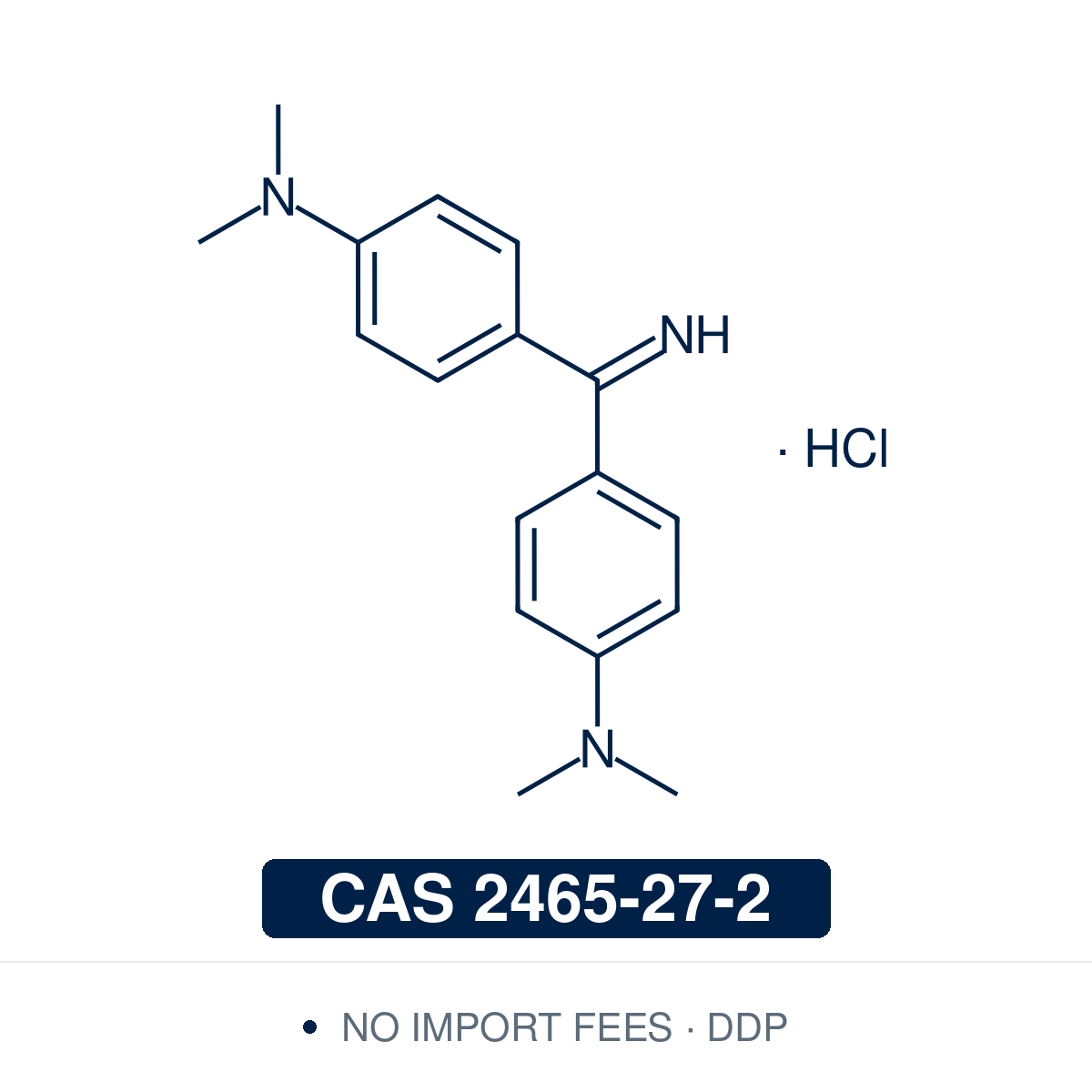
Auramine O
Auramine O | CAS 2465-27-2 | ≥80% Dye Content
Couldn't load pickup availability
Technical Specifications
| CAS Number | 2465-27-2 |
| EC / EINECS Number | 682-593-1 |
| MDL Number | MFCD00012484 |
| RTECS Number | BY3675000 |
| SMILES | CN(C)C1=CC=C(C=C1)C(=N)C2=CC=C(C=C2)N(C)C.Cl |
| InChI | InChI=1S/C17H21N3.ClH/c1-19(2)15-9-5-13(6-10-15)17(18)14-7-11-16(12-8-14)20(3)4;/h5-12,18H,1-4H3;1H |
| InChIKey | KSCQDDRPFHTIRL-UHFFFAOYSA-N |
| PubChem CID | 17170 |
| Molecular Formula | C₁₇H₂₂ClN₃ |
| Molecular Weight | 303.83 g/mol |
| Melting Point | 267 °C (dec.) |
| Solubility | 10 mg/mL in water (20 °C); ~1 mg/mL in ethanol; soluble in DMF |
| Log Pow | 2.98 |
| Purity | ≥80% dye content |
| Physical Form | Yellow powder |
| HS Code | 3204.13 |
| Shelf Life | Retest period: 36 months from date of manufacture. |
| Storage Conditions | Store in a dry place in a tightly sealed container at room temperature. |
Product Description & Scientific Applications
Auramine O (Basic Yellow 2; C.I. 41000) is a fluorescent cationic dye and a molecular rotor, built from two 4-(dimethylamino)phenyl arms joined at a central carbon.
Common Scientific Applications
Acid-fast fluorescence stain. Auramine O stains acid-fast bacilli, including Mycobacterium tuberculosis, in sputum smears read by fluorescence microscopy. As a fluorochrome method it detects mycobacteria more sensitively than the Ziehl–Neelsen carbol-fuchsin stain and is quicker to screen; it is used as the auramine-phenol stain and, combined with rhodamine, as the auramine-rhodamine stain, under both mercury-vapour and LED excitation. The same auramine-phenol method screens faecal smears for Cryptosporidium oocysts.
Fluorescent molecular rotor. In low-viscosity solution Auramine O is weakly fluorescent and short-lived, because the excited dye decays without emitting, through intramolecular rotation. Hindering that rotation — by high viscosity, a rigid matrix, or adsorption onto a surface such as cellulose — sharply raises both the fluorescence intensity and the excited-state lifetime. Its emission therefore reports the rigidity of the dye's immediate environment.
Amyloid and protein binding. Binding to amyloid fibrils switches on Auramine O fluorescence through the same restriction of rotation, which has prompted its investigation as an alternative to thioflavin T. Selectivity for fibrils is limited: the dye also binds non-amyloid proteins such as serum albumin with strong emission enhancement, lowering the contrast between native and aggregated protein.
Light-up aptamer reporter. A DNA "light-up" aptamer binds Auramine O in its loop and restricts its rotation, turning the fluorescence on. This binding-induced signal makes Auramine O a label-free reporter in CRISPR/Cas12a biosensors. In one design a split aptamer reassembles to raise the emission; in another a hairpin aptamer is cleaved by Cas12a to lower it. Reported targets include site-specific DNA methylation for colorectal-cancer screening and the SARS-CoV-2 nucleocapsid protein.
Plant cuticle stain. Auramine O is a fluorescent stain for the plant cuticle. Under confocal microscopy it resolves cuticle architecture and deposition, and distinguishes wild-type tissue from cutin-deficient mutants in tomato (Solanum lycopersicum).
Shipping Destinations
- EU: Priority delivery, 2–5 business days.
- United Kingdom: 3–7 business days.
- Norway (DDP): 3–7 business days, duties and taxes prepaid.
- Switzerland (DDP): 3–7 business days, duties and taxes prepaid.
- Classified as dangerous goods — shipping restrictions apply outside the above destinations.
Safety Information
| GHS Pictograms |


|
| Signal Word | Danger |
| Hazard Class | UN 2811 — Toxic solid, organic, n.o.s. (Class 6.1, PG III) |
| Transport Category | Dangerous Goods — Class 6.1, PG III (ADR/IATA/IMDG) |
| H-Statements | H302 - H311 - H351 |
| P-Statements | P201 - P202 - P264 - P270 - P280 - P301+P330+P331 - P302+P352 - P308+P313 - P312 - P361+P364 - P405 - P501 |
Documentation
| Safety Data Sheet | Download PDF |