NorrChemica™
Barium Carbonate
Barium Carbonate | CAS 513-77-9 | ≥99.5%
| Pack size | Excl. VAT | Incl. VAT | Add to cart |
|---|---|---|---|
| 250 g | €39,90 | ||
| 500 g | €59,20 | ||
| 1 kg | €89,20 |
Taxes and fees, e.g. VAT, included in the price. Shipping calculated at checkout.Free shipping on EU, UK and EFTA orders above €250, and above €400 to the rest of the world.
Technical Specifications
| CAS Number | 513-77-9 |
| EC / EINECS Number | 208-167-3 |
| MDL Number | MFCD00003448 |
| RTECS Number | CQ8600000 |
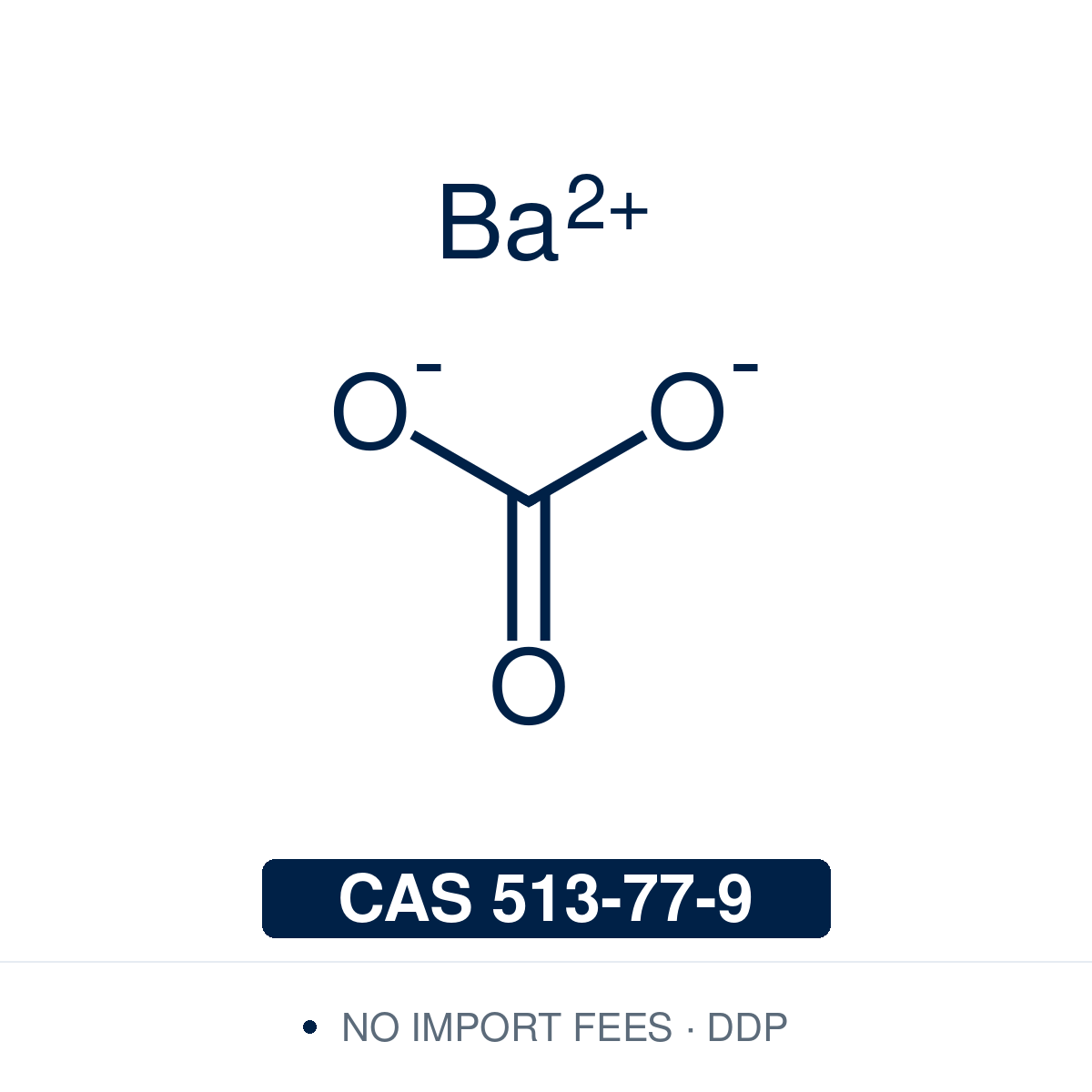
| SMILES | C(=O)([O-])[O-].[Ba+2] |
| InChI | InChI=1S/CH2O3.Ba/c2-1(3)4;/h(H2,2,3,4);/q;+2/p-2 |
| InChIKey | AYJRCSIUFZENHW-UHFFFAOYSA-L |
| PubChem CID | 10563 |
| Molecular Formula | CBaO₃ |
| Molecular Weight | 197.34 g/mol |
| Melting Point | >1450 °C (dec.) |
| Solubility | Insoluble in ethanol and water. |
| Purity | ≥99.5% |
| Physical Form | White solid powder |
| HS Code | 2836.60 |
| Shelf Life | Retest period: 36 months from date of manufacture |
| Storage Conditions | Store at room temperature in a tightly sealed container, protected from moisture. |
Product Description & Scientific Applications
Barium carbonate (BaCO₃) is an inorganic salt that forms only the mineral witherite under standard conditions.
Barium titanate. Barium carbonate reacts with titanium dioxide in the solid state to give barium titanate (BaTiO₃) powder. The particle-size ratio of TiO₂ to BaCO₃ affects the tetragonality and particle size of the product.
Barium iron oxide. In a molten-salt synthesis, barium carbonate, Fe₂O₃ and sodium chloride are mixed in stoichiometric amounts and calcined to give BaFeO₃. This phase is then used to make core–shell composites.
Superconductors. With Y₂O₃ and CuO, barium carbonate is a precursor powder for Y123 (YBa₂Cu₃O₇-type) superconductors. The powders are reaction-sintered into polycrystalline bodies, including 3D-printed parts that are then converted into single crystals by melt growth.
NOx storage catalysts. In NOx storage-reduction catalysts, barium carbonate is the barium storage component, used with an alumina support. Under typical engine exhaust-gas composition, the barium oxide surface is carbonated to a large extent, and the carbonate blocks a large part of the available storage sites.
Water treatment. Barium carbonate removes sulphate from acid mine drainage with a high sulphate content. In this desalination process, the barium carbonate is recovered and used again.
Silica co-precipitation. Co-precipitated with amorphous silica, barium carbonate crystallises into complex microstructures. An acid-regulated feedback mechanism controls their shape, and the structures are suited to dispersing and supporting catalytic nanocrystals.
Radiophosphorescent standards. As a precipitation carrier, barium carbonate physically adsorbs beta-emitting radionuclides onto phosphor powders. These powders are the basis of solid radiophosphorescent standards for calibrating luminometers.
Imaging carriers. Micro- and nanocarriers made of barium carbonate with built-in technetium-99m allow dual-modality imaging. The barium is visible by X-ray computed tomography, and the technetium-99m by single-photon emission tomography.
Shipping Destinations
- EU & UK: Priority delivery, 2–5 business days.
- United States (DDP): 3–7 business days, duties and taxes prepaid.
- EFTA Countries (DDP): 3–7 business days, duties and taxes prepaid.
- Worldwide: 7–14 business days, selected locations.
Safety Information
| GHS Pictograms |

|
| Signal Word | Warning |
| Hazard Class | Not classified as dangerous goods |
| Transport Category | Not dangerous goods (ADR/IATA/IMDG) |
| H-Statements | H302 |
| P-Statements | P264 - P270 - P301+P312 - P330 - P501 |
Documentation
| Safety Data Sheet | Download PDF |