NorrChemica™
Basic Fuchsin (Indicator pH 1.0–3.1)
Basic Fuchsin (Indicator pH 1.0–3.1) | CAS 632-99-5 | Reagent Grade
Couldn't load pickup availability
Technical Specifications
| CAS Number | 632-99-5 |
| EC / EINECS Number | 684-520-9 |
| MDL Number | MFCD00012569 |
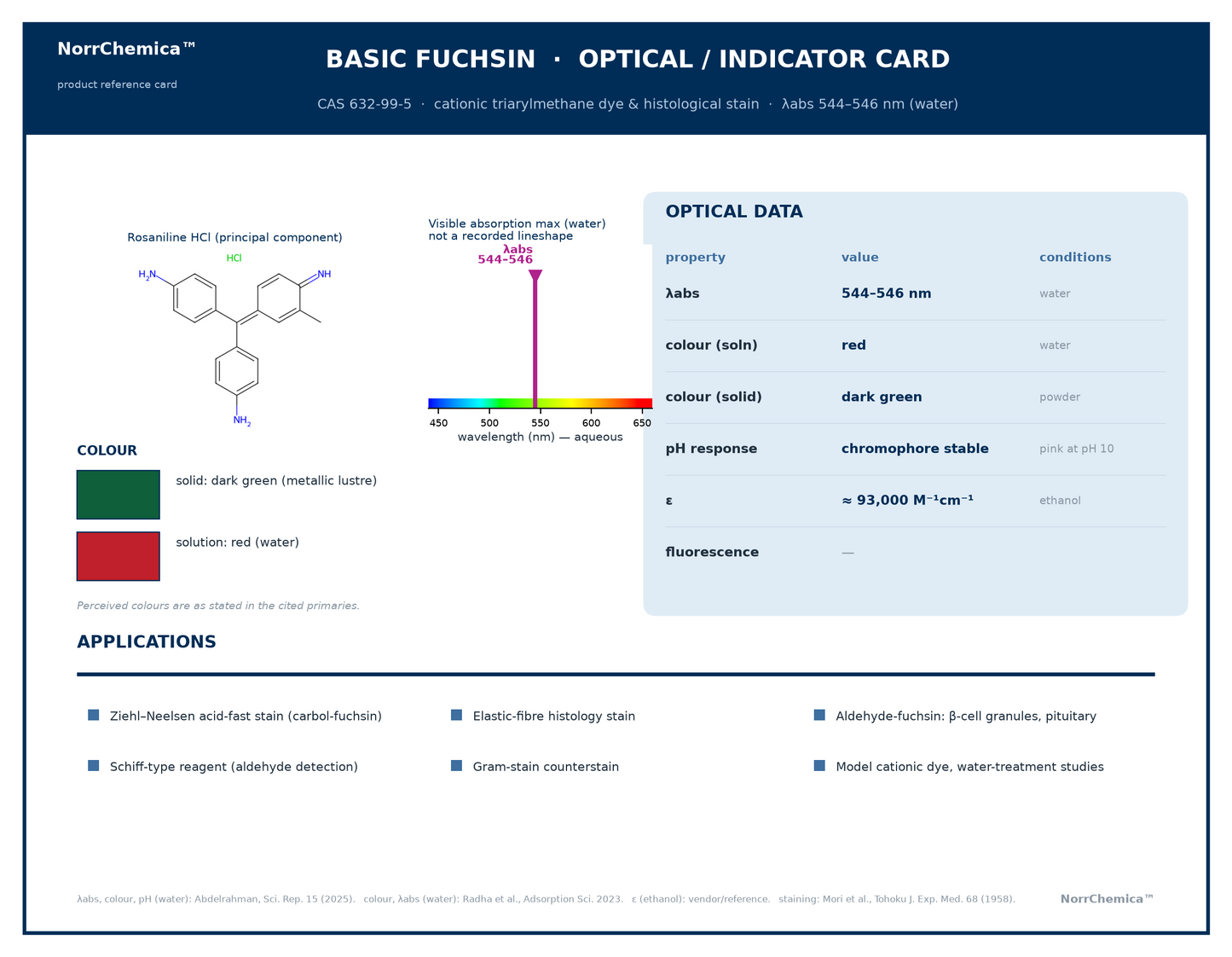
| SMILES | CC1=CC(=C(C2=CC=C(C=C2)N)C3=CC=C(C=C3)N)C=CC1=N.Cl |
| InChI | InChI=1S/C20H19N3.ClH/c1-13-12-16(6-11-19(13)23)20(14-2-7-17(21)8-3-14)15-4-9-18(22)10-5-15;/h2-12,23H,21-22H2,1H3;1H |
| InChIKey | AXDJCCTWPBKUKL-UHFFFAOYSA-N |
| PubChem CID | 12447 |
| Molecular Formula | C₂₀H₂₀ClN₃ |
| Molecular Weight | 337.85 g/mol |
| Melting Point | ~235 °C (dec.) |
| Solubility | Slightly soluble in water (~4 g/L at 25 °C); soluble in ethanol (~30 g/L); soluble in ethylene glycol methyl ether (~30 g/L); insoluble in diethyl ether |
| Log Pow | -0,21 |
| Purity | Reagent Grade |
| Physical Form | Dark green powder with metallic lustre |
| HS Code | 3204.13 |
| Shelf Life | Retest period: 36 months from date of manufacture |
| Storage Conditions | Store in a cool, dry place in a tightly sealed container, protected from light and moisture |
Product Description & Scientific Applications
Basic Fuchsin (rosaniline hydrochloride; fuchsine; Magenta I; C.I. Basic Violet 14; C.I. 42510) is a triarylmethane (triphenylmethane) dye supplied as dark green crystals with a metallic lustre that dissolve to an intense magenta-red in water and alcohol. The commercial dye is a mixture of closely related triaminotriarylmethane homologues — principally rosaniline (CAS 632-99-5), with pararosaniline (Basic Red 9, CAS 569-61-9), Magenta II, and New Fuchsin — differing only in the number and position of ring methyl groups on a shared chromophore. One of the foundational biological stains, it is the chromophore of carbol fuchsin in Ziehl–Neelsen acid-fast staining, the active dye of Schiff reagent in the periodic acid–Schiff (PAS) reaction, a Gram counterstain, and a component of Gomori's aldehyde-fuchsin method; it also functions as an acid-range pH indicator and as a cationic textile dye. This product is supplied as indicator grade, transition pH 1.0–3.1 (colourless to magenta).
Common Scientific Applications
- Ziehl–Neelsen acid-fast staining: Basic Fuchsin is the chromophore of carbol fuchsin — the dye dissolved in phenol and ethanol — used to stain acid-fast bacilli such as Mycobacterium tuberculosis. Under heat it penetrates the mycolic-acid-rich cell wall and forms a complex that resists acid-alcohol decolourisation, the basis of acid-fastness. The Kinyoun cold method uses a more concentrated carbol fuchsin without heating.
- Schiff reagent and the PAS reaction: Decolourisation with sulphurous acid gives Schiff reagent (leucofuchsin), which restores the magenta chromophore on contact with free aldehydes. In the periodic acid–Schiff reaction, periodic acid oxidises vicinal diols in polysaccharides to aldehydes that Schiff reagent renders magenta, demonstrating glycogen, mucins, glycoproteins, basement membranes, and fungal cell walls in tissue sections.
- Feulgen reaction for DNA: Mild acid hydrolysis exposes aldehyde groups on deoxyribose, which Schiff reagent stains stoichiometrically — a classical method for quantitative measurement of nuclear DNA content.
- Gram counterstain: After crystal-violet staining, iodine mordanting, and alcohol decolourisation, Basic Fuchsin counterstains Gram-negative organisms magenta-red, giving sharp contrast against violet Gram-positive cells, and stains thin or weakly staining Gram-negative species more intensely than safranin.
- Gomori aldehyde-fuchsin staining: Oxidised with paraldehyde and hydrochloric acid, the dye forms aldehyde-fuchsin, which selectively stains elastic fibres, sulfated mucins, and pancreatic islet beta-cell granules in tissue sections.
- HBFP myocardial staining: In the haematoxylin–basic fuchsin–picric acid method, early-ischaemic myocytes stain red with Basic Fuchsin while surrounding tissue stains yellow with picric acid, a histochemical technique for detecting early myocardial injury in tissue sections.
- Acid-range pH indicator: Transitions from colourless below pH 1.0 to magenta-red above pH 3.1, serving as an indicator for strongly acidic titrations; this product is the indicator grade specified for that range.
- Cationic textile and substrate dye: As a basic (cationic) dye, it binds anionic substrates such as silk, wool, leather, paper, and cotton, producing bright magenta coloration.
Shipping Destinations
- EU & UK: Priority delivery, 2–5 business days.
- United States (DDP): 3–7 business days, duties and taxes prepaid.
- EFTA Countries (DDP): 3–7 business days, duties and taxes prepaid.
- Worldwide: 7–14 business days, selected locations.
Safety Information
| GHS Pictograms |


|
| Signal Word | Warning |
| Hazard Class | Not regulated for transport |
| Transport Category | Not classified as dangerous goods for transport (ADR/IATA/IMDG) |
| H-Statements | H302 - H315 - H319 - H351 |
| P-Statements | P201 - P202 - P264 - P270 - P280 - P301+P312 - P302+P352 - P305+P351+P338 - P308+P313 - P330 - P332+P313 - P337+P313 - P362+P364 - P405 - P501 |
Documentation
| Safety Data Sheet | Download PDF |