NorrChemica™
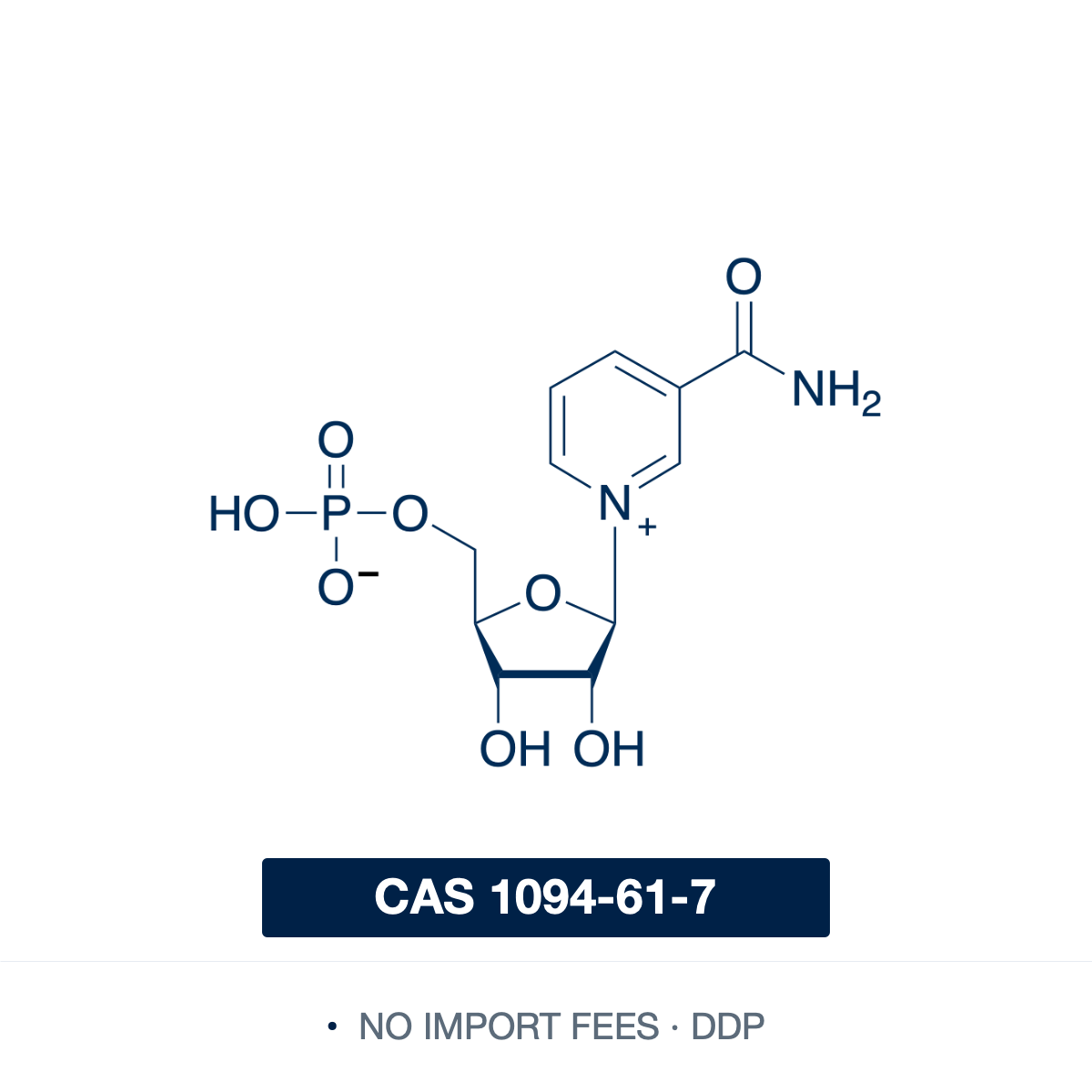
β-Nicotinamide Mononucleotide
β-Nicotinamide Mononucleotide | CAS 1094-61-7 | ≥99.0%
Couldn't load pickup availability
Technical Specifications
| CAS Number | 1094-61-7 |
| EC / EINECS Number | 214-136-5 |
| MDL Number | MFCD00038748 |
| SMILES | C1=CC(=C[N+](=C1)[C@H]2[C@@H]([C@@H]([C@H](O2)COP(=O)(O)[O-])O)O)C(=O)N |
| InChI | InChI=1S/C11H15N2O8P/c12-10(16)6-2-1-3-13(4-6)11-9(15)8(14)7(21-11)5-20-22(17,18)19/h1-4,7-9,11,14-15H,5H2,(H3-,12,16,17,18,19)/t7-,8-,9-,11-/m1/s1 |
| InChIKey | DAYLJWODMCOQEW-TURQNECASA-N |
| PubChem CID | 14180 |
| Molecular Formula | C₁₁H₁₅N₂O₈P |
| Molecular Weight | 334.25 g/mol |
| Melting Point | 166 °C (dec.) |
| Solubility | ~50 mg/mL in water (25 °C) |
| Purity | ≥99% |
| Physical Form | White crystalline powder |
| HS Code | 2934.99 |
| Country of Origin | Finland |
| Shelf Life | Retest period: 36 months from date of manufacture |
| Storage Conditions | Store refrigerated (2–8 °C) in a tightly sealed container |
Product Description & Scientific Applications
β-Nicotinamide Mononucleotide (β-NMN; nicotinamide ribotide; CAS 1094-61-7) is the biologically common β-anomer of nicotinamide mononucleotide, a pyridine nucleotide and central intermediate in nicotinamide adenine dinucleotide (NAD⁺) biosynthesis. It is distinguished from the α-anomer (α-NMN), which differs in stereochemistry and analytical behaviour. In the mammalian salvage pathway, nicotinamide phosphoribosyltransferase (NAMPT) converts nicotinamide and 5-phosphoribosyl-1-pyrophosphate into β-NMN, which nicotinamide mononucleotide adenylyltransferase (NMNAT) enzymes adenylate to NAD⁺. It is supplied as a white to light-yellow powder, soluble in water.
Enzymatic Intermediate in NAD⁺ Biosynthesis Research
NMN is a direct substrate for ATP-dependent, NMNAT-catalysed NAD⁺ formation. Mammalian systems contain three NMNAT isoforms — NMNAT1, NMNAT2, and NMNAT3 — differing in tissue distribution, subcellular localisation, and catalytic properties. It also supports steady-state kinetic and substrate-specificity measurements, and pathway-flux experiments distinguishing salvage-pathway intermediates from downstream dinucleotides and related pyridine nucleotide metabolites.
Biochemical Tool for NAD⁺-Dependent Enzymology
NAD⁺ is consumed by enzyme families including sirtuin deacylases, poly(ADP-ribose) polymerases, and CD38-family ectoenzymes. NMN is used in studies connecting precursor availability with NAD⁺-dependent activity.
Noncanonical Redox Cofactor in Engineered Biocatalysis
Oxidised NMN and reduced NMNH have been developed as a noncanonical redox cofactor pair for engineered enzymatic systems. In cell-free and engineered-cell platforms, the NMN⁺/NMNH cycle can be separated from natural NAD(P)⁺/NAD(P)H pools, letting researchers design orthogonal redox pathways and tune cofactor specificity.
Analytical and Molecular Biology Applications
NMN serves as an analytical reference compound in LC-MS/MS, UHPLC-MS/MS, and HPLC methods quantifying NAD⁺ metabolites and related pyridine nucleotide intermediates. It is polar and chemically labile; analytical workflows attend to chromatographic retention and isomer separation. NMN is also used in RNA aptamer binding studies and ribozyme activation research involving β-NMN-responsive or β-NMN-activated RNA systems.
Shipping Destinations
- EU & UK: Priority delivery, 2–5 business days.
- Norway (DDP): 3–7 business days, duties and taxes prepaid.
- Switzerland (DDP): 3–7 business days, duties and taxes prepaid.
Safety Information
| GHS Pictograms |
|
| Hazard Class | None — not subject to transport regulations |
| Transport Category | Not classified as dangerous goods for transport (ADR/IATA/IMDG) |
Documentation
| Safety Data Sheet | Download PDF |
Share