NorrChemica™
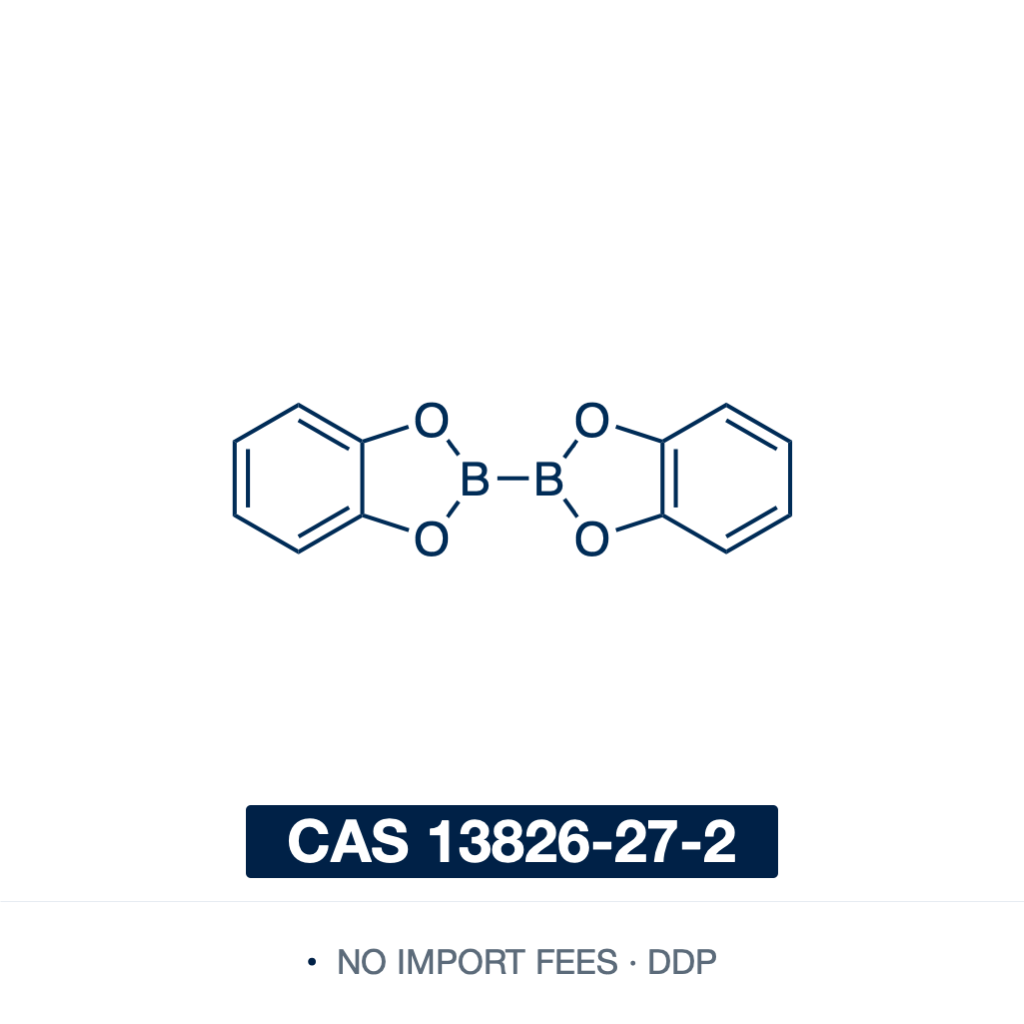
Bis(catecholato)diboron (B2cat2)
Bis(catecholato)diboron (B2cat2) | CAS 13826-27-2 | ≥98%
Couldn't load pickup availability
Technical Specifications
| CAS Number | 13826-27-2 |
| EC / EINECS Number | 691-473-8 |
| MDL Number | MFCD09842343 |
| SMILES | B1(OC2=CC=CC=C2O1)B3OC4=CC=CC=C4O3 |
| InChI | InChI=1S/C12H8B2O4/c1-2-6-10-9(5-1)15-13(16-10)14-17-11-7-3-4-8-12(11)18-14/h1-8H |
| InChIKey | WYBQOWXCLDXZNR-UHFFFAOYSA-N |
| PubChem CID | 3488065 |
| Molecular Formula | C₁₂H₈B₂O₄ |
| Molecular Weight | 237.8 g/mol |
| Melting Point | 192 - 197 °C |
| Solubility | Sparingly soluble in common organic solvents. Forms Lewis-base adducts with amide solvents such as DMF, DMA and NMP. |
| Purity | ≥98% |
| Physical Form | White to light yellow crystalline powder |
| HS Code | 2920.90 |
| Shelf Life | Retest period: 36 months from date of manufacture |
| Storage Conditions | Tightly closed. Dry. Air and moisture sensitive. Handle and store under inert gas. |
Product Description & Scientific Applications
Bis(catecholato)diboron (B₂cat₂) is two catechol boronate esters joined by a B–B bond. The aromatic diolate withdraws density from boron, so both centres are far more Lewis acidic than those of the pinacol ester. The white to light-orange crystalline solid is sparingly soluble in common organic solvents and is handled under inert gas, away from air and moisture.
Lewis-base activation. Each boron carries an empty p orbital. A Lewis base coordinates to one of them and inverts the electronic character of the reagent. The Lewis acid becomes an electron donor and transfers a boryl group. Amide solvents do this unaided, serving as medium and activator at once.
Radical borylation. Alkyl and aryl iodides borylate under mild conditions with no metal present. Alkylamines activated as pyridinium salts give alkyl trifluoroborate salts, and visible light drives the same reaction without catalyst or additive. Alkyl carboxylic acids borylate decarboxylatively, primary through tertiary.
Deoxygenative borylation. Alcohols preactivated as thionocarbonates undergo Barton–McCombie radical deoxygenation under visible light, with no photocatalyst, initiator or tin hydride. Aldehydes and ketones react directly in N,N-dimethylacetamide with no base: aldehydes give 1,1,2-tris(boronates), ketones give benzylboronates.
Chemoselective reduction. Sulfoxides reduce to sulfides. Halides, alkynes, carbonyls, nitriles and heterocycles survive intact.
Diboration. An amine catalyst diborates hindered alkenes through an sp²–sp³ adduct, and the catechol esters transesterify to isolable pinacol boronates in the same pot.
Shipping Destinations
- EU & UK: Priority delivery, 2–5 business days.
- United States (DDP): 3–7 business days, duties and taxes prepaid.
- EFTA Countries (DDP): 3–7 business days, duties and taxes prepaid.
- Worldwide: 7–14 business days, selected locations.
Safety Information
| Hazard Class | Not regulated for transport |
| Transport Category | Not classified as dangerous goods for transport (ADR/IATA/IMDG) |
Documentation
| Safety Data Sheet | Download PDF |
Share