NorrChemica™
Bismuth(III) Acetate (Bi(OAc)₃)
Bismuth(III) Acetate (Bi(OAc)₃) | CAS 22306-37-2 | ≥99%
Pack sizes & prices
| Pack size | Excl. VAT | Incl. VAT | Add to cart |
|---|---|---|---|
| 1.0 g | €48,20 | ||
| 5.0 g | €79,20 | ||
| 10 g | €129,20 | ||
| 25 g | €249,20 | ||
| 100 g | €349,20 |
Taxes and fees, e.g. VAT, included in the price. Shipping calculated at checkout.Free shipping on EU, UK and EFTA orders above €250, and above €400 to the rest of the world.
Technical Specifications
| CAS Number | 22306-37-2 |
| EC / EINECS Number | 244-904-5 |
| MDL Number | MFCD00015629 |
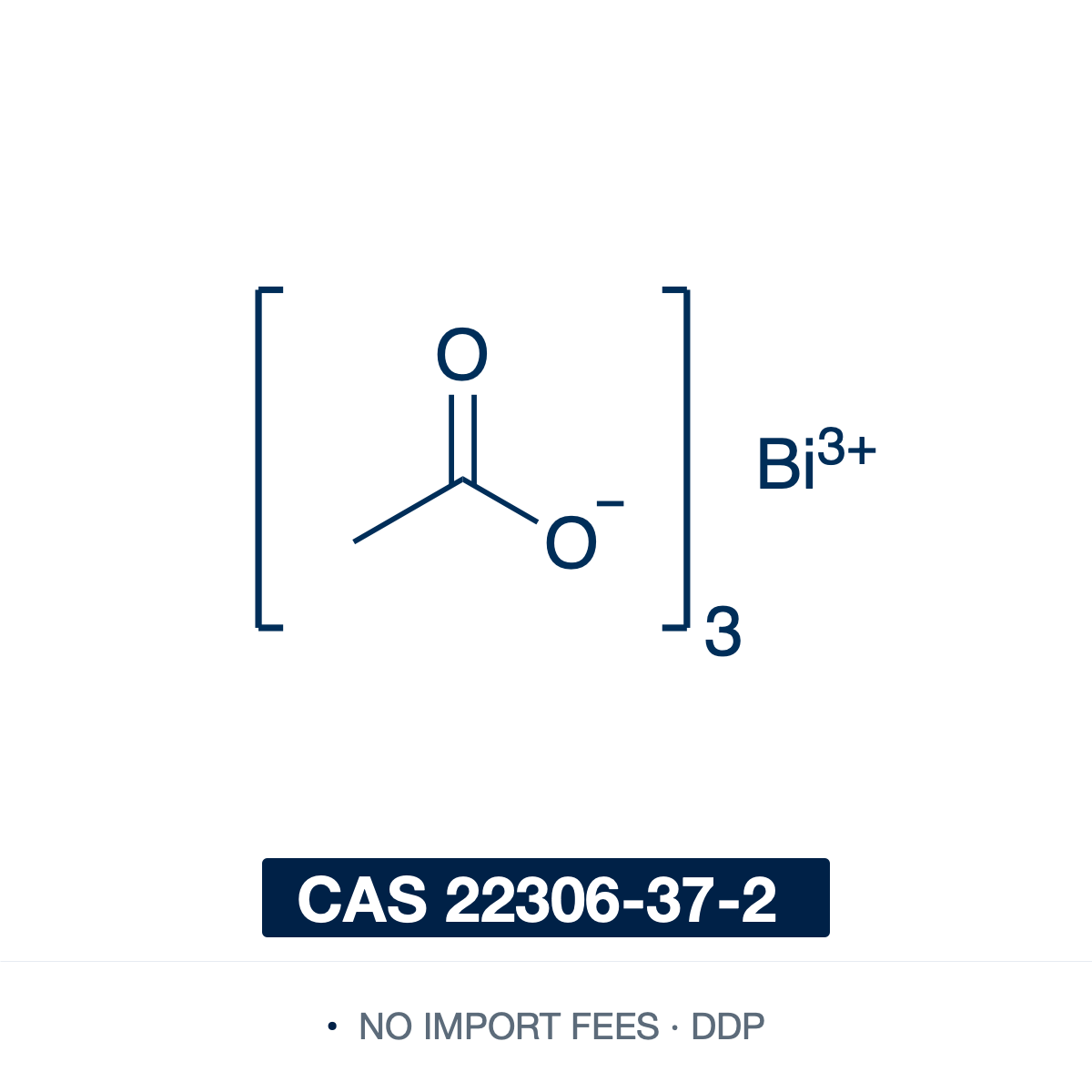
| SMILES | CC(=O)[O-].CC(=O)[O-].CC(=O)[O-].[Bi+3] |
| InChI | InChI=1S/3C2H4O2.Bi/c3*1-2(3)4;/h3*1H3,(H,3,4);/q;;;+3/p-3 |
| InChIKey | WKLWZEWIYUTZNJ-UHFFFAOYSA-K |
| PubChem CID | 31132 |
| Molecular Formula | C₆H₉BiO₆ |
| Molecular Weight | 386.11 g/mol |
| Solubility | Hydrolyzes in water |
| Purity | ≥99% |
| Physical Form | White to almost white powder to crystal |
| HS Code | 2915.29 |
| Shelf Life | Retest period: 36 months from date of manufacture |
| Storage Conditions | Store in a cool, dry place in a tightly sealed container, protected from moisture. |
Product Description & Scientific Applications
Bismuth acetate, Bi(OAc)3, is the bismuth(III) salt of acetic acid (C6H9BiO6, 386.11 g/mol): a hygroscopic white to almost white powder that hydrolyses in water to insoluble basic bismuth acetate. Bismuth carboxylates have a particularly low toxicity, which is the feature supporting their use over the tin initiators employed for the same polymerisations.
It works both as a catalyst in organic synthesis and as the bismuth source for oxide, sulfide and thin-film materials, going into solution in polar organic media — ethylene glycol, or as an oleic-acid complex — rather than in water.
Applications and Reactions
- Protodeboronation: a safe, inexpensive and selective facilitator of sequential protodeboronation of di- and triborylated indoles; paired with iridium-catalysed borylation it opens access to diversely borylated indoles.
- Lactide polymerisation: initiates ring-opening polymerisation of L-lactide in concentrated chlorobenzene solution to telechelic and star-shaped poly(L-lactide). Slightly less reactive than tin(II) 2-ethylhexanoate, and less toxic.
- Bismuth oxide nanoparticles: thermal decomposition in ethylene glycol with an oxidising agent gives Bi2O3 nanoparticles for X-ray contrast core-shell particles.
- Bismuth sulfide nanostructures: the oleic-acid complex reacts with elemental sulfur to grow sheaf-like Bi2S3.
- Semiconductor films: with thiourea it forms the spin-coating precursor solution for bismuth sulfide photoresistor films.
- Reference material: used as a bismuth-containing reference compound in solid-state 209Bi NMR studies.
Shipping Destinations
- EU & UK: Priority delivery, 2–5 business days.
- United States (DDP): 3–7 business days, duties and taxes prepaid.
- EFTA Countries (DDP): 3–7 business days, duties and taxes prepaid.
- Worldwide: 7–14 business days, selected locations.
Safety Information
| Hazard Class | Not regulated for transport |
| Transport Category | Not classified as dangerous goods for transport (ADR/IATA/IMDG) |
Documentation
| Safety Data Sheet | Download PDF |
Share