1
/
of
1
NorrChemica™
Bismuth(III) Trifluoromethanesulfonate
CAS 88189-03-1
≥98%
Bismuth(III) Trifluoromethanesulfonate | CAS 88189-03-1 | ≥98%
Pack sizes & prices
| Pack size | Excl. VAT | Incl. VAT | Add to cart |
|---|---|---|---|
| 1 g | €79,20 | ||
| 5 g | €94,20 | ||
| 10 g | €129,20 |
Taxes and fees, e.g. VAT, included in the price. Shipping calculated at checkout.Free shipping on EU, UK and EFTA orders above €250, and above €400 to the rest of the world.
Technical Specifications
| CAS Number | 88189-03-1 |
| EC / EINECS Number | 628-926-6 |
| MDL Number | MFCD02093669 |
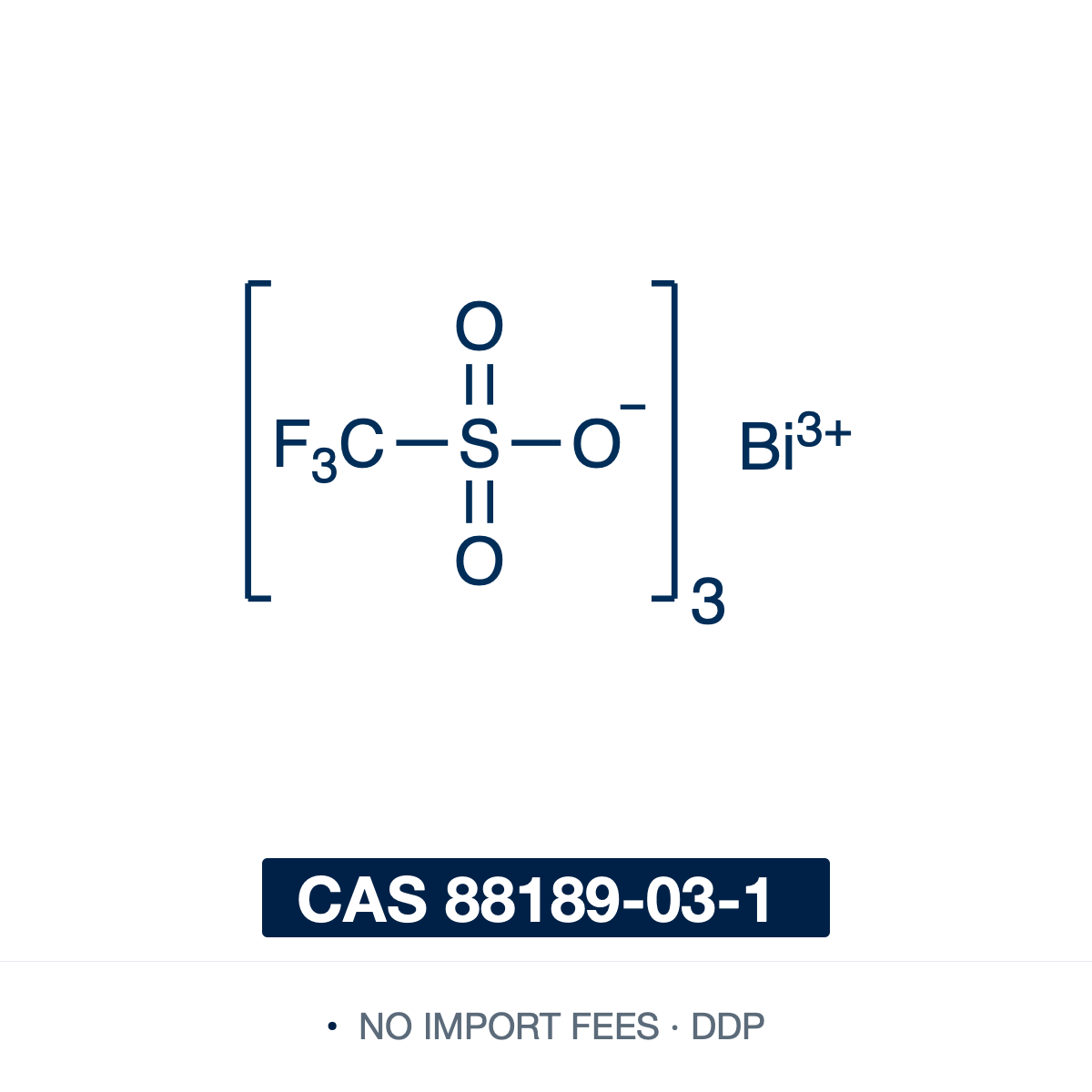
| SMILES | C(F)(F)(F)S(=O)(=O)[O-].C(F)(F)(F)S(=O)(=O)[O-].C(F)(F)(F)S(=O)(=O)[O-].[Bi+3] |
| InChI | InChI=1S/3CHF3O3S.Bi/c3*2-1(3,4)8(5,6)7;/h3*(H,5,6,7);/q;;;+3/p-3 |
| InChIKey | NYENCOMLZDQKNH-UHFFFAOYSA-K |
| PubChem CID | 9917655 |
| Molecular Formula | C₃BiF₉O₉S₃ |
| Molecular Weight | 656.2 g/mol |
| Melting Point | >300 °C |
| Solubility | Soluble in acetonitrile, 1,4-dioxane, dimethylformamide and dimethyl sulfoxide. Reacts with alcohols and amines, and reacts reversibly with water. |
| Purity | ≥98% |
| Physical Form | White to off-white powder |
| HS Code | 2904.99 |
| Shelf Life | Retest period: 36 months from date of manufacture |
| Storage Conditions | Hygroscopic. Store in a tightly closed container, protected from moisture. |
Product Description & Scientific Applications
Bismuth(III) triflate, Bi(OTf)3, is a water-tolerant Lewis acid: three bulky, strongly electron-withdrawing triflate groups on one bismuth centre induce a high positive charge on the metal. It replaces corrosive triflic acid in the same reactions, and its low toxicity is the feature supporting its use over tin and lanthanide triflates.
The active species is debated. A low concentration of triflic acid, formed on hydrolysis, may be the true catalyst — reaction with any water present gives triflic acid and bismuth oxide.
Applications and Reactions
- Friedel–Crafts acylation and sulfonylation: acylates and sulfonylates arenes in place of stoichiometric triflic acid.
- Acylation of alcohols: acylates sterically demanding, tertiary, acid-labile and base-labile alcohols. Less reactive anhydrides — benzoic, pivalic — work under the same conditions.
- Acetal chemistry: catalyses both formation and deprotection of acetals, and the formation of acylals.
- THP protection: forms tetrahydropyranyl ethers solvent-free, and removes them; the tetrahydrate operates at 0.1–1.0 mol% for both directions.
- Epoxide chemistry: substituted anilines open epoxides on this catalyst, giving secondary or primary alcohols according to the oxirane substituent. Also catalyses epoxide rearrangement.
- Cycloadditions: Diels–Alder and aza-Diels–Alder.
- Glycosylation: with N-bromosuccinimide, activates thio- and selenoglycosides.
- Limits: insoluble in the usual glycosylation solvents, so cosolvents are needed and those affect diastereoselectivity. Ketones give poor yields under conditions that work for aldehydes and acetals.
Shipping Destinations
- EU & UK: Priority delivery, 2–5 business days.
- United States (DDP): 3–7 business days, duties and taxes prepaid.
- EFTA Countries (DDP): 3–7 business days, duties and taxes prepaid.
- Worldwide: 7–14 business days, selected locations.
Safety Information
| Hazard Class | Not regulated for transport |
| Transport Category | Not classified as dangerous goods for transport (ADR/IATA/IMDG) |
Documentation
| Safety Data Sheet | Download PDF |
Share