NorrChemica™
Bismuth(III) Chloride (BiCl3)
CAS 7787-60-2
≥97%
Bismuth(III) Chloride (BiCl3) | CAS 7787-60-2 | ≥97%
| Pack size | Excl. VAT | Incl. VAT | Add to cart |
|---|---|---|---|
| 25 g | €89,20 | ||
| 100 g | €149,20 | ||
| 500 g | €189,20 | ||
| 1 kg | €309,20 |
Taxes and fees, e.g. VAT, included in the price. Shipping calculated at checkout.Free shipping on EU, UK and EFTA orders above €250, and above €400 to the rest of the world.
Technical Specifications
| CAS Number | 7787-60-2 |
| EC / EINECS Number | 232-123-2 |
| MDL Number | MFCD00003461 |
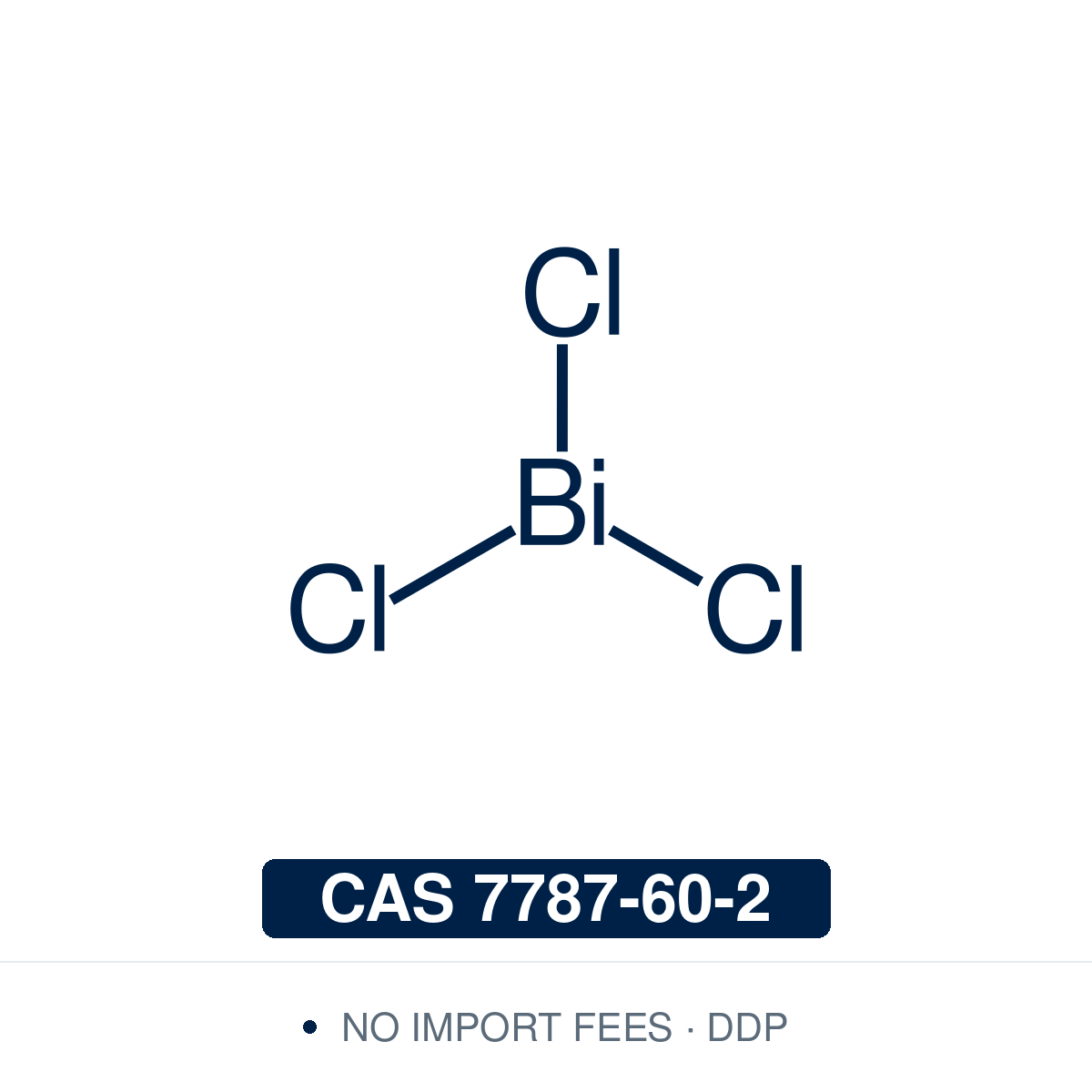
| SMILES | Cl[Bi](Cl)Cl |
| InChI | InChI=1S/Bi.3ClH/h;3*1H/q+3;;;/p-3 |
| InChIKey | JHXKRIRFYBPWGE-UHFFFAOYSA-K |
| PubChem CID | 24591 |
| Molecular Formula | BiCl₃ |
| Molecular Weight | 315.34 g/mol |
| Melting Point | 230–232 °C |
| Solubility | Soluble in methanol, diethyl ether and acetone. Hydrolyses in water to insoluble bismuth oxychloride; dissolves in concentrated hydrochloric acid. |
| Purity | ≥97% |
| Physical Form | White to pale yellow crystalline powder, chunks or granules |
| HS Code | 2827.39 |
| Shelf Life | Retest period: 36 months from date of manufacture |
| Storage Conditions | Hygroscopic. Store under an inert atmosphere in a tightly closed container, in a dry place at room temperature. |
Product Description & Scientific Applications
Bismuth(III) chloride, BiCl3, is the anhydrous bismuth trichloride (315.34 g/mol): a hygroscopic white to pale yellow solid and the standard entry point to bismuth chemistry. Its three chlorides are displaced by quinolate, amide and phosphinoamine ligands in ethanol, THF or methanol, which is the reactivity behind both its catalysis and its role as a precursor.
It hydrolyses in water to insoluble bismuth oxychloride, so reactions and stock solutions are run in organic media or in concentrated hydrochloric acid.
Applications and Reactions
- Cyclopropanated sugar cyclisation: in the presence of BiCl3 the cyclisation of 1,2-cyclopropanated sugars with olefins is highly diastereoselective, giving 2,2-disubstituted products.
- Trifluoromethylthiolation: activates trifluoromethanesulfanylamide in the palladium-catalysed synthesis of 3-((trifluoromethyl)thio)indoles, where its presence is crucial to the transformation.
- Luminescent Bi(III) complexes: functionalised 8-hydroxyquinolate ligands added in a 3:1 mole ratio in ethanol or THF give homoleptic tris(8-hydroxyquinolate) bismuth(III) complexes.
- Organobismuth synthesis: lithium N-trimethylsilylamides give mono-, di- or triaminobismuthanes according to ligand bulk and stoichiometry, and bis(diisopropylphosphino)amine in methanol gives a catenated bismuth compound in one step.
- Bismuth nanoparticle deposition: bismuth nanocatalysts are electrodeposited onto indium tin oxide from BiCl3 solution by potentiostatic double-pulse techniques.
- Sulfide detection: forms a black precipitate with hydrogen sulfide, the basis of a visual assay for bacterial H2S production.
Shipping Destinations
- EU & UK: Priority delivery, 2–5 business days.
- United States (DDP): 3–7 business days, duties and taxes prepaid.
- EFTA Countries (DDP): 3–7 business days, duties and taxes prepaid.
- Worldwide: 7–14 business days, selected locations.
Safety Information
| GHS Pictograms |

|
| Signal Word | Warning |
| Hazard Class | Not regulated for transport |
| Transport Category | Not classified as dangerous goods for transport (ADR/IATA/IMDG) |
| H-Statements | H315 - H319 |
| P-Statements | P261 - P264 - P271 - P280 - P302+P352 - P304+P340 - P305+P351+P338 - P312 - P321 - P332+P313 - P337+P313 - P362+P364 - P403+P233 - P405 - P501 |
Documentation
| Safety Data Sheet | Download PDF |